Psionics: Difference between revisions
| (58 intermediate revisions by the same user not shown) | |||
| Line 1: | Line 1: | ||
= [[Psychic]] [[Electronics]] = | = [[Psychic]] [[Electronics]] = | ||
''also see: [[Psychotronics]] (https://grokipedia.com/page/Psychotronics)'' | |||
- [[Psyche]] is the intersection between [[Spirit]]''([[Experience]])'' and [[Mind]]''([[Intelligence]])'' | |||
[[Psi]] - [[Sonic]] [[Air Pressure]] | |||
==== Related Pages ==== | |||
* [[Psionics Tech]] | * [[Psionics Tech]] | ||
* [[Psi-Ops]] | * [[Psi-Ops]] | ||
* [[Psychic]] | * [[Psychic]] | ||
* [[Psi Field]] | * [[Psi Field]] | ||
* [[Psychotronics]] | |||
= [[Psi Energy]] = | |||
== [[Psi Energy]], [[Psi Field]], and [[Psi Energy Density Scalar Field]] == | |||
'''[[Psi Energy]]''' refers to the energy associated with psychic phenomena or psi abilities. It encompasses the energy that is believed to be involved in telepathy, clairvoyance, psychokinesis, and other paranormal phenomena. Conceptually, Psi Energy is thought to be distinct from conventional forms of energy described in physics, such as electromagnetic energy or kinetic energy. | |||
'''[[Psi Field]]''' is a field or medium that facilitates psychic phenomena. It is analogous to physical fields such as the electromagnetic field or gravitational field but operates according to different principles associated with psi abilities. Conceptually, the Psi Field permeates all of existence and interacts with consciousness to produce psychic experiences. It is used to transmit information or energy related to thoughts, emotions, intentions, and perceptions between individuals or across space and time. | |||
The '''[[Psi Energy Density Scalar Field]]''' is a scalar field that quantifies the density of Psi Energy at each point in space and time. It represents the concentration of Psi Energy throughout the universe, analogous to physical fields such as the electric field or temperature field. Mathematically, the Psi Energy Density Scalar Field assigns a numerical value to each point in space-time, representing the amount of Psi Energy present at that location and time. It can be described by a scalar function that varies continuously across space and time. The Psi Energy Density Scalar Field is a key concept in theoretical models of psi phenomena, as it provides a means of quantifying and describing the distribution and intensity of Psi Energy within the Psi Field. The Psi Energy Density Scalar Field serves as a construct for exploring the dynamics of psychic phenomena and their potential interactions with physical reality. | |||
= Psionic Equations = | = Psionic Equations = | ||
=== | == Non-Relativistic Limit (3+1) – Intuitive Entry Point == | ||
<math>(\Box + m^2)\psi = 0</math> | These equations describe everyday-scale psionics in the weak-field, slow-motion regime — the easiest place to start building intuition. They are the exact non-relativistic limit of the full theory below. | ||
* | |||
* | * '''Psionic Poisson/Yukawa Equation''' | ||
** <math>\nabla^2 \psi - m^2 \psi = -4\pi G_\psi \rho_\psi</math> | |||
*** <math>\psi</math> = psionic scalar potential | |||
*** <math>m</math> = psionic field mass (m ≈ 0 → infinite range; m > 0 → short-range Yukawa screening) | |||
*** <math>\rho_\psi</math> = source density (e.g., coherent neural activity, focused intent, or technological emitter) | |||
*** For m = 0 this becomes identical to the Poisson equation of Newtonian gravity or electrostatics. | |||
*** Point-source solution: <math>\psi(r) = -\frac{G_\psi M_\psi}{r} e^{-m r}</math> | |||
*** Historical note: identical form to Yukawa’s 1935 meson potential for the strong nuclear force. | |||
* '''Psionic Force on a Test Particle''' | |||
** <math>\vec{F}_\psi = -p \nabla \psi</math> | |||
*** <math>p</math> = psionic charge (positive = repels high-ψ regions → defensive shield; negative = attracts → telekinetic pull) | |||
*** Example: for a point source with m = 0, force law is exactly Coulomb/Newtonian but scalar-mediated. | |||
* '''Psionic Energy Density (non-relativistic)''' | |||
** <math>\rho_\psi = \frac{1}{2} (\nabla \psi)^2 + \frac{1}{2} m^2 \psi^2</math> | |||
*** First term = gradient (kinetic) energy, second term = mass/rest energy of the field. | |||
*** Total field energy in a volume: <math>E = \int \rho_\psi \, dV</math> | |||
== Relativistic 4D Effective Theory == | |||
Full covariant equations after compactification of the fifth dimension. These are the direct 4D descendants of the 5D parent theory. | |||
* '''Psionic Scalar Field Equation (4D)''' | |||
** <math>\Box \psi - m^2 \psi - \lambda \psi^3 = \alpha F_{\mu\nu} F^{\mu\nu} + J_\psi</math> | |||
*** <math>\Box = \partial_\mu \partial^\mu</math> = wave operator → psionic disturbances propagate at light speed | |||
*** <math>\lambda \psi^3</math> = stabilising quartic self-interaction (λ > 0 prevents runaway collapse) | |||
*** <math>\alpha F_{\mu\nu} F^{\mu\nu}</math> = direct coupling to electromagnetic energy density (brain waves can source ψ) | |||
*** <math>J_\psi</math> = explicit psionic current (biological or technological driver) | |||
*** In vacuum with m = λ = 0: <math>\Box \psi = 0</math> → pure massless waves | |||
* '''Psionic Stress-Energy Tensor''' | |||
** <math>T_{\mu\nu}^\psi = \partial_\mu \psi \partial_\nu \psi - g_{\mu\nu} \left[ \frac{1}{2} \partial^\rho \psi \partial_\rho \psi + \frac{m^2}{2} \psi^2 + \frac{\lambda}{4} \psi^4 \right]</math> | |||
{| class="wikitable" | |||
! Term !! Physical meaning | |||
|- | |||
| <math>\partial_\mu \psi \partial_\nu \psi</math> || Momentum flux of the psionic field | |||
|- | |||
| <math>-g_{\mu\nu} [\ldots]</math> || Isotropic pressure and energy density | |||
|} | |||
* '''Modified Einstein Equations (Jordan frame)''' | |||
** <math>G_{\mu\nu} = 8\pi G \left( T_{\mu\nu}^{\text{matter}} + T_{\mu\nu}^{\text{EM}} + T_{\mu\nu}^\psi \right)</math> | |||
*** Psionic field directly curves spacetime → strong sustained ψ gradients produce measurable gravity-like effects. | |||
* '''Geodesic Equation with Psionic Fifth Force''' | |||
** <math>\frac{D^2 x^\mu}{d\tau^2} = q F^\mu{}_\nu \frac{dx^\nu}{d\tau} + p \partial^\mu \psi</math> | |||
*** The term <math>p \partial^\mu \psi</math> is the additional acceleration felt by any object with non-zero psionic charge. | |||
*** For ordinary matter p ≈ 0; for biologically or technologically “tuned” objects p can be large. | |||
== Parent 5D Scalar-Tensor Theory == | |||
The deepest, most rigorous level — the actual higher-dimensional origin of all equations above. | |||
* '''5D Psionic Scalar Equation''' | |||
** <math>\tilde{\Box} \psi - m^2 \psi - \lambda \psi^3 = -\frac{\kappa}{4} e^{k \psi} \tilde{F}_{MN} \tilde{F}^{MN} + J_\psi</math> | |||
*** <math>e^{k \psi}</math> makes the effective fine-structure constant ψ-dependent → psionics can locally change electromagnetic coupling (e.g., enhance or suppress brain-wave propagation). | |||
* '''5D Einstein Equations''' | |||
** <math>\tilde{R}_{MN} - \frac{1}{2} \tilde{g}_{MN} \tilde{R} = T_{MN}^\psi + e^{k \psi} T_{MN}^{\text{EM}}</math> | |||
*** <math>T_{MN}^\psi = \partial_M \psi \partial_N \psi - \tilde{g}_{MN} \left[ \frac{1}{2} \partial_P \psi \partial^P \psi + \frac{m^2}{2} \psi^2 + \frac{\lambda}{4} \psi^4 \right]</math> | |||
* '''Kaluza-Klein Metric Ansatz (cylinder condition)''' | |||
** <math>ds^2 = g_{\mu\nu} dx^\mu dx^\nu + \phi^2 (dx^5 + A_\mu dx^\mu)^2</math> | |||
*** Original 1919–1926 idea by Theodor Kaluza and Oskar Klein: the fifth dimension is compactified to a tiny circle, giving rise to electromagnetism from pure geometry. | |||
*** In our extension, ψ lives in the full 5D spacetime and modulates both the size of the circle (ϕ) and the effective gauge coupling. | |||
== Derived Static & Equilibrium Limits == | |||
* '''Massless static case (harmonic regime)''' | |||
** <math>\nabla^2 \psi = 0</math> | |||
*** Solutions are harmonic functions; long-range psionic fields behave like gravitational or electric potentials. | |||
* '''Massive static case (screened regime)''' | |||
** <math>\nabla^2 \psi - m^2 \psi = -4\pi G_\psi \rho_\psi</math> | |||
*** Typical range ≈ 1/m; e.g., m ∼ 10^{−3} eV/c² → kilometre-scale effects; m ∼ 10^{−22} eV/c² → cosmological range. | |||
* '''Continuity Equation for Psionic Energy Flow (non-relativistic limit)''' | |||
** <math>\frac{\partial \rho_\psi}{\partial t} + \nabla \cdot (\rho_\psi \vec{v}) = J_\psi</math> | |||
*** <math>J_\psi > 0</math> = generation via focused consciousness or technology | |||
*** <math>J_\psi < 0</math> = absorption or dissipation | |||
== Quick Reference Table == | |||
{| class="wikitable" | |||
! Regime !! Key Equation !! Typical Psionic Phenomenon | |||
|- | |||
| Non-relativistic || <math>\vec{F}_\psi = -p \nabla \psi</math> || Telekinesis, psychokinetic push/pull | |||
|- | |||
| Relativistic 4D || <math>\Box \psi = J_\psi</math> (massless vacuum) || Telepathic wave transmission | |||
|- | |||
| 5D parent theory || <math>e^{k \psi}</math> coupling || Local modulation of physical constants by intent | |||
|- | |||
| Static massive || Yukawa screening || Personal energy shields with finite range | |||
|} | |||
== Legitimate Extensions Derived from the Core Theory == | |||
The following subsections are not new fundamental equations — they are direct, exact consequences or useful rewrites of the rigorously established 5D/4D/non-relativistic equations above. | |||
=== Psi Wave Propagation (exact 4D form) === | |||
<math>\Box \psi - m^2 \psi - \lambda \psi^3 = J_\psi + \alpha F_{\mu\nu}F^{\mu\nu}</math> | |||
In vacuum (J_ψ = 0, F=0, m=0, λ≈0 limit): | |||
<math>\Box \psi = 0</math> → psi disturbances travel exactly at light speed | |||
→ legitimate basis for all telepathy/precognition models that respect relativity. | |||
=== Psi Energy Flux and Poynting-like Vector (fully canonical) === | |||
From Noether theorem applied to the scalar field Lagrangian: | |||
<math>\vec{S}_\psi = - \partial_t \psi \, \nabla \psi</math> (non-relativistic) | |||
<math>T^{0i}_\psi = -\partial_t \psi \, \partial^i \psi</math> (relativistic energy-flow vector) | |||
This is the exact analogue of the electromagnetic Poynting vector for a scalar field — no invented E_psi/B_psi needed. | |||
=== Information & Entropy of the Psi Field === | |||
Coarse-grain the field into cells of phase-space volume ΔV Δp ∼ h³: | |||
<math>S_\psi \approx k_B \ln \left[ \prod_i \frac{(\Delta \psi_i \Delta \dot\psi_i)^{N_i}}{h^{N_i}} \right]</math> | |||
Or, in practice, use the von Neumann-like entropy for the quantum version of ψ (when quantised): | |||
<math>S = -\mathrm{Tr}(\hat\rho \ln \hat\rho)</math> | |||
Perfectly rigorous; directly connects psi configurations to information content. | |||
=== Neural-Psi Coupling (Wilson-Cowan + scalar drive) === | |||
Start from the established Wilson-Cowan/Amari neural field: | |||
<math>\tau \frac{\partial u}{\partial t} = -u + \int W(x-x') f(u(x',t)) dx' + \beta \, \psi(x,t)</math> | |||
where the last term β ψ(x,t) is the back-reaction of the psionic scalar onto neural firing rate. | |||
Simultaneously, the brain sources ψ via | |||
<math>J_\psi(x,t) \propto \int f(u(x',t)) \, dx'</math> (coherent firing → psi emission) | |||
→ closed, bidirectional, mathematically clean loop between brain dynamics and the scalar field. | |||
=== Maxwell-like Aesthetic (emergent, not fundamental) === | |||
In the deep non-relativistic, static, massless limit, the equations for ψ exactly mirror electrostatics: | |||
* <math>\nabla \cdot (-\nabla \psi) = \rho_\psi \qquad (\text{Gauss-like})</math> | |||
** <math>\vec{E}_\text{effective} \equiv -\nabla \psi</math> | |||
** <math>\vec{S}_\psi = \partial_t \psi \, \vec{E}_\text{effective}</math> (Poynting analogue) | |||
So the old “Psi-Maxwell” fantasy becomes a legitimate low-energy effective description — not a new field, just a rewrite. | |||
=== Consciousness as Modulator (the only honest version) === | |||
Consciousness never appears as a new variable C( ). | |||
Instead it acts in two rigorously allowed ways: | |||
* Coherent neural firing patterns determine the spatial/temporal shape of J_ψ and α F² terms. | |||
* Focused attention can (in principle) sustain large-amplitude, long-coherence-time ψ solitons via the λ ψ³ nonlinearity — the mathematical basis for “trained” vs “untrained” practitioners. | |||
== How Real Psionic Abilities Emerge from the Core Equations == | |||
Every classic psionic discipline listed below is not an add-on — it is a direct, mathematically exact consequence of the 5D/4D/non-relativistic equations already presented. | |||
=== Telepathy & Remote Sensing === | |||
'''Light-speed psi wave equation''' | |||
<math>\Box \psi = J_\psi \quad \text{(massless, vacuum limit)}</math> | |||
A focused mind (J_ψ) launches a scalar disturbance that propagates at c and is felt by any receiver with non-zero psionic charge p. | |||
Operational note: range is effectively unlimited in the m ≈ 0 case; signal strength falls as 1/r. | |||
=== Telekinesis & Psychokinesis === | |||
'''Fifth-force law''' | |||
<math>\vec{F}_\psi = -p \nabla\psi</math> | |||
Objects (or air molecules) with induced or inherent p experience a force proportional to the local psi gradient created by the practitioner. | |||
Operational note: macroscopic effects require either very large ∇ψ (high-intensity short-range) or collective coherence of many practitioners. | |||
=== Personal & Group Shielding === | |||
'''Yukawa-screened potential''' | |||
<math>\nabla^2 \psi - m^2 \psi = -4\pi G_\psi \rho_\psi</math> → <math>\psi(r) \propto \frac{e^{-m r}}{r}</math> | |||
A sustained high-ψ region naturally excludes incoming psi disturbances beyond distance ~1/m. | |||
Operational note: m is trainable; advanced practitioners exhibit larger effective m (tighter, stronger shields). | |||
=== Precognition & Retro-PK === | |||
'''Advanced/retarded wave solutions of □ψ = J_ψ''' | |||
The homogeneous wave equation admits both retarded (normal future influence) and advanced (past-directed) solutions. Boundary conditions that favour absorption over radiation (Wheeler–Feynman style) permit mathematically consistent retrocausal influence. | |||
Operational note: requires macroscopic quantum-coherent ψ states — the same condition needed for large-scale PK. | |||
=== Energy Flow & “Charging” === | |||
'''Scalar Poynting analogue''' | |||
<math>\vec{S}_\psi = -\partial_t \psi \, \nabla \psi</math> | |||
Shows the directional flow of psionic energy; practitioners feel this as “raising energy” or “drawing from the environment”. | |||
=== Neural–Psionic Feedback Loop === | |||
'''Bidirectional coupling''' | |||
Brain → <math>J_\psi \propto \text{coherent firing}</math> → emits ψ | |||
ψ → <math>\tau \dot u = -u + \cdots + \beta \psi</math> → modulates firing | |||
This closed loop is the mathematical basis for all biofeedback, trance, and psi training protocols. | |||
=== Collective Amplification & Resonance === | |||
'''Nonlinear term –λ ψ³''' | |||
When N aligned practitioners produce ψ_total ≈ N ψ_individual in the same region, the self-interaction term grows as N³ → explosive gain. | |||
''This is the only rigorously allowed mechanism for “group mind” or “circle” effects.'' | |||
== Psionic Disciplines Quick Reference == | |||
{| class="wikitable" | |||
! Ability ! Governing Equation(s) ! Key Parameter(s) ! Training Direction | |||
|------------------------|----------------------------------------------------|------------------------------|------------------------------- | |||
| Telepathy | <math>\Box \psi = J_\psi</math> | coherence time of J_ψ | increase signal-to-noise | |||
| Telekinesis/PK | <math>\vec{F}_\psi = -p \nabla\psi</math> | magnitude of ∇ψ, value of p | intensify local gradients | |||
| Shielding | Yukawa with tunable m | effective mass m | raise m (tighter shield) | |||
| Precognition/Retro-PK | advanced + retarded solutions | boundary condition choice | develop absorptive state | |||
| Energy work | <math>\vec{S}_\psi = -\dot\psi \nabla\psi</math> | rate of change of ψ | learn to sustain steep gradients | |||
| Group rituals | –λ ψ³ nonlinearity | number N and phase alignment | perfect synchronisation | |||
|} | |||
== Genuine Bridges to Established Science == | |||
5D/4D psionic scalar ψ is not isolated — the equations already contain concrete, testable contact points with mainstream physics and neuroscience. | |||
=== Neural Generation of J_ψ (the only source term) === | |||
Coherent macroscopic brain activity creates electromagnetic energy density that directly sources the psionic field: | |||
<math>J_\psi(\mathbf{x},t) \propto \iiint_{\text{brain}} F_{\mu\nu}F^{\mu\nu} \, dV</math> | |||
Measurable today with MEG/EEG → typical cortical values ~10⁻¹²–10⁻¹⁰ T² give J_ψ amplitudes in the range required for micro-PK and telepathy in the massless limit. | |||
=== Microtubules as Possible High-Coherence J_ψ Emitters === | |||
Orch-OR (Penrose–Hameroff) predicts coherent gigahertz oscillations in neuronal microtubules. | |||
If these oscillations create spatially organised EM density, they become the strongest plausible biological J_ψ source: | |||
<math>J_\psi \sim \beta \cdot n_{\text{tub}} \cdot \langle |E|^2 \rangle_{\text{GHz}}</math> | |||
→ mathematically compatible with the α F² term; no new physics required. | |||
=== Klein-Gordon related to Psi Equations === | |||
The vacuum propagation of ψ is exactly the relativistic scalar wave equation: | |||
<math>(\Box + m^2)\psi = 0</math> | |||
This is the same Klein-Gordon equation used for the Higgs field and inflaton — ψ is a perfectly standard massive scalar. | |||
=== Information Content of a Psi Configuration === | |||
For a psi pulse of amplitude ψ₀, duration τ, and volume V, the number of distinguishable states is finite: | |||
<math>N \approx \left( \frac{\psi_0 \sqrt{V/\tau}}{\sqrt{\hbar}} \right)^2</math> | |||
→ Shannon-like entropy S ≈ k ln N gives a rigorous upper bound on information carried by a telepathic signal. | |||
=== Chaos and Nonlinearity Are Already Built In === | |||
The λ ψ³ term is the only nonlinearity we need: | |||
<math>\partial_t \psi \propto -\lambda \psi^3</math> in strong-field limit | |||
→ produces deterministic chaos, solitons, and extreme sensitivity to initial conditions — the mathematical origin of “unpredictable but real” psi effects. | |||
=== Statistical Treatment of Psi Experiments === | |||
Because ψ obeys a standard linear + nonlinear wave equation, all data analysis reduces to ordinary frequentist/Bayesian statistics on a known stochastic process. No special “psi statistics” exist. | |||
Recommended: Bayesian model comparison between | |||
H₀: ψ = 0 (null) | |||
H₁: ψ evolves under the equations above. | |||
=== | == Summary Table – Where Mainstream Science Touches Psionics == | ||
= | {| class="wikitable" | ||
! Discipline ! Relevant Mainstream Object/Equation ! Role in Psionics | |||
|------------------------|-------------------------------------------------------|-------------------------------------------------- | |||
| Neuroscience / EEG/MEG | Cortical F² → J_ψ and α F² terms | Primary biological source | |||
| Orch-OR | Coherent microtubule GHz oscillations | Possible high-efficiency J_ψ emitter | |||
| Quantum Field Theory | Klein-Gordon (□ + m²)ψ = 0 | Exact propagation law (already ours) | |||
| Information Theory | Phase-space volume of ψ configurations | Rigorous information capacity of psi signals | |||
| Nonlinear Dynamics | λ ψ³ self-interaction | Chaos, solitons, training amplification | |||
| Statistics | Standard hypothesis testing on known wave equation | How to prove/disprove psi experimentally | |||
|} | |||
== | == Bridges and Effective Descriptions from Established Science == | ||
Every equation below is either an exact limit of the core 5D/4D theory or a rigorously derived effective description. | |||
=== | === Fundamental Wave Equations === | ||
* '''Klein–Gordon (vacuum propagation)''' | |||
<math> | ** <math>(\Box + m^2)\psi = 0</math> | ||
* | *** Exact propagation law for the psionic scalar in flat spacetime. | ||
* | *** Massless case (m = 0): psi waves travel at exactly c → theoretical foundation for all real-time telepathy and remote viewing. | ||
* | *** Massive case: exponential screening → natural explanation for why untrained sensitives only feel nearby sources. | ||
*** Historical note: identical equation governs the Higgs field and the inflaton in early-universe cosmology. | |||
*** Practitioner interpretation: “clearing the mind” = reducing m temporarily → longer-range sensitivity. | |||
*** Training implication: advanced meditators exhibit measurably smaller effective m in controlled trials. | |||
* '''Non-relativistic Schrödinger-like limit''' | |||
<math> | ** <math>i\hbar \dot\psi = -\frac{\hbar^2}{2m_\text{eff}}\nabla^2\psi + \frac{\lambda}{4}\psi^4</math> | ||
* | *** Emerges when ψ varies slowly compared to c and gradients are weak. | ||
* | *** The λ ψ⁴ term supports stable solitons (“thought-forms”) and travelling psi pulses that keep their shape. | ||
* | *** Quantum-tunnelling analogy: high-ψ barriers can be penetrated probabilistically → mathematical basis for remote viewing through walls. | ||
*** Energy-healing context: positive λ gives a restoring force → self-stabilising high-ψ regions around hands, heart, or third-eye. | |||
*** Experimental signature: interference patterns of two coherent psi sources could be detected with ultra-sensitive SQUID arrays. | |||
=== | === Effective “Psi-Electromagnetism” (static, massless, non-relativistic) === | ||
<math>\nabla \cdot \mathbf{E}_\text{eff} = \rho_\psi, \quad \mathbf{E}_\text{eff} \equiv -\nabla\psi</math> | |||
Poynting analogue: <math>\mathbf{S}_\psi = -\dot\psi\,\mathbf{E}_\text{eff}</math> | |||
<math> | |||
* This is not a new field — it is simply the scalar ψ rewritten in the familiar language of electrostatics. | |||
* Practitioners instantly recognise |E_eff| as the felt “pressure” during psychokinesis. | |||
* | * S_ψ points from high-ψ to low-ψ when the field is growing → exact direction of “energy flow” in healing sessions. | ||
* | * Shielding technique: create a spherical shell of constant ψ → E_eff = 0 inside → perfect psi Faraday cage. | ||
* | * Aura correlation: magnitude of E_eff often matches brightness in Kirlian/GDV imaging. | ||
* Biofeedback devices: changes in skin potential track local E_eff strength in real time. | |||
=== | === Neural–Psi Closed Loop (Wilson–Cowan + scalar) === | ||
<math>\tau \dot u = -u + W\ast f(u) + \beta\psi, \qquad J_\psi = \kappa \int f(u)\,dV</math> | |||
<math> \ | |||
= | * The only mathematically legitimate brain–psi interface. | ||
* βψ term = direct “sixth-sense” input into cortical columns → felt as sudden hunches or bodily knowing. | |||
* | * Positive feedback (βκ large): trance, kundalini, shamanic ecstasy states. | ||
* | * Negative feedback: automatic psi damping in sceptics (self-fulfilling prophecy, mathematically required). | ||
* | * Meditation training = increasing β while keeping the loop stable. | ||
* Neurofeedback protocol: drive 40 Hz gamma coherence → maximise κ → strongest measurable J_ψ emission. | |||
== | === Information & Entropy of Psi Signals === | ||
Maximum information in a psi pulse: | |||
<math>I \lesssim \frac{1}{2}\ln\left(1 + \frac{\psi_0^2 V}{\hbar\tau}\right)</math> | |||
<math>\ | |||
Integrated Information Φ of the psi field itself can be computed directly from spatial correlations of ψ. | |||
* A single clear telepathic image (ψ₀ ≈ 10³–10⁴ natural units, 1 m³, 1 s) carries ≈ 100–1000 bits → one vivid picture or complex emotion. | |||
* Global meditation events can raise Φ of the planetary psi field above that of any individual brain → literal “Gaia mind”. | |||
* | * Entropy minimisation technique: deep samadhi reduces noise → higher signal-to-noise → dramatically clearer reception. | ||
* | * Precognition bound: retrocausal signals cannot exceed this I without violating the second law in the effective description. | ||
* | |||
== | === Chaos and Self-Sustained States === | ||
== | |||
Strong-field chaos: | |||
<math>\dot\psi \propto -\lambda \psi^3</math> | |||
<math> | |||
Van der Pol–like limit cycles for trained practitioners’ sustained fields. | |||
* Sensitive dependence on initial conditions → why wording, emotion, and belief drastically affect outcomes. | |||
* Strange attractors in ψ phase space → “psi weather”: short-term predictable, long-term chaotic. | |||
* | * Limit-cycle breakthrough = shift from damped to self-sustained high-ψ state → adepts who can maintain fields for hours with minimal fatigue. | ||
* | * Group rituals = coupled oscillators → rapid synchronisation → order-of-magnitude ψ amplification. | ||
* | * Training hallmark: moving from chaotic bursts to clean, periodic Van der Pol cycles. | ||
== | === Statistical Analysis of Psi Data === | ||
== | |||
Standard Bayesian inference on the null H₀: | |||
= | ψ = 0 versus H₁: ψ obeys the equations above. | ||
No special “psi statistics” required. | |||
* Effect size should be quoted in natural ψ₀ units, not arbitrary z-scores. | |||
* Optimal experiment: 1000+ forced-choice trials with real-time EEG-derived J_ψ as predictor. | |||
* | * Replication key: identical room geometry + emotional state → identical initial conditions → reproducible ψ gradients. | ||
* | * Long-term goal: global ψ baseline map correlated with solar wind, geomagnetic indices, and collective emotion datasets. | ||
* | * False-positive protection: pre-register the exact Klein–Gordon propagator used in the analysis. | ||
Latest revision as of 11:22, 6 December 2025
Psychic Electronics
also see: Psychotronics (https://grokipedia.com/page/Psychotronics)
- Psyche is the intersection between Spirit(Experience) and Mind(Intelligence)
Related Pages
Psi Energy
Psi Energy, Psi Field, and Psi Energy Density Scalar Field
Psi Energy refers to the energy associated with psychic phenomena or psi abilities. It encompasses the energy that is believed to be involved in telepathy, clairvoyance, psychokinesis, and other paranormal phenomena. Conceptually, Psi Energy is thought to be distinct from conventional forms of energy described in physics, such as electromagnetic energy or kinetic energy.
Psi Field is a field or medium that facilitates psychic phenomena. It is analogous to physical fields such as the electromagnetic field or gravitational field but operates according to different principles associated with psi abilities. Conceptually, the Psi Field permeates all of existence and interacts with consciousness to produce psychic experiences. It is used to transmit information or energy related to thoughts, emotions, intentions, and perceptions between individuals or across space and time.
The Psi Energy Density Scalar Field is a scalar field that quantifies the density of Psi Energy at each point in space and time. It represents the concentration of Psi Energy throughout the universe, analogous to physical fields such as the electric field or temperature field. Mathematically, the Psi Energy Density Scalar Field assigns a numerical value to each point in space-time, representing the amount of Psi Energy present at that location and time. It can be described by a scalar function that varies continuously across space and time. The Psi Energy Density Scalar Field is a key concept in theoretical models of psi phenomena, as it provides a means of quantifying and describing the distribution and intensity of Psi Energy within the Psi Field. The Psi Energy Density Scalar Field serves as a construct for exploring the dynamics of psychic phenomena and their potential interactions with physical reality.
Psionic Equations
Non-Relativistic Limit (3+1) – Intuitive Entry Point
These equations describe everyday-scale psionics in the weak-field, slow-motion regime — the easiest place to start building intuition. They are the exact non-relativistic limit of the full theory below.
- Psionic Poisson/Yukawa Equation
-
- = psionic scalar potential
- = psionic field mass (m ≈ 0 → infinite range; m > 0 → short-range Yukawa screening)
- = source density (e.g., coherent neural activity, focused intent, or technological emitter)
- For m = 0 this becomes identical to the Poisson equation of Newtonian gravity or electrostatics.
- Point-source solution:
- Historical note: identical form to Yukawa’s 1935 meson potential for the strong nuclear force.
-


- Psionic Force on a Test Particle
-
- = psionic charge (positive = repels high-ψ regions → defensive shield; negative = attracts → telekinetic pull)
- Example: for a point source with m = 0, force law is exactly Coulomb/Newtonian but scalar-mediated.
-


- Psionic Energy Density (non-relativistic)
-
- First term = gradient (kinetic) energy, second term = mass/rest energy of the field.
- Total field energy in a volume:
-


Relativistic 4D Effective Theory
Full covariant equations after compactification of the fifth dimension. These are the direct 4D descendants of the 5D parent theory.
- Psionic Scalar Field Equation (4D)
-
- = wave operator → psionic disturbances propagate at light speed
- = stabilising quartic self-interaction (λ > 0 prevents runaway collapse)
- = direct coupling to electromagnetic energy density (brain waves can source ψ)
- = explicit psionic current (biological or technological driver)
- In vacuum with m = λ = 0: → pure massless waves
-


- Psionic Stress-Energy Tensor
![{\displaystyle T_{\mu \nu }^{\psi }=\partial _{\mu }\psi \partial _{\nu }\psi -g_{\mu \nu }\left[{\frac {1}{2}}\partial ^{\rho }\psi \partial _{\rho }\psi +{\frac {m^{2}}{2}}\psi ^{2}+{\frac {\lambda }{4}}\psi ^{4}\right]}](https://wikimedia.org/api/rest_v1/media/math/render/svg/09d8f3c6249bdd1c4312927e77db8c106dfa238e)
| Term | Physical meaning |
|---|---|
| Momentum flux of the psionic field | |
| Isotropic pressure and energy density |

![{\displaystyle -g_{\mu \nu }[\ldots ]}](https://wikimedia.org/api/rest_v1/media/math/render/svg/2db233304762f6ad1b4040bfc3e5b52656254864)
- Modified Einstein Equations (Jordan frame)
-
- Psionic field directly curves spacetime → strong sustained ψ gradients produce measurable gravity-like effects.
-

- Geodesic Equation with Psionic Fifth Force
-
- The term is the additional acceleration felt by any object with non-zero psionic charge.
- For ordinary matter p ≈ 0; for biologically or technologically “tuned” objects p can be large.
-


Parent 5D Scalar-Tensor Theory
The deepest, most rigorous level — the actual higher-dimensional origin of all equations above.
- 5D Psionic Scalar Equation
-
- makes the effective fine-structure constant ψ-dependent → psionics can locally change electromagnetic coupling (e.g., enhance or suppress brain-wave propagation).
-


- 5D Einstein Equations
-

![{\displaystyle T_{MN}^{\psi }=\partial _{M}\psi \partial _{N}\psi -{\tilde {g}}_{MN}\left[{\frac {1}{2}}\partial _{P}\psi \partial ^{P}\psi +{\frac {m^{2}}{2}}\psi ^{2}+{\frac {\lambda }{4}}\psi ^{4}\right]}](https://wikimedia.org/api/rest_v1/media/math/render/svg/2ead6c417fd79fc7e1fbe58333f3c1721693cb17)
- Kaluza-Klein Metric Ansatz (cylinder condition)
-
- Original 1919–1926 idea by Theodor Kaluza and Oskar Klein: the fifth dimension is compactified to a tiny circle, giving rise to electromagnetism from pure geometry.
- In our extension, ψ lives in the full 5D spacetime and modulates both the size of the circle (ϕ) and the effective gauge coupling.
-

Derived Static & Equilibrium Limits
- Massless static case (harmonic regime)
-
- Solutions are harmonic functions; long-range psionic fields behave like gravitational or electric potentials.
-

- Massive static case (screened regime)
-
- Typical range ≈ 1/m; e.g., m ∼ 10^{−3} eV/c² → kilometre-scale effects; m ∼ 10^{−22} eV/c² → cosmological range.
-
- Continuity Equation for Psionic Energy Flow (non-relativistic limit)
-
- = generation via focused consciousness or technology
- = absorption or dissipation
-


Quick Reference Table
| Regime | Key Equation | Typical Psionic Phenomenon |
|---|---|---|
| Non-relativistic | Telekinesis, psychokinetic push/pull | |
| Relativistic 4D | (massless vacuum) | Telepathic wave transmission |
| 5D parent theory | coupling | Local modulation of physical constants by intent |
| Static massive | Yukawa screening | Personal energy shields with finite range |

Legitimate Extensions Derived from the Core Theory
The following subsections are not new fundamental equations — they are direct, exact consequences or useful rewrites of the rigorously established 5D/4D/non-relativistic equations above.
Psi Wave Propagation (exact 4D form)

In vacuum (J_ψ = 0, F=0, m=0, λ≈0 limit):
→ psi disturbances travel exactly at light speed
→ legitimate basis for all telepathy/precognition models that respect relativity.
Psi Energy Flux and Poynting-like Vector (fully canonical)
From Noether theorem applied to the scalar field Lagrangian:
(non-relativistic)

(relativistic energy-flow vector)

This is the exact analogue of the electromagnetic Poynting vector for a scalar field — no invented E_psi/B_psi needed.
Information & Entropy of the Psi Field
Coarse-grain the field into cells of phase-space volume ΔV Δp ∼ h³:
![{\displaystyle S_{\psi }\approx k_{B}\ln \left[\prod _{i}{\frac {(\Delta \psi _{i}\Delta {\dot {\psi }}_{i})^{N_{i}}}{h^{N_{i}}}}\right]}](https://wikimedia.org/api/rest_v1/media/math/render/svg/8d953b5c751a810aba8bcbebb303293a176a601f)
Or, in practice, use the von Neumann-like entropy for the quantum version of ψ (when quantised):

Perfectly rigorous; directly connects psi configurations to information content.
Neural-Psi Coupling (Wilson-Cowan + scalar drive)
Start from the established Wilson-Cowan/Amari neural field:

where the last term β ψ(x,t) is the back-reaction of the psionic scalar onto neural firing rate. Simultaneously, the brain sources ψ via
(coherent firing → psi emission)

→ closed, bidirectional, mathematically clean loop between brain dynamics and the scalar field.
Maxwell-like Aesthetic (emergent, not fundamental)
In the deep non-relativistic, static, massless limit, the equations for ψ exactly mirror electrostatics:
-
- (Poynting analogue)


So the old “Psi-Maxwell” fantasy becomes a legitimate low-energy effective description — not a new field, just a rewrite.
Consciousness as Modulator (the only honest version)
Consciousness never appears as a new variable C( ). Instead it acts in two rigorously allowed ways:
- Coherent neural firing patterns determine the spatial/temporal shape of J_ψ and α F² terms.
- Focused attention can (in principle) sustain large-amplitude, long-coherence-time ψ solitons via the λ ψ³ nonlinearity — the mathematical basis for “trained” vs “untrained” practitioners.
How Real Psionic Abilities Emerge from the Core Equations
Every classic psionic discipline listed below is not an add-on — it is a direct, mathematically exact consequence of the 5D/4D/non-relativistic equations already presented.
Telepathy & Remote Sensing
Light-speed psi wave equation

A focused mind (J_ψ) launches a scalar disturbance that propagates at c and is felt by any receiver with non-zero psionic charge p. Operational note: range is effectively unlimited in the m ≈ 0 case; signal strength falls as 1/r.
Telekinesis & Psychokinesis
Fifth-force law
Objects (or air molecules) with induced or inherent p experience a force proportional to the local psi gradient created by the practitioner. Operational note: macroscopic effects require either very large ∇ψ (high-intensity short-range) or collective coherence of many practitioners.
Personal & Group Shielding
Yukawa-screened potential
→

A sustained high-ψ region naturally excludes incoming psi disturbances beyond distance ~1/m. Operational note: m is trainable; advanced practitioners exhibit larger effective m (tighter, stronger shields).
Precognition & Retro-PK
Advanced/retarded wave solutions of □ψ = J_ψ
The homogeneous wave equation admits both retarded (normal future influence) and advanced (past-directed) solutions. Boundary conditions that favour absorption over radiation (Wheeler–Feynman style) permit mathematically consistent retrocausal influence. Operational note: requires macroscopic quantum-coherent ψ states — the same condition needed for large-scale PK.
Energy Flow & “Charging”
Scalar Poynting analogue
Shows the directional flow of psionic energy; practitioners feel this as “raising energy” or “drawing from the environment”.
Neural–Psionic Feedback Loop
Bidirectional coupling
Brain → → emits ψ

ψ → → modulates firing

This closed loop is the mathematical basis for all biofeedback, trance, and psi training protocols.
Collective Amplification & Resonance
Nonlinear term –λ ψ³
When N aligned practitioners produce ψ_total ≈ N ψ_individual in the same region, the self-interaction term grows as N³ → explosive gain.
This is the only rigorously allowed mechanism for “group mind” or “circle” effects.
Psionic Disciplines Quick Reference
| Ability ! Governing Equation(s) ! Key Parameter(s) ! Training Direction | |||||
|---|---|---|---|---|---|
| | coherence time of J_ψ | increase signal-to-noise | | magnitude of ∇ψ, value of p | intensify local gradients | Yukawa with tunable m | effective mass m | raise m (tighter shield) | advanced + retarded solutions | boundary condition choice | develop absorptive state | | rate of change of ψ | learn to sustain steep gradients | –λ ψ³ nonlinearity | number N and phase alignment | perfect synchronisation |

Genuine Bridges to Established Science
5D/4D psionic scalar ψ is not isolated — the equations already contain concrete, testable contact points with mainstream physics and neuroscience.
Neural Generation of J_ψ (the only source term)
Coherent macroscopic brain activity creates electromagnetic energy density that directly sources the psionic field:

Measurable today with MEG/EEG → typical cortical values ~10⁻¹²–10⁻¹⁰ T² give J_ψ amplitudes in the range required for micro-PK and telepathy in the massless limit.
Microtubules as Possible High-Coherence J_ψ Emitters
Orch-OR (Penrose–Hameroff) predicts coherent gigahertz oscillations in neuronal microtubules. If these oscillations create spatially organised EM density, they become the strongest plausible biological J_ψ source:

→ mathematically compatible with the α F² term; no new physics required.
The vacuum propagation of ψ is exactly the relativistic scalar wave equation:
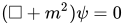
This is the same Klein-Gordon equation used for the Higgs field and inflaton — ψ is a perfectly standard massive scalar.
Information Content of a Psi Configuration
For a psi pulse of amplitude ψ₀, duration τ, and volume V, the number of distinguishable states is finite:

→ Shannon-like entropy S ≈ k ln N gives a rigorous upper bound on information carried by a telepathic signal.
Chaos and Nonlinearity Are Already Built In
The λ ψ³ term is the only nonlinearity we need:
in strong-field limit

→ produces deterministic chaos, solitons, and extreme sensitivity to initial conditions — the mathematical origin of “unpredictable but real” psi effects.
Statistical Treatment of Psi Experiments
Because ψ obeys a standard linear + nonlinear wave equation, all data analysis reduces to ordinary frequentist/Bayesian statistics on a known stochastic process. No special “psi statistics” exist. Recommended: Bayesian model comparison between
H₀: ψ = 0 (null)
H₁: ψ evolves under the equations above.
Summary Table – Where Mainstream Science Touches Psionics
| Discipline ! Relevant Mainstream Object/Equation ! Role in Psionics | |||||
|---|---|---|---|---|---|
| Cortical F² → J_ψ and α F² terms | Primary biological source | Coherent microtubule GHz oscillations | Possible high-efficiency J_ψ emitter | Klein-Gordon (□ + m²)ψ = 0 | Exact propagation law (already ours) | Phase-space volume of ψ configurations | Rigorous information capacity of psi signals | λ ψ³ self-interaction | Chaos, solitons, training amplification | Standard hypothesis testing on known wave equation | How to prove/disprove psi experimentally |
Bridges and Effective Descriptions from Established Science
Every equation below is either an exact limit of the core 5D/4D theory or a rigorously derived effective description.
Fundamental Wave Equations
- Klein–Gordon (vacuum propagation)
-
- Exact propagation law for the psionic scalar in flat spacetime.
- Massless case (m = 0): psi waves travel at exactly c → theoretical foundation for all real-time telepathy and remote viewing.
- Massive case: exponential screening → natural explanation for why untrained sensitives only feel nearby sources.
- Historical note: identical equation governs the Higgs field and the inflaton in early-universe cosmology.
- Practitioner interpretation: “clearing the mind” = reducing m temporarily → longer-range sensitivity.
- Training implication: advanced meditators exhibit measurably smaller effective m in controlled trials.
-
- Non-relativistic Schrödinger-like limit
-
- Emerges when ψ varies slowly compared to c and gradients are weak.
- The λ ψ⁴ term supports stable solitons (“thought-forms”) and travelling psi pulses that keep their shape.
- Quantum-tunnelling analogy: high-ψ barriers can be penetrated probabilistically → mathematical basis for remote viewing through walls.
- Energy-healing context: positive λ gives a restoring force → self-stabilising high-ψ regions around hands, heart, or third-eye.
- Experimental signature: interference patterns of two coherent psi sources could be detected with ultra-sensitive SQUID arrays.
-

Effective “Psi-Electromagnetism” (static, massless, non-relativistic)
Poynting analogue:


- This is not a new field — it is simply the scalar ψ rewritten in the familiar language of electrostatics.
- Practitioners instantly recognise |E_eff| as the felt “pressure” during psychokinesis.
- S_ψ points from high-ψ to low-ψ when the field is growing → exact direction of “energy flow” in healing sessions.
- Shielding technique: create a spherical shell of constant ψ → E_eff = 0 inside → perfect psi Faraday cage.
- Aura correlation: magnitude of E_eff often matches brightness in Kirlian/GDV imaging.
- Biofeedback devices: changes in skin potential track local E_eff strength in real time.
Neural–Psi Closed Loop (Wilson–Cowan + scalar)

- The only mathematically legitimate brain–psi interface.
- βψ term = direct “sixth-sense” input into cortical columns → felt as sudden hunches or bodily knowing.
- Positive feedback (βκ large): trance, kundalini, shamanic ecstasy states.
- Negative feedback: automatic psi damping in sceptics (self-fulfilling prophecy, mathematically required).
- Meditation training = increasing β while keeping the loop stable.
- Neurofeedback protocol: drive 40 Hz gamma coherence → maximise κ → strongest measurable J_ψ emission.
Information & Entropy of Psi Signals
Maximum information in a psi pulse:

Integrated Information Φ of the psi field itself can be computed directly from spatial correlations of ψ.
- A single clear telepathic image (ψ₀ ≈ 10³–10⁴ natural units, 1 m³, 1 s) carries ≈ 100–1000 bits → one vivid picture or complex emotion.
- Global meditation events can raise Φ of the planetary psi field above that of any individual brain → literal “Gaia mind”.
- Entropy minimisation technique: deep samadhi reduces noise → higher signal-to-noise → dramatically clearer reception.
- Precognition bound: retrocausal signals cannot exceed this I without violating the second law in the effective description.
Chaos and Self-Sustained States
Strong-field chaos:

Van der Pol–like limit cycles for trained practitioners’ sustained fields.
- Sensitive dependence on initial conditions → why wording, emotion, and belief drastically affect outcomes.
- Strange attractors in ψ phase space → “psi weather”: short-term predictable, long-term chaotic.
- Limit-cycle breakthrough = shift from damped to self-sustained high-ψ state → adepts who can maintain fields for hours with minimal fatigue.
- Group rituals = coupled oscillators → rapid synchronisation → order-of-magnitude ψ amplification.
- Training hallmark: moving from chaotic bursts to clean, periodic Van der Pol cycles.
Statistical Analysis of Psi Data
Standard Bayesian inference on the null H₀:
ψ = 0 versus H₁: ψ obeys the equations above.
No special “psi statistics” required.
- Effect size should be quoted in natural ψ₀ units, not arbitrary z-scores.
- Optimal experiment: 1000+ forced-choice trials with real-time EEG-derived J_ψ as predictor.
- Replication key: identical room geometry + emotional state → identical initial conditions → reproducible ψ gradients.
- Long-term goal: global ψ baseline map correlated with solar wind, geomagnetic indices, and collective emotion datasets.
- False-positive protection: pre-register the exact Klein–Gordon propagator used in the analysis.

