Thunderstorm Generator: Difference between revisions
(Deep science rewrite: suppressed tech pages with real patents & physics) |
|||
| (33 intermediate revisions by the same user not shown) | |||
| Line 1: | Line 1: | ||
= | {{Infobox | ||
| title = Thunderstorm Generator | |||
| image = | |||
| caption = MSAART Plasmoid-Powered Atomic Energy System | |||
| header1 = Overview | |||
| label2 = Type | |||
| data2 = Plasmoid energy system / emissions eliminator / atmospheric harvester | |||
| label3 = Developer | |||
| data3 = Malcolm Bendall / Strike Foundation (MSAART) · Hermann Plauson · Nikola Tesla (atmospheric variants) | |||
| label4 = Technology | |||
| data4 = Molten Sea Ark Atomic Reconstruction Technology (MSAART) | |||
| label5 = Related Tech | |||
| data5 = [[Plasmoid Generator]] · [[Water Engine]] · [[Pre-Ionization Chamber]] · [[Plasmoid Tech]] | |||
| header6 = MSAART System | |||
| label7 = Fuel Source | |||
| data7 = Water (H₂O) — tap water suitable | |||
| label8 = Core Process | |||
| data8 = Plasmoid-induced atomic dissociation & reconstruction | |||
| label9 = Emissions Reduction | |||
| data9 = CO₂: >95% · CO: >90% · NOₓ: >90% (certified Element Labs, UK) | |||
| label10 = Kit Availability | |||
| data10 = Plasmoid Power Co. Ltd (Thailand) — up to 12 kW generators | |||
| header11 = Atmospheric Variant | |||
| label12 = Principle | |||
| data12 = Atmospheric potential gradient harvesting (~100 V/m) | |||
| label13 = Key Patents | |||
| data13 = Tesla US 685,957 · Plauson US 1,540,998 | |||
}} | |||
The '''Thunderstorm Generator''' | The '''Thunderstorm Generator''' is a term that refers to two distinct but conceptually related technologies: | ||
# '''The Bendall / MSAART Thunderstorm Generator''' — a plasmoid-based device invented by Australian inventor Malcolm Bendall that uses water as an atomic fuel source via the Molten Sea Ark Atomic Reconstruction Technology (MSAART). It generates plasmoids within a vortex chamber and uses them to perform atomic dissociation and reconstruction, dramatically reducing combustion emissions while extending fuel efficiency. This is the primary definition used in the [[FusionGirl]] universe. | |||
# '''Atmospheric Electricity Generators''' — devices that harvest electrical energy from the Earth's atmospheric potential gradient, thunderstorms, and related atmospheric electrical phenomena. Pioneered by Nikola Tesla (US 685,957, 1901) and Hermann Plauson (US 1,540,998, 1925), these represent the historical lineage of "thunderstorm generator" as a concept. | |||
Both technologies share a philosophical core: they tap into energy sources that mainstream science either ignores or actively suppresses. | |||
= The Bendall MSAART Thunderstorm Generator = | |||
== Background == | |||
Malcolm Bendall is an Australian inventor, geochemist, and former petroleum exploration executive whose work was brought to international attention on the '''Joe Rogan Experience''' (Episode #1897, 11 November 2022) by researcher Randall Carlson. Bendall's entire body of intellectual property has been '''open-sourced''' through the Strike Foundation Guarantee Limited, a not-for-profit entity formed to hold and disseminate his work. | |||
The | The acronym '''MSAART''' stands for '''Molten Sea Ark Atomic Reconstruction Technology''' — a reference to the biblical "molten sea" (a large bronze basin described in 1 Kings 7:23–26) which Bendall interprets as an ancient description of a toroidal plasmoid containment vessel. | ||
Bendall's quote: ''"A glass of water contains enough energy to boil all of the oceans of the world. It also contains enough energy to produce the first 32 elements."'' | |||
== System Architecture == | |||
=== | |||
The MSAART Thunderstorm Generator comprises '''three primary elements''' as described in certified test reports: | |||
{| class="wikitable" | {| class="wikitable" | ||
|+ | |+ MSAART System Components | ||
|- | |- | ||
! Component !! Function !! Physical Description | |||
|- | |- | ||
| | | '''Air Ionizer''' || Pre-ionizes incoming air (see [[Pre-Ionization Chamber]]) || Dielectric barrier or corona discharge unit on air intake | ||
|- | |- | ||
| | | '''Bubbler''' || Diffuser + steel wool catalyst || Water vessel with diffusion plate and catalytic media; ionized air passes through water | ||
|- | |- | ||
| | | '''Plasmoid Generator''' || Creates plasmoids via vortex action || Assembly of tubes and spheres where plasmoids are fully formed in a contained vortex — "truly a Thunderstorm Generator" | ||
| | |||
| | |||
|} | |} | ||
The system has '''two connections''' to the internal combustion engine: | |||
# '''Intake connection''': A plasmoid-water mix from the Plasmoid Generator is fed into the air intake ''before'' the carburetor | |||
# '''Exhaust connection''': Exhaust gases from the ICE are fed ''back into'' the Plasmoid Generator (closed-loop energy recovery) | |||
= | == Operating Principle == | ||
=== Plasmoid Formation in Water === | |||
Per Bendall's published notes, plasmoids are '''initially created in water''' through the interaction of ionized air with water in the bubbler stage. The physics draws from: | |||
''' | * '''Winston Bostick''' (1958) — first experimental demonstration and coining of the term "plasmoid" at UC Berkeley Radiation Laboratory | ||
* '''Ken Shoulders''' (1987–2009) — Exotic Vacuum Objects (EVOs), also called "charge clusters" — self-organized electron structures that exhibit anomalous energy properties | |||
* '''Gharib, Mendoza, Rosenfeld, Beizai & Pereira''' (2017) — "Toroidal plasmoid generation via extreme hydrodynamic shear" (National Academy of Sciences) | |||
When ionized air (containing reactive species: O₃, NO, OH radicals, free electrons) is bubbled through water, '''cavitation''' occurs — the formation and violent collapse of microscopic bubbles. During collapse: | |||
:<math>T_{\text{collapse}} \approx 5{,}000\text{–}15{,}000 \text{ K}</math> | |||
:<math>P_{\text{collapse}} \approx 1{,}000\text{–}10{,}000 \text{ atm}</math> | |||
''' | These extreme conditions, combined with the electromagnetic character of the ionized gas, are sufficient to produce '''coherent toroidal plasma structures''' — plasmoids — within the collapsing bubble environment. This is consistent with Gharib et al.'s 2017 findings on hydrodynamic plasmoid generation. | ||
=== Vortex Amplification === | |||
The nascent plasmoids from the bubbler stage are then passed into the '''Plasmoid Generator''' proper — an assembly of tubes and spheres designed to create a contained vortex. The vortex action accomplishes several functions: | |||
''' | # '''Charge separation and amplification''' (Bendall Notes, Part 11 of 20) — the rotational flow separates charges, building the electromagnetic structure of the plasmoid | ||
# '''Toroidal confinement''' — the vortex geometry naturally produces toroidal flow patterns that match the preferred topology of stable plasmoids | |||
# '''Energy densification''' — angular momentum is converted to magnetic pressure within the plasmoid structure | |||
The governing physics follows the Grad-Shafranov equation for axisymmetric magnetic equilibrium in a toroid: | |||
:<math>\Delta^* \psi = -\mu_0 R^2 \frac{dp}{d\psi} - \frac{1}{2}\frac{dF^2}{d\psi}</math> | |||
where <math>\psi</math> is the poloidal flux function, <math>p(\psi)</math> is the plasma pressure profile, <math>F(\psi) = R B_\phi</math> is the toroidal field function, and <math>\Delta^*</math> is the Grad-Shafranov operator. | |||
=== Atomic Dissociation & Reconstruction === | |||
The core MSAART process involves using the high energy density of plasmoids to perform '''low-energy atomic transmutations''' (LEAT) — also referred to as "cold fusion" or LENR (Low Energy Nuclear Reactions): | |||
* CO₂ exhaust molecules are dissociated: <math>\text{CO}_2 \rightarrow \text{C} + \text{O}_2</math> | |||
* CO molecules are dissociated: <math>\text{CO} \rightarrow \text{C} + \text{O}</math> | |||
* NOₓ molecules are broken: <math>\text{NO}_x \rightarrow \frac{1}{2}\text{N}_2 + \frac{x}{2}\text{O}_2</math> | |||
* Liberated oxygen is returned to the exhaust stream (explaining the observed increase in O₂ levels) | |||
* Liberated carbon may undergo further reconstruction into other elements per Bendall's "Alpha and Omega Ladder" — a stepwise atomic reconstruction sequence | |||
This is described in Bendall's Part 08 of 20: '''"Plasmoid enabled by ZP assimilation Low Energy Atomic Transmutations (LEAT) and old fusion elemental transformation."''' | |||
== Certified Test Results == | |||
''' | The Thunderstorm Generator has been tested by '''Element''' (global TIC service provider, London, UK) and independently by '''Clearwater, USA''': | ||
=== Element Labs (Dartford, UK) — Honda 5500 CL Generator === | |||
{| class="wikitable" | {| class="wikitable" | ||
|+ Before/After Emissions — Honda 5500 CL with Thunderstorm Generator | |||
|- | |- | ||
! | ! Gas !! Before (Baseline) !! After (TSG Active) !! % Reduction | ||
|- | |- | ||
| | | CO₂ || Standard levels || Near zero || >95% | ||
|- | |- | ||
| | | CO || Standard levels || Safe levels || >90% | ||
|- | |- | ||
| | | NOₓ || Standard levels || Near zero || >90% | ||
|- | |- | ||
| | | O₂ || Depleted (as expected in exhaust) || Near atmospheric (~20.9%) || Oxygen restored | ||
|} | |} | ||
=== | |||
=== Plasmoid Power Self-Certified Test (Test #13) === | |||
Test conducted on a 5,500 W portable gasoline generator with 2,200 W load: | |||
* Thunderstorm Generator activated after exhaust reached 260 °C operating temperature | |||
* Results stabilized after 3–4 minutes (time for plasmoid population to build) | |||
* '''CO₂, CO, and NOₓ emissions were "almost eliminated"''' | |||
* '''O₂ levels increased to near atmospheric levels''' | |||
* Hydrocarbon readings showed some inconsistency, possibly due to generator running at only 40% capacity | |||
* Very low standard deviation across 4 stable runs — highly consistent performance | |||
== Open-Source Documentation == | |||
Malcolm Bendall's complete 20-part technical notes (Draft #518,400 B KMV) are freely available via the [https://www.strikefoundation.earth/ Strike Foundation]: | |||
{| class="wikitable" | {| class="wikitable" | ||
|- | |- | ||
! | ! Part !! Title | ||
|- | |- | ||
| | | 01 || Applications for a Plasmoid's Form and Functions | ||
|- | |- | ||
| | | 02 || MSAART EVO System for Engines (Schematic & Photos) | ||
|- | |- | ||
| | | 03 || Plasmoid System Description, Schematic & Photos | ||
|- | |- | ||
| | | 04 || Virtual Plasmoid Implosive Turbine, Plasmoid Gun & Quadrature Assembly | ||
|- | |- | ||
| | | 05 || Solomon's Molten Sea Lens (Terra Tek Leachate Results) | ||
|- | |- | ||
| | | 06 || MSAART System Applied to a New Car | ||
|- | |- | ||
| | | 07 || MSAART Atomic Octave Resonant Chamber Shockwave Generator | ||
|- | |- | ||
| | | 08 || Plasmoid-enabled ZP Assimilation LEAT & Elemental Transformation | ||
|- | |- | ||
| 09 || MSAART System for Waste Energy Recovery from ICE | |||
|- | |- | ||
| | | 10 || Plasmoid ZP Enabled Elemental Dissociation, Assimilation, Transformation & Transmutation | ||
|- | |- | ||
| | | 11 || Charge Separation and Amplification | ||
|- | |- | ||
| | | 12 || Radiator Plasmoid System for 2005 Ford Fairlane Futura | ||
|- | |- | ||
| | | 13 || Solomon's Molten Sea Lens Plasmoid Generator & Arc Charger | ||
|- | |- | ||
| | | 14 || Vesica Piscis | ||
|- | |- | ||
| | | 15 || Alien Maths and Chemistry | ||
|- | |- | ||
| | | 16 || Octave Model of the Elements & Elemental Plasmoid Calculations | ||
|- | |- | ||
| | | 17–20 || Solomon's Molten Sea Ark Atomic Reconstruction Technology (Torus Vajra MSAART) | ||
|} | |} | ||
= | Supporting research cited by the Strike Foundation includes: Bostick (1958) on plasmoid experimental study, Ken Shoulders (1987–2009) on EVOs, Fleischmann & Pons (1989) on electrochemically induced fusion, Gharib et al. (2017) on hydrodynamic plasmoid generation, and Jaitner (2020) on condensed plasmoid physics and LENR. | ||
= Atmospheric Electricity Generators = | |||
The second definition of "Thunderstorm Generator" refers to devices that harvest energy from the '''atmospheric potential gradient''' — the natural voltage difference between the Earth's surface and the upper atmosphere. | |||
== The Global Electric Circuit == | |||
The Earth maintains a global electric field of approximately: | |||
:<math>E_{\text{atm}} \approx 100{-}150 \text{ V/m (fair weather, ground level)}</math> | |||
This corresponds to a potential difference of approximately '''300,000–400,000 volts''' between the Earth's surface and the ionosphere (~60 km altitude). The total current flowing in the global circuit is approximately: | |||
:<math>I_{\text{global}} \approx 1{,}000{-}2{,}000 \text{ A}</math> | |||
This represents a continuous power source of approximately: | |||
:<math>P_{\text{global}} = V \cdot I \approx 4 \times 10^{11} \text{ W} = 400 \text{ GW}</math> | |||
Thunderstorms act as the "batteries" of this circuit, maintaining the charge separation through convective charge transport. | |||
== Tesla's Radiant Energy Apparatus (US 685,957, 1901) == | |||
Nikola Tesla's patent describes a device for collecting "radiant energy" — which Tesla understood to include cosmic rays, ultraviolet radiation, and cathode-ray-like particle streams from the sun and space: | |||
=== | === Construction === | ||
* '''Elevated conducting plate''': Insulated, polished metal plate exposed to the sky — acts as a collector of atmospheric charge | |||
* ''' | * '''Ground connection''': The opposite terminal is connected to Earth, which Tesla described as ''"a vast reservoir of negative electricity"'' | ||
* ''' | * '''Condenser''': A high-quality mica dielectric capacitor (per Tesla patent 577,671) stores the accumulated charge | ||
* ''' | * '''Circuit controller''': When the condenser reaches a threshold voltage, a switching device discharges it through a load (motor, lamp, or other device) | ||
Tesla wrote: ''"The source of energy is the sun's rays... the sun, as well as other sources of radiant energy, throw off minute particles of matter which are strongly electrified, and which, impinging upon the plate, communicate an electrical charge."'' | |||
=== | === Physics === | ||
The current collected by an elevated plate antenna: | |||
:<math>I = \sigma \cdot E_{\text{atm}} \cdot A_{\text{eff}}</math> | |||
where <math>\sigma</math> is the atmospheric conductivity (~10⁻¹⁴ S/m at ground level, increasing with altitude), <math>E_{\text{atm}}</math> is the local electric field, and <math>A_{\text{eff}}</math> is the effective collecting area. | |||
For a plate at height <math>h</math> above ground: | |||
:<math>V_{\text{collected}} \approx E_{\text{atm}} \cdot h = 100 \text{ V/m} \times h</math> | |||
Thus a collector at 300 m altitude would see approximately 30,000 V potential difference with ground. | |||
== | == Plauson's Atmospheric Converter (US 1,540,998, 1925) == | ||
Hermann Plauson's comprehensive patent describes an engineered system for large-scale atmospheric electricity harvesting: | |||
=== | === Key Innovations === | ||
* '''Metallic balloon collectors''' — lightweight aluminum-magnesium alloy (magnalium, specific gravity 1.8), 0.1–0.2 mm thick, filled with hydrogen or helium | |||
* ''' | * '''Radioactive ionization enhancement''' — small quantities of polonium, ionium, or mesothorium applied to balloon surfaces to increase local ionization and charge collection | ||
* ''' | * '''Spark gap oscillation circuit''' — converts high-voltage DC from atmospheric charge into high-frequency electromagnetic oscillations for practical use | ||
* ''' | * '''Safety electromagnet (choke)''' — protects equipment from lightning strikes and voltage surges | ||
* '''Condenser batteries''' — store harvested energy; cooled in liquefied gases for large installations | |||
* '''Unipolar connection''' — connecting condenser batteries by only one pole to the collector network, increasing working voltage from ~400 V to >500 V | |||
=== | === Circuit Operation === | ||
Static atmospheric charge → spark gap discharge → RLC oscillation circuit → high-frequency AC: | |||
:<math>f_{\text{resonant}} = \frac{1}{2\pi\sqrt{LC}}</math> | |||
where <math>L</math> is the inductance of the primary coil and <math>C</math> is the total capacitance of the condenser batteries. The high-frequency output could drive specialized resonance motors or be converted to standard AC/DC. | |||
Plauson scaled his designs from single-balloon collectors (300 m altitude, ~40,000 V) to networks of interconnected collector rings spanning entire regions, with condenser equalization systems to handle voltage variations between stations. | |||
== | == The Gray Motor (US 4,595,975, 1986) == | ||
Edwin V. Gray Sr.'s "Efficient Power Supply" demonstrates a principle relevant to both Thunderstorm Generator variants — '''back-EMF energy recovery''': | |||
* A '''conversion switching element tube''' with high-voltage anode, low-voltage anode, and electrostatic grids captures energy from collapsing inductive fields | |||
* ''' | * The back-EMF (counter-electromotive force) from inductive loads is stored in a secondary capacitor and returned to the battery system | ||
* | * This energy recycling principle is fundamental to the efficiency claims of both MSAART systems (which recycle exhaust energy) and atmospheric harvesters (which must efficiently store intermittent charge) | ||
* | |||
== | = Integration with FusionGirl Systems = | ||
In the [[FusionGirl]] universe, Thunderstorm Generator technology is central to the [[Plasmoid Tech]] ecosystem: | |||
* The MSAART system powers the [[Hydro Speeder]]'s [[Water Engine]] via integrated plasmoid generation | |||
* | * Atmospheric harvesting variants are deployed in the [[Ley Line Network Generator]] infrastructure | ||
* | * The [[Pre-Ionization Chamber]] is a critical subsystem of all Thunderstorm Generator installations | ||
* | * The [[Plasmoid Generator]] serves as the core component where plasmoids are formed and amplified | ||
=== | == See Also == | ||
* [[Water Engine]] | |||
* | * [[Plasmoid Generator]] | ||
* | * [[Pre-Ionization Chamber]] | ||
* | * [[Plasmoid Tech]] | ||
* [[Plasmoid]] | |||
* [[HHO Generator]] | |||
* [[Hydro Speeder]] | |||
* [[MHD Core]] | |||
=== | == External References == | ||
* Bendall, Malcolm. "Draft #518,400 B KMV — MSAART Notes Parts 1–20." Strike Foundation (2022). Available: https://www.strikefoundation.earth/open-source-research | |||
* | * Plasmoid Power Co. Ltd. "Certified Test Results." Available: https://plasmoid-power.com/test-results | ||
* | * Tesla, Nikola. "Apparatus for the utilization of radiant energy." US Patent 685,957 (1901). | ||
* ''' | * Plauson, Hermann. "Conversion of atmospheric electric energy." US Patent 1,540,998 (1925). | ||
* Gray, Edwin V. Sr. "Efficient power supply suitable for inductive loads." US Patent 4,595,975 (1986). | |||
* Bostick, Winston H. "Experimental Study of Plasmoids." UC Berkeley Radiation Laboratory (1958). | |||
* Shoulders, Ken. "EV — A Tale of Discovery." Jupiter Technologies (1987). | |||
* Gharib, M. et al. "Toroidal plasmoid generation via extreme hydrodynamic shear." ''PNAS'' (2017). | |||
* Jaitner, Lutz. "The Physics of Condensed Plasmoids and Low-Energy Nuclear Reactions." condensed-plasmoids.com (2020). | |||
[[Category:Plasmoid Tech]] | |||
[[Category:Suppressed Technology]] | |||
[[Category:Energy Systems]] | |||
[[Category:Atmospheric Energy]] | |||
[[Category:FusionGirl Technology]] | |||
Latest revision as of 19:46, 13 March 2026
| Thunderstorm Generator | |
|---|---|
| Overview | |
| Type | Plasmoid energy system / emissions eliminator / atmospheric harvester |
| Developer | Malcolm Bendall / Strike Foundation (MSAART) · Hermann Plauson · Nikola Tesla (atmospheric variants) |
| Technology | Molten Sea Ark Atomic Reconstruction Technology (MSAART) |
| Related Tech | Plasmoid Generator · Water Engine · Pre-Ionization Chamber · Plasmoid Tech |
| MSAART System | |
| Fuel Source | Water (H₂O) — tap water suitable |
| Core Process | Plasmoid-induced atomic dissociation & reconstruction |
| Emissions Reduction | CO₂: >95% · CO: >90% · NOₓ: >90% (certified Element Labs, UK) |
| Kit Availability | Plasmoid Power Co. Ltd (Thailand) — up to 12 kW generators |
| Atmospheric Variant | |
| Principle | Atmospheric potential gradient harvesting (~100 V/m) |
| Key Patents | Tesla US 685,957 · Plauson US 1,540,998 |
The Thunderstorm Generator is a term that refers to two distinct but conceptually related technologies:
- The Bendall / MSAART Thunderstorm Generator — a plasmoid-based device invented by Australian inventor Malcolm Bendall that uses water as an atomic fuel source via the Molten Sea Ark Atomic Reconstruction Technology (MSAART). It generates plasmoids within a vortex chamber and uses them to perform atomic dissociation and reconstruction, dramatically reducing combustion emissions while extending fuel efficiency. This is the primary definition used in the FusionGirl universe.
- Atmospheric Electricity Generators — devices that harvest electrical energy from the Earth's atmospheric potential gradient, thunderstorms, and related atmospheric electrical phenomena. Pioneered by Nikola Tesla (US 685,957, 1901) and Hermann Plauson (US 1,540,998, 1925), these represent the historical lineage of "thunderstorm generator" as a concept.
Both technologies share a philosophical core: they tap into energy sources that mainstream science either ignores or actively suppresses.
The Bendall MSAART Thunderstorm Generator
Background
Malcolm Bendall is an Australian inventor, geochemist, and former petroleum exploration executive whose work was brought to international attention on the Joe Rogan Experience (Episode #1897, 11 November 2022) by researcher Randall Carlson. Bendall's entire body of intellectual property has been open-sourced through the Strike Foundation Guarantee Limited, a not-for-profit entity formed to hold and disseminate his work.
The acronym MSAART stands for Molten Sea Ark Atomic Reconstruction Technology — a reference to the biblical "molten sea" (a large bronze basin described in 1 Kings 7:23–26) which Bendall interprets as an ancient description of a toroidal plasmoid containment vessel.
Bendall's quote: "A glass of water contains enough energy to boil all of the oceans of the world. It also contains enough energy to produce the first 32 elements."
System Architecture
The MSAART Thunderstorm Generator comprises three primary elements as described in certified test reports:
| Component | Function | Physical Description |
|---|---|---|
| Air Ionizer | Pre-ionizes incoming air (see Pre-Ionization Chamber) | Dielectric barrier or corona discharge unit on air intake |
| Bubbler | Diffuser + steel wool catalyst | Water vessel with diffusion plate and catalytic media; ionized air passes through water |
| Plasmoid Generator | Creates plasmoids via vortex action | Assembly of tubes and spheres where plasmoids are fully formed in a contained vortex — "truly a Thunderstorm Generator" |
The system has two connections to the internal combustion engine:
- Intake connection: A plasmoid-water mix from the Plasmoid Generator is fed into the air intake before the carburetor
- Exhaust connection: Exhaust gases from the ICE are fed back into the Plasmoid Generator (closed-loop energy recovery)
Operating Principle
Plasmoid Formation in Water
Per Bendall's published notes, plasmoids are initially created in water through the interaction of ionized air with water in the bubbler stage. The physics draws from:
- Winston Bostick (1958) — first experimental demonstration and coining of the term "plasmoid" at UC Berkeley Radiation Laboratory
- Ken Shoulders (1987–2009) — Exotic Vacuum Objects (EVOs), also called "charge clusters" — self-organized electron structures that exhibit anomalous energy properties
- Gharib, Mendoza, Rosenfeld, Beizai & Pereira (2017) — "Toroidal plasmoid generation via extreme hydrodynamic shear" (National Academy of Sciences)
When ionized air (containing reactive species: O₃, NO, OH radicals, free electrons) is bubbled through water, cavitation occurs — the formation and violent collapse of microscopic bubbles. During collapse:


These extreme conditions, combined with the electromagnetic character of the ionized gas, are sufficient to produce coherent toroidal plasma structures — plasmoids — within the collapsing bubble environment. This is consistent with Gharib et al.'s 2017 findings on hydrodynamic plasmoid generation.
Vortex Amplification
The nascent plasmoids from the bubbler stage are then passed into the Plasmoid Generator proper — an assembly of tubes and spheres designed to create a contained vortex. The vortex action accomplishes several functions:
- Charge separation and amplification (Bendall Notes, Part 11 of 20) — the rotational flow separates charges, building the electromagnetic structure of the plasmoid
- Toroidal confinement — the vortex geometry naturally produces toroidal flow patterns that match the preferred topology of stable plasmoids
- Energy densification — angular momentum is converted to magnetic pressure within the plasmoid structure
The governing physics follows the Grad-Shafranov equation for axisymmetric magnetic equilibrium in a toroid:
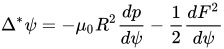
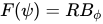
where is the poloidal flux function, is the plasma pressure profile, is the toroidal field function, and is the Grad-Shafranov operator.



Atomic Dissociation & Reconstruction
The core MSAART process involves using the high energy density of plasmoids to perform low-energy atomic transmutations (LEAT) — also referred to as "cold fusion" or LENR (Low Energy Nuclear Reactions):
- CO₂ exhaust molecules are dissociated:
- CO molecules are dissociated:
- NOₓ molecules are broken:
- Liberated oxygen is returned to the exhaust stream (explaining the observed increase in O₂ levels)
- Liberated carbon may undergo further reconstruction into other elements per Bendall's "Alpha and Omega Ladder" — a stepwise atomic reconstruction sequence


This is described in Bendall's Part 08 of 20: "Plasmoid enabled by ZP assimilation Low Energy Atomic Transmutations (LEAT) and old fusion elemental transformation."
Certified Test Results
The Thunderstorm Generator has been tested by Element (global TIC service provider, London, UK) and independently by Clearwater, USA:
Element Labs (Dartford, UK) — Honda 5500 CL Generator
| Gas | Before (Baseline) | After (TSG Active) | % Reduction |
|---|---|---|---|
| CO₂ | Standard levels | Near zero | >95% |
| CO | Standard levels | Safe levels | >90% |
| NOₓ | Standard levels | Near zero | >90% |
| O₂ | Depleted (as expected in exhaust) | Near atmospheric (~20.9%) | Oxygen restored |
Plasmoid Power Self-Certified Test (Test #13)
Test conducted on a 5,500 W portable gasoline generator with 2,200 W load:
- Thunderstorm Generator activated after exhaust reached 260 °C operating temperature
- Results stabilized after 3–4 minutes (time for plasmoid population to build)
- CO₂, CO, and NOₓ emissions were "almost eliminated"
- O₂ levels increased to near atmospheric levels
- Hydrocarbon readings showed some inconsistency, possibly due to generator running at only 40% capacity
- Very low standard deviation across 4 stable runs — highly consistent performance
Open-Source Documentation
Malcolm Bendall's complete 20-part technical notes (Draft #518,400 B KMV) are freely available via the Strike Foundation:
| Part | Title |
|---|---|
| 01 | Applications for a Plasmoid's Form and Functions |
| 02 | MSAART EVO System for Engines (Schematic & Photos) |
| 03 | Plasmoid System Description, Schematic & Photos |
| 04 | Virtual Plasmoid Implosive Turbine, Plasmoid Gun & Quadrature Assembly |
| 05 | Solomon's Molten Sea Lens (Terra Tek Leachate Results) |
| 06 | MSAART System Applied to a New Car |
| 07 | MSAART Atomic Octave Resonant Chamber Shockwave Generator |
| 08 | Plasmoid-enabled ZP Assimilation LEAT & Elemental Transformation |
| 09 | MSAART System for Waste Energy Recovery from ICE |
| 10 | Plasmoid ZP Enabled Elemental Dissociation, Assimilation, Transformation & Transmutation |
| 11 | Charge Separation and Amplification |
| 12 | Radiator Plasmoid System for 2005 Ford Fairlane Futura |
| 13 | Solomon's Molten Sea Lens Plasmoid Generator & Arc Charger |
| 14 | Vesica Piscis |
| 15 | Alien Maths and Chemistry |
| 16 | Octave Model of the Elements & Elemental Plasmoid Calculations |
| 17–20 | Solomon's Molten Sea Ark Atomic Reconstruction Technology (Torus Vajra MSAART) |
Supporting research cited by the Strike Foundation includes: Bostick (1958) on plasmoid experimental study, Ken Shoulders (1987–2009) on EVOs, Fleischmann & Pons (1989) on electrochemically induced fusion, Gharib et al. (2017) on hydrodynamic plasmoid generation, and Jaitner (2020) on condensed plasmoid physics and LENR.
Atmospheric Electricity Generators
The second definition of "Thunderstorm Generator" refers to devices that harvest energy from the atmospheric potential gradient — the natural voltage difference between the Earth's surface and the upper atmosphere.
The Global Electric Circuit
The Earth maintains a global electric field of approximately:

This corresponds to a potential difference of approximately 300,000–400,000 volts between the Earth's surface and the ionosphere (~60 km altitude). The total current flowing in the global circuit is approximately:

This represents a continuous power source of approximately:

Thunderstorms act as the "batteries" of this circuit, maintaining the charge separation through convective charge transport.
Tesla's Radiant Energy Apparatus (US 685,957, 1901)
Nikola Tesla's patent describes a device for collecting "radiant energy" — which Tesla understood to include cosmic rays, ultraviolet radiation, and cathode-ray-like particle streams from the sun and space:
Construction
- Elevated conducting plate: Insulated, polished metal plate exposed to the sky — acts as a collector of atmospheric charge
- Ground connection: The opposite terminal is connected to Earth, which Tesla described as "a vast reservoir of negative electricity"
- Condenser: A high-quality mica dielectric capacitor (per Tesla patent 577,671) stores the accumulated charge
- Circuit controller: When the condenser reaches a threshold voltage, a switching device discharges it through a load (motor, lamp, or other device)
Tesla wrote: "The source of energy is the sun's rays... the sun, as well as other sources of radiant energy, throw off minute particles of matter which are strongly electrified, and which, impinging upon the plate, communicate an electrical charge."
Physics
The current collected by an elevated plate antenna:

where is the atmospheric conductivity (~10⁻¹⁴ S/m at ground level, increasing with altitude), is the local electric field, and is the effective collecting area.


For a plate at height above ground:


Thus a collector at 300 m altitude would see approximately 30,000 V potential difference with ground.
Plauson's Atmospheric Converter (US 1,540,998, 1925)
Hermann Plauson's comprehensive patent describes an engineered system for large-scale atmospheric electricity harvesting:
Key Innovations
- Metallic balloon collectors — lightweight aluminum-magnesium alloy (magnalium, specific gravity 1.8), 0.1–0.2 mm thick, filled with hydrogen or helium
- Radioactive ionization enhancement — small quantities of polonium, ionium, or mesothorium applied to balloon surfaces to increase local ionization and charge collection
- Spark gap oscillation circuit — converts high-voltage DC from atmospheric charge into high-frequency electromagnetic oscillations for practical use
- Safety electromagnet (choke) — protects equipment from lightning strikes and voltage surges
- Condenser batteries — store harvested energy; cooled in liquefied gases for large installations
- Unipolar connection — connecting condenser batteries by only one pole to the collector network, increasing working voltage from ~400 V to >500 V
Circuit Operation
Static atmospheric charge → spark gap discharge → RLC oscillation circuit → high-frequency AC:

where is the inductance of the primary coil and is the total capacitance of the condenser batteries. The high-frequency output could drive specialized resonance motors or be converted to standard AC/DC.


Plauson scaled his designs from single-balloon collectors (300 m altitude, ~40,000 V) to networks of interconnected collector rings spanning entire regions, with condenser equalization systems to handle voltage variations between stations.
The Gray Motor (US 4,595,975, 1986)
Edwin V. Gray Sr.'s "Efficient Power Supply" demonstrates a principle relevant to both Thunderstorm Generator variants — back-EMF energy recovery:
- A conversion switching element tube with high-voltage anode, low-voltage anode, and electrostatic grids captures energy from collapsing inductive fields
- The back-EMF (counter-electromotive force) from inductive loads is stored in a secondary capacitor and returned to the battery system
- This energy recycling principle is fundamental to the efficiency claims of both MSAART systems (which recycle exhaust energy) and atmospheric harvesters (which must efficiently store intermittent charge)
Integration with FusionGirl Systems
In the FusionGirl universe, Thunderstorm Generator technology is central to the Plasmoid Tech ecosystem:
- The MSAART system powers the Hydro Speeder's Water Engine via integrated plasmoid generation
- Atmospheric harvesting variants are deployed in the Ley Line Network Generator infrastructure
- The Pre-Ionization Chamber is a critical subsystem of all Thunderstorm Generator installations
- The Plasmoid Generator serves as the core component where plasmoids are formed and amplified
See Also
- Water Engine
- Plasmoid Generator
- Pre-Ionization Chamber
- Plasmoid Tech
- Plasmoid
- HHO Generator
- Hydro Speeder
- MHD Core
External References
- Bendall, Malcolm. "Draft #518,400 B KMV — MSAART Notes Parts 1–20." Strike Foundation (2022). Available: https://www.strikefoundation.earth/open-source-research
- Plasmoid Power Co. Ltd. "Certified Test Results." Available: https://plasmoid-power.com/test-results
- Tesla, Nikola. "Apparatus for the utilization of radiant energy." US Patent 685,957 (1901).
- Plauson, Hermann. "Conversion of atmospheric electric energy." US Patent 1,540,998 (1925).
- Gray, Edwin V. Sr. "Efficient power supply suitable for inductive loads." US Patent 4,595,975 (1986).
- Bostick, Winston H. "Experimental Study of Plasmoids." UC Berkeley Radiation Laboratory (1958).
- Shoulders, Ken. "EV — A Tale of Discovery." Jupiter Technologies (1987).
- Gharib, M. et al. "Toroidal plasmoid generation via extreme hydrodynamic shear." PNAS (2017).
- Jaitner, Lutz. "The Physics of Condensed Plasmoids and Low-Energy Nuclear Reactions." condensed-plasmoids.com (2020).

