Thunderstorm Generator: Difference between revisions

From FusionGirl Wiki
Jump to navigationJump to search
(Deep science rewrite: suppressed tech pages with real patents & physics)
 
(23 intermediate revisions by the same user not shown)
Line 1: Line 1:
= Introduction =
{{Infobox
| title      = Thunderstorm Generator
| image      =  
| caption    = MSAART Plasmoid-Powered Atomic Energy System
| header1    = Overview
| label2    = Type
| data2      = Plasmoid energy system / emissions eliminator / atmospheric harvester
| label3    = Developer
| data3      = Malcolm Bendall / Strike Foundation (MSAART) · Hermann Plauson · Nikola Tesla (atmospheric variants)
| label4    = Technology
| data4      = Molten Sea Ark Atomic Reconstruction Technology (MSAART)
| label5    = Related Tech
| data5      = [[Plasmoid Generator]] · [[Water Engine]] · [[Pre-Ionization Chamber]] · [[Plasmoid Tech]]
| header6    = MSAART System
| label7    = Fuel Source
| data7      = Water (H₂O) — tap water suitable
| label8    = Core Process
| data8      = Plasmoid-induced atomic dissociation & reconstruction
| label9    = Emissions Reduction
| data9      = CO₂: >95% · CO: >90% · NOₓ: >90% (certified Element Labs, UK)
| label10    = Kit Availability
| data10    = Plasmoid Power Co. Ltd (Thailand) — up to 12 kW generators
| header11  = Atmospheric Variant
| label12    = Principle
| data12    = Atmospheric potential gradient harvesting (~100 V/m)
| label13    = Key Patents
| data13    = Tesla US 685,957 · Plauson US 1,540,998
}}


The '''Thunderstorm Generator''' represents a paradigm shift in the realm of energy production, offering a disruptive solution to the longstanding challenges associated with internal combustion engines. Conceived and developed by Australian inventor Malcolm Bendall, this revolutionary technology stands at the forefront of the renewable energy movement, heralding a new era of sustainability and efficiency in power generation.
The '''Thunderstorm Generator''' is a term that refers to two distinct but conceptually related technologies:


At its core, the Thunderstorm Generator is a testament to human ingenuity, leveraging proprietary plasmoid-induced and controlled atomic energy release processes to unlock the latent potential of water as a viable atomic fuel source. Unlike conventional engines reliant solely on finite fossil fuels, the Bendall Engine, as it is affectionately known, embraces a hybrid approach that seamlessly integrates water and traditional hydrocarbon fuels.
# '''The Bendall / MSAART Thunderstorm Generator''' — a plasmoid-based device invented by Australian inventor Malcolm Bendall that uses water as an atomic fuel source via the Molten Sea Ark Atomic Reconstruction Technology (MSAART). It generates plasmoids within a vortex chamber and uses them to perform atomic dissociation and reconstruction, dramatically reducing combustion emissions while extending fuel efficiency. This is the primary definition used in the [[FusionGirl]] universe.


Central to the Thunderstorm Generator's operation is the concept of plasmoids, self-regulating toroidal structures of plasma confined by magnetic fields. These plasmoids serve as the catalyst for atomic fusion, enabling the efficient extraction and utilization of energy from water molecules. By harnessing the power of plasmoid technology, the Thunderstorm Generator transcends the limitations of traditional combustion engines, offering a pathway to cleaner, more sustainable energy production.
# '''Atmospheric Electricity Generators''' — devices that harvest electrical energy from the Earth's atmospheric potential gradient, thunderstorms, and related atmospheric electrical phenomena. Pioneered by Nikola Tesla (US 685,957, 1901) and Hermann Plauson (US 1,540,998, 1925), these represent the historical lineage of "thunderstorm generator" as a concept.


Moreover, the Thunderstorm Generator represents a monumental leap forward in environmental stewardship, boasting unparalleled reductions in toxic emissions compared to its fossil fuel counterparts. Through meticulous engineering and innovative design, Malcolm Bendall has unlocked a new frontier in energy efficiency, with retrofit capabilities that promise to transform existing engine and generator systems worldwide.
Both technologies share a philosophical core: they tap into energy sources that mainstream science either ignores or actively suppresses.


As we stand on the cusp of a global energy transition, the Thunderstorm Generator stands as a beacon of hope, offering a tangible solution to the pressing challenges of climate change and environmental degradation. With its ability to harness the elemental power of water and unleash it in a controlled and sustainable manner, this groundbreaking technology paves the way for a brighter, more sustainable future for generations to come.
= The Bendall MSAART Thunderstorm Generator =


== Background ==


== Overview ==
Malcolm Bendall is an Australian inventor, geochemist, and former petroleum exploration executive whose work was brought to international attention on the '''Joe Rogan Experience''' (Episode #1897, 11 November 2022) by researcher Randall Carlson. Bendall's entire body of intellectual property has been '''open-sourced''' through the Strike Foundation Guarantee Limited, a not-for-profit entity formed to hold and disseminate his work.


The Thunderstorm Generator is a cutting-edge technology that uses plasmoids to control atomic energy release, primarily through catalyzing atomic fusion reactions using water as fuel. Unlike traditional engines, it efficiently extracts energy from water, reducing reliance on finite fossil fuels and emissions. Its components include a fusion chamber, closed-loop fuel system, and specialized injectors for optimal performance. With retrofit capabilities, it can integrate into existing systems, offering over 90% efficiency and minimal waste heat. Developed by Malcolm Bendall, it addresses climate change and environmental concerns, offering a sustainable solution for clean energy generation.
The acronym '''MSAART''' stands for '''Molten Sea Ark Atomic Reconstruction Technology''' — a reference to the biblical "molten sea" (a large bronze basin described in 1 Kings 7:23–26) which Bendall interprets as an ancient description of a toroidal plasmoid containment vessel.


= Operation and Working Principle =
Bendall's quote: ''"A glass of water contains enough energy to boil all of the oceans of the world. It also contains enough energy to produce the first 32 elements."''


The Thunderstorm Generator operates on a complex interplay of processes involving the combustion of HHO gas, the utilization of plasmoids and plasma, preconditioned water, and fossil fuels. Below is a detailed explanation of its working principle:
== System Architecture ==


=== Burning HHO Gas and Reverting to HzO Liquid ===
The MSAART Thunderstorm Generator comprises '''three primary elements''' as described in certified test reports:
 
The process begins with the combustion of HHO gas, a mixture of hydrogen and oxygen. When HHO gas is ignited, it undergoes a chemical reaction and reverts to liquid water (HzO). This phase transition from gas to liquid releases energy in the form of heat.
 
=== Disassembly of Water into Ionized Hydrogen and Oxygen Gases ===
 
Within the Thunderstorm Generator, HzO liquid is subjected to intense forces and conditions. Through the application of plasmoids and plasma, along with the use of catalysts, water molecules are disassembled into ionized hydrogen (H) and oxygen (O) gases. This disassociation process occurs due to the high pressures and temperatures generated within the system.
 
=== Utilization of Plasmoids, Plasma, and Preconditioned Water ===
 
Plasmoids, which are coherent toroidal structures of plasma confined by magnetic fields, play a crucial role in the energy generation process. Within the Thunderstorm Generator, plasmoids interact with preconditioned water and plasma to enhance the disassembly of water molecules. These plasmoids harvest electrons and protons from the ionized hydrogen within the water, increasing the system's energy output significantly.
 
Plasma, a state of matter consisting of charged particles, further aids in the disassociation of water and the subsequent energy release. By subjecting the water to plasma, the disassembly process is accelerated, leading to more efficient energy generation.
 
=== Role of Catalysts and Enhancement of Engine Efficiency ===
 
Catalysts are utilized within the Thunderstorm Generator to induce and facilitate the disassociation of water molecules. These catalysts, often composed of materials like stainless steel, assist in breaking the chemical bonds within water, allowing for the separation of hydrogen and oxygen gases. By reducing the energy required for this process, catalysts enhance the overall efficiency of the engine, enabling more effective utilization of the energy released from water as an atomic fuel.
 
In summary, the Thunderstorm Generator harnesses the power of combustion, plasmoids, plasma, and catalysts to convert water into a potent source of energy. By optimizing the disassembly process and enhancing engine efficiency, it offers a promising solution for sustainable energy generation with reduced environmental impact.
 
This section provides a comprehensive overview of how the Thunderstorm Generator operates and the principles behind its functionality, including the utilization of various elements such as HHO gas, plasmoids, plasma, preconditioned water, and catalysts.


{| class="wikitable"
|+ Equations Relevant to Thunderstorm Generator Operation
|-
! Equation !! Description
|-
| <math>E = mc^2</math> || Einstein's equation relating energy (E) to mass (m) and the speed of light (c). Relevant for understanding the potential energy release during atomic processes within the Thunderstorm Generator.
|-
| <math>P = IV</math> || The equation for electrical power (P) as the product of current (I) and voltage (V). Used to calculate the power input/output in electrical components such as the Plasma Injector and Plasmoid Generator.
|-
| <math>F = ma</math> || Newton's second law of motion, defining force (F) as the product of mass (m) and acceleration (a). Relevant for understanding the forces involved in the movement of gases and particles within the Thunderstorm Generator.
|-
| <math>E_{\text{cell}} = E^{\circ}_{\text{cell}} - \frac{RT}{nF}\ln Q</math> || The Nernst equation for calculating the electromotive force (cell potential) of an electrochemical cell at any concentration of reactants and products. Relevant for understanding the electrochemical reactions involved in the electrolysis process within the Thunderstorm Generator.
|-
| <math>KE = \frac{1}{2}mv^2</math> || The equation for kinetic energy (KE) as the product of half the mass (m) and the square of the velocity (v). Relevant for understanding the energy of particles and gases within the Thunderstorm Generator, particularly during combustion and plasma generation processes.
|-
| <math>\Delta G = \Delta H - T\Delta S</math> || The Gibbs free energy equation, where ΔG represents the change in Gibbs free energy, ΔH represents the change in enthalpy, T represents temperature, and ΔS represents the change in entropy. Relevant for understanding the thermodynamics of chemical reactions, such as the disassociation of water molecules and the formation of plasmoids within the Thunderstorm Generator.
|-
| <math>F = k\frac{q_1q_2}{r^2}</math> || Coulomb's law equation, where F is the electrostatic force between two charged particles, k is Coulomb's constant, q1 and q2 are the magnitudes of the charges, and r is the distance between the charges. Relevant for understanding the interaction between charged particles, such as ions and plasmoids, within the Thunderstorm Generator.
|}
 
= Technical Components =
 
{| class="wikitable"
|+ Components and Modules of the Thunderstorm Generator
|-
! Component/Module !! Description
|-
| Combustion Chamber || The chamber where HHO gas is ignited to revert it to liquid water (HzO).
|-
| Plasmoid Generator || Device responsible for generating and controlling plasmoids within the system.
|-
| Plasma Injector || Component that introduces plasma into the system to aid in the disassembly of water molecules.
|-
| Catalysts || Materials or substances used to induce the disassociation of water into hydrogen and oxygen gases.
|}
 
== Vortex Tube Mechanism ==
 
=== Introduction ===
The Vortex Tube Mechanism stands as a testament to the ingenuity of thermodynamics, offering a revolutionary approach to thermal management and energy separation. Originally conceptualized by French physicist Georges Ranque in 1931 and later refined by German physicist Rudolf Hilsch in 1945, the vortex tube represents a pinnacle of fluid dynamics engineering. In the context of the Thunderstorm Generator, this mechanism plays a pivotal role in regulating gas temperatures, enabling efficient energy transfer, and facilitating the generation of hot and cold streams essential for engine operation.
 
{{clear}}
 
=== Principles of Operation ===
At its core, the vortex tube operates on the principles of centrifugal force and angular momentum, harnessing the inherent properties of compressed gases to achieve thermal separation. The mechanism consists of a cylindrical chamber with tangential inlet and axial outlet ports, creating a swirling motion within the gas stream upon entry. As the pressurized gas enters the chamber, it undergoes rapid rotation, with denser molecules migrating towards the outer periphery due to centrifugal forces. This results in the formation of a high-velocity outer stream, characterized by elevated temperatures, and a low-velocity inner stream, corresponding to cooler temperatures.
 
The operation of the vortex tube is based on fundamental principles of fluid dynamics and thermodynamics. Here's a breakdown of its key operating principles:
 
* '''Centrifugal Force''': Gas molecules within the vortex tube experience centrifugal forces, causing denser molecules to move towards the outer periphery while lighter molecules migrate towards the center.
* '''Angular Momentum''': The swirling motion of the gas stream creates angular momentum, which leads to the separation of the gas into hot and cold streams.
* '''Gas Compression''': The incoming gas is subjected to compression, leading to an increase in temperature and pressure, which subsequently contributes to the generation of hot and cold streams.
* '''Expansion Effect''': As the compressed gas expands and accelerates within the vortex tube, it undergoes adiabatic cooling, resulting in a reduction in temperature in the cold stream.
 
 
=== Engineering Design ===
The design of the vortex tube is meticulously engineered to optimize thermal separation and streamline gas flow. Key design parameters, including the diameter of the chamber, the angle of the tangential inlet, and the length-to-diameter ratio, are carefully calibrated to achieve desired temperature differentials and flow characteristics. Additionally, the internal geometry of the tube, such as the conical shape of the nozzle and the presence of vortex generators, serves to enhance fluid dynamics and maximize energy efficiency.
 
The engineering design of the vortex tube is crucial for optimizing its performance and efficiency. Here are some key design considerations:


{| class="wikitable"
|+ MSAART System Components
|-
|-
! Parameter
! Component !! Function !! Physical Description
! Description
|-
|-
| Chamber Diameter
| '''Air Ionizer''' || Pre-ionizes incoming air (see [[Pre-Ionization Chamber]]) || Dielectric barrier or corona discharge unit on air intake
| The diameter of the vortex tube chamber affects the velocity and turbulence of the gas flow, influencing temperature differentials between the hot and cold streams.
|-
|-
| Inlet Angle
| '''Bubbler''' || Diffuser + steel wool catalyst || Water vessel with diffusion plate and catalytic media; ionized air passes through water
| The angle at which the gas enters the chamber impacts the swirl intensity and vortex formation, affecting the efficiency of thermal separation.
|-
|-
| Length-to-Diameter Ratio
| '''Plasmoid Generator''' || Creates plasmoids via vortex action || Assembly of tubes and spheres where plasmoids are fully formed in a contained vortex — "truly a Thunderstorm Generator"
| The ratio of the length to the diameter of the chamber influences the residence time of the gas and the degree of thermal stratification within the tube.
|}
|}


=== Temperature Control ===
The system has '''two connections''' to the internal combustion engine:
One of the defining features of the vortex tube is its ability to precisely control temperature gradients within the gas streams. By adjusting operating parameters such as inlet pressure, gas flow rate, and outlet orifice size, engineers can manipulate the temperature differentials between the hot and cold streams with remarkable precision. This level of control is instrumental in applications where specific temperature ranges are required, such as industrial cooling systems, refrigeration units, and heat exchangers.
# '''Intake connection''': A plasmoid-water mix from the Plasmoid Generator is fed into the air intake ''before'' the carburetor
 
# '''Exhaust connection''': Exhaust gases from the ICE are fed ''back into'' the Plasmoid Generator (closed-loop energy recovery)
Temperature control is a crucial aspect of vortex tube operation, enabling precise regulation of thermal differentials between the hot and cold streams. Here's how temperature control is achieved:
 
* '''Inlet Pressure Adjustment''': By varying the inlet pressure of the gas, engineers can modulate the temperature differential between the hot and cold streams.
* '''Gas Flow Rate Control''': Adjusting the flow rate of the gas entering the vortex tube allows for fine-tuning of temperature differentials and overall system performance.
* '''Orifice Size Modification''': Altering the size of the outlet orifice influences the flow distribution and velocity profiles within the vortex tube, impacting temperature control.
 
 
=== Applications in the Thunderstorm Generator ===
Within the context of the Thunderstorm Generator, the vortex tube mechanism assumes a critical role in managing thermal energy and optimizing engine performance. By leveraging the inherent characteristics of compressed gases, the mechanism facilitates the generation of hot streams for combustion enhancement and cold streams for thermal regulation. Through strategic integration into the generator's architecture, the vortex tube enables efficient energy utilization, reduces environmental impact, and enhances overall system reliability.


The vortex tube mechanism finds diverse applications within the Thunderstorm Generator, contributing to its operational efficiency and performance. Here are some key applications:
== Operating Principle ==


* '''Combustion Enhancement''': Hot streams generated by the vortex tube are utilized to enhance combustion efficiency within the engine, leading to improved power output and reduced emissions.
=== Plasmoid Formation in Water ===
* '''Thermal Regulation''': Cold streams produced by the vortex tube play a crucial role in thermal regulation, maintaining optimal operating temperatures within the engine and associated components.
* '''Energy Recovery''': By harnessing thermal energy from the hot streams, the Thunderstorm Generator can recover waste heat and convert it into usable mechanical or electrical energy, enhancing overall system efficiency.


Per Bendall's published notes, plasmoids are '''initially created in water''' through the interaction of ionized air with water in the bubbler stage. The physics draws from:


=== Advancements and Future Prospects ===
* '''Winston Bostick''' (1958) — first experimental demonstration and coining of the term "plasmoid" at UC Berkeley Radiation Laboratory
Continued research and development in the field of fluid dynamics promise to unlock new frontiers in vortex tube technology. Advancements in materials science, computational modeling, and manufacturing techniques are poised to further refine the performance and efficiency of vortex tubes, paving the way for novel applications in diverse industries. As the Thunderstorm Generator continues to evolve, the vortex tube mechanism will undoubtedly remain a cornerstone of its design, driving innovation and propelling the engine towards unprecedented levels of efficiency and sustainability.
* '''Ken Shoulders''' (1987–2009) — Exotic Vacuum Objects (EVOs), also called "charge clusters" — self-organized electron structures that exhibit anomalous energy properties
* '''Gharib, Mendoza, Rosenfeld, Beizai & Pereira''' (2017) — "Toroidal plasmoid generation via extreme hydrodynamic shear" (National Academy of Sciences)


Advancements in vortex tube technology hold promise for unlocking new applications and improving performance in the Thunderstorm Generator. Here are some areas of potential advancement:
When ionized air (containing reactive species: O₃, NO, OH radicals, free electrons) is bubbled through water, '''cavitation''' occurs — the formation and violent collapse of microscopic bubbles. During collapse:


* '''Materials Innovation''': Advanced materials with enhanced thermal conductivity and durability could improve the efficiency and reliability of vortex tubes in harsh operating conditions.
:<math>T_{\text{collapse}} \approx 5{,}000\text{–}15{,}000 \text{ K}</math>
* '''Computational Modeling''': Sophisticated computational fluid dynamics (CFD) simulations can provide insights into flow behavior and temperature distribution within vortex tubes, aiding in design optimization.
:<math>P_{\text{collapse}} \approx 1{,}000\text{–}10{,}000 \text{ atm}</math>
* '''Manufacturing Techniques''': Additive manufacturing and precision machining technologies enable the production of complex vortex tube geometries with high accuracy, expanding design possibilities and performance capabilities.


These extreme conditions, combined with the electromagnetic character of the ionized gas, are sufficient to produce '''coherent toroidal plasma structures''' — plasmoids — within the collapsing bubble environment. This is consistent with Gharib et al.'s 2017 findings on hydrodynamic plasmoid generation.


=== Conclusion ===
=== Vortex Amplification ===
In summary, the Vortex Tube Mechanism represents a pinnacle of engineering innovation, harnessing the principles of fluid dynamics to achieve remarkable feats of thermal separation and energy management. Within the Thunderstorm Generator, this mechanism plays a central role in regulating gas temperatures, facilitating combustion enhancement, and optimizing engine performance. As advancements in vortex tube technology continue to unfold, the potential for transformative applications across various industries remains boundless, reaffirming its status as a cornerstone of modern engineering.


{{See also|* [[Thermal Management]] * [[Fluid Dynamics]] * [[Energy Efficiency]]}}
The nascent plasmoids from the bubbler stage are then passed into the '''Plasmoid Generator''' proper — an assembly of tubes and spheres designed to create a contained vortex. The vortex action accomplishes several functions:


{{clear}}
# '''Charge separation and amplification''' (Bendall Notes, Part 11 of 20) — the rotational flow separates charges, building the electromagnetic structure of the plasmoid
# '''Toroidal confinement''' — the vortex geometry naturally produces toroidal flow patterns that match the preferred topology of stable plasmoids
# '''Energy densification''' — angular momentum is converted to magnetic pressure within the plasmoid structure


=== Proprietary Fuel, Plasmoid, and Plasma Injector Technology ===
The governing physics follows the Grad-Shafranov equation for axisymmetric magnetic equilibrium in a toroid:
Central to the Thunderstorm Generator's revolutionary design is its proprietary fuel, plasmoid, and plasma injector technology. Developed through years of rigorous research and experimentation, these injectors represent a paradigm shift in combustion engine engineering. At the heart of this technology lies the implosive principle, harnessing the power of controlled implosions to unleash unprecedented levels of energy. The fuel and plasmoid injector system comprises a network of precision-engineered nozzles and conduits, meticulously designed to channel fuel and plasmoids towards a central tungsten carbide sphere. Here, under extreme pressure and temperature conditions, the injected fuel undergoes a rapid implosion, triggering a cascade of energy release. Complementing this system is the plasma injector, a marvel of modern engineering that generates and manipulates plasma within the engine's combustion chamber. By introducing carefully calibrated bursts of plasma, the injector enhances combustion efficiency and facilitates the disassociation of water molecules into their constituent elements. Together, these injector systems form the backbone of the Thunderstorm Generator, propelling it towards unparalleled levels of performance and efficiency.


=== Specific Components ===
:<math>\Delta^* \psi = -\mu_0 R^2 \frac{dp}{d\psi} - \frac{1}{2}\frac{dF^2}{d\psi}</math>
# [[Central Tungsten Carbide Sphere]]:  
#* Serving as the epicenter of implosive energy generation, the central tungsten carbide sphere plays a pivotal role in maximizing energy transfer and combustion efficiency within the Thunderstorm Generator.
# [[HHO Generator]]:
#* An essential component responsible for generating the hydrogen and oxygen gases used as fuel in the Thunderstorm Generator. The HHO generator employs cutting-edge electrolysis technology to efficiently split water molecules into their constituent elements, providing a clean and abundant source of fuel for the engine.
# [[Plasma Discharge System]]:
#* This sophisticated system governs the generation and manipulation of plasma within the engine's combustion chamber, orchestrating precise bursts of energy to optimize combustion and energy release. Through meticulous control of plasma dynamics, the discharge system ensures consistent and efficient operation of the Thunderstorm Generator.
# [[Injector Assemblies]]:
#* A complex network of injector assemblies, comprising fuel, plasmoid, and plasma injectors, regulates the flow and distribution of fuel, plasmoids, and plasma within the engine. Engineered to exacting standards, these assemblies deliver precise quantities of reactants to the combustion chamber, enabling controlled implosions and maximizing energy output.
# [[Thermal Management Components]]:
#* The Thunderstorm Generator incorporates an array of thermal management components, including heat exchangers, coolant systems, and insulation materials, to maintain optimal operating temperatures and safeguard critical engine components. These components work in concert to dissipate excess heat, minimize thermal losses, and ensure the longevity and reliability of the generator under demanding operating conditions.


== Definition of Construction ==
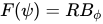
where <math>\psi</math> is the poloidal flux function, <math>p(\psi)</math> is the plasma pressure profile, <math>F(\psi) = R B_\phi</math> is the toroidal field function, and <math>\Delta^*</math> is the Grad-Shafranov operator.


In the context of engineering and technology, the terms "systems," "modules," "devices," "components," "parts," "sub-parts," and "pieces" are often used to describe different levels of organization or hierarchical structures within a larger entity. Here's a brief explanation of each term:
=== Atomic Dissociation & Reconstruction ===


    [[Systems]]: A system is a collection of interconnected elements or components that work together to achieve a specific function or goal. Systems can be complex and may consist of multiple subsystems.
The core MSAART process involves using the high energy density of plasmoids to perform '''low-energy atomic transmutations''' (LEAT) — also referred to as "cold fusion" or LENR (Low Energy Nuclear Reactions):


    [[Modules]]: Modules are self-contained units or components that perform a specific function within a larger system. They are often designed to be interchangeable or easily replaceable.
* CO₂ exhaust molecules are dissociated: <math>\text{CO}_2 \rightarrow \text{C} + \text{O}_2</math>
* CO molecules are dissociated: <math>\text{CO} \rightarrow \text{C} + \text{O}</math>
* NOₓ molecules are broken: <math>\text{NO}_x \rightarrow \frac{1}{2}\text{N}_2 + \frac{x}{2}\text{O}_2</math>
* Liberated oxygen is returned to the exhaust stream (explaining the observed increase in O₂ levels)
* Liberated carbon may undergo further reconstruction into other elements per Bendall's "Alpha and Omega Ladder" — a stepwise atomic reconstruction sequence


    [[Devices]]: Devices are physical or electronic instruments that serve a specific purpose or function within a system. They can range from simple tools to complex machinery.
This is described in Bendall's Part 08 of 20: '''"Plasmoid enabled by ZP assimilation Low Energy Atomic Transmutations (LEAT) and old fusion elemental transformation."'''


    [[Components]]: Components are individual parts or elements that make up a device, module, or system. They are often assembled or integrated to form larger structures.
== Certified Test Results ==


    [[Parts]]: Parts are smaller subdivisions of components, often referring to specific pieces or sections that contribute to the overall functionality of a device or system.
The Thunderstorm Generator has been tested by '''Element''' (global TIC service provider, London, UK) and independently by '''Clearwater, USA''':


    [[Sub-parts]]: Sub-parts are further subdivisions of parts, representing even smaller components or elements within a larger structure.
=== Element Labs (Dartford, UK) — Honda 5500 CL Generator ===


    [[Pieces]]: Pieces are the smallest units or elements that make up a device, component, or part. They are often discrete items that can be individually identified or manipulated.
== Additional & Alternative Components of an Advanced Thunderstorm Generator ==
=== Systems ===
{| class="wikitable"
|+ Before/After Emissions — Honda 5500 CL with Thunderstorm Generator
|-
|-
! System !! Description !! Purpose
! Gas !! Before (Baseline) !! After (TSG Active) !! % Reduction
|-
|-
| Plasmoid Induction System || Generates and controls plasmoids || Initiates and sustains atomic fusion reactions
| CO₂ || Standard levels || Near zero || >95%
|-
|-
| Atomic Fusion Chamber || Encloses the fusion reaction || Contains and directs energy release
| CO || Standard levels || Safe levels || >90%
|-
|-
| Closed-loop Fuel Circulation System || Circulates water fuel || Maintains fuel supply and purity
| NOₓ || Standard levels || Near zero || >90%
|-
|-
| Energy Conversion and Power Generation System || Converts energy to electricity || Powers the engine and auxiliary systems
| O₂ || Depleted (as expected in exhaust) || Near atmospheric (~20.9%) || Oxygen restored
|-
| Thermal Regulation and Cooling System || Regulates temperature || Prevents overheating and ensures optimal operation
|-
| Exhaust Gas Management and Emissions Control System || Processes exhaust gases || Reduces emissions and pollution
|-
| Control and Monitoring System || Monitors and regulates operation || Ensures safety and efficiency
|-
| Safety and Emergency Shutdown System || Activates in emergencies || Prevents damage and hazards
|}
|}
=== Modules ===
 
=== Plasmoid Power Self-Certified Test (Test #13) ===
 
Test conducted on a 5,500 W portable gasoline generator with 2,200 W load:
 
* Thunderstorm Generator activated after exhaust reached 260 °C operating temperature
* Results stabilized after 3–4 minutes (time for plasmoid population to build)
* '''CO₂, CO, and NOₓ emissions were "almost eliminated"'''
* '''O₂ levels increased to near atmospheric levels'''
* Hydrocarbon readings showed some inconsistency, possibly due to generator running at only 40% capacity
* Very low standard deviation across 4 stable runs — highly consistent performance
 
== Open-Source Documentation ==
 
Malcolm Bendall's complete 20-part technical notes (Draft #518,400 B KMV) are freely available via the [https://www.strikefoundation.earth/ Strike Foundation]:
 
{| class="wikitable"
|-
|-
! Module !! Description !! Function
! Part !! Title
|-
|-
| Plasmoid Generation Module || Produces plasmoids || Initiates fusion reactions
| 01 || Applications for a Plasmoid's Form and Functions
|-
|-
| Fuel Injection and Atomization Module || Injects and atomizes water fuel || Facilitates combustion and energy release
| 02 || MSAART EVO System for Engines (Schematic & Photos)
|-
|-
| Heat Recovery and Thermal Exchange Module || Recovers and exchanges heat || Improves efficiency and conserves energy
| 03 || Plasmoid System Description, Schematic & Photos
|-
|-
| Electricity Generation and Power Distribution Module || Generates and distributes electricity || Powers onboard systems and external devices
| 04 || Virtual Plasmoid Implosive Turbine, Plasmoid Gun & Quadrature Assembly
|-
|-
| Electronic Control and Monitoring Module || Controls and monitors operation || Regulates parameters and provides feedback
| 05 || Solomon's Molten Sea Lens (Terra Tek Leachate Results)
|-
|-
| Cooling and Heat Dissipation Module || Cools components and dissipates heat || Prevents overheating and damage
| 06 || MSAART System Applied to a New Car
|-
|-
| Exhaust Gas Purification and Treatment Module || Purifies and treats exhaust gases || Reduces emissions and pollution
| 07 || MSAART Atomic Octave Resonant Chamber Shockwave Generator
|-
|-
| Magnetic Confinement and Plasma Control Module || Controls magnetic fields and plasma || Stabilizes fusion reactions and plasma flow
| 08 || Plasmoid-enabled ZP Assimilation LEAT & Elemental Transformation
|}
=== Devices ===
{| class="wikitable"
|-
|-
! Device !! Description !! Role
| 09 || MSAART System for Waste Energy Recovery from ICE
|-
|-
| Plasmoid Generator Unit || Generates plasmoids || Initiates fusion reactions
| 10 || Plasmoid ZP Enabled Elemental Dissociation, Assimilation, Transformation & Transmutation
|-
|-
| Injector Assembly || Injects fuel into the chamber || Facilitates combustion
| 11 || Charge Separation and Amplification
|-
|-
| Heat Exchanger Unit || Exchanges heat with external environment || Regulates temperature
| 12 || Radiator Plasmoid System for 2005 Ford Fairlane Futura
|-
|-
| Electricity Generator || Converts mechanical energy to electricity || Powers electrical systems
| 13 || Solomon's Molten Sea Lens Plasmoid Generator & Arc Charger
|-
|-
| Electronic Control Unit (ECU) || Controls system operation || Regulates parameters and sequences
| 14 || Vesica Piscis
|-
|-
| Cooling Fan or Radiator || Cools components || Prevents overheating
| 15 || Alien Maths and Chemistry
|-
|-
| Exhaust Gas Scrubber or Catalytic Converter || Cleans exhaust gases || Reduces emissions
| 16 || Octave Model of the Elements & Elemental Plasmoid Calculations
|-
|-
| Magnetic Coil Array || Generates magnetic fields || Controls plasma confinement
| 17–20 || Solomon's Molten Sea Ark Atomic Reconstruction Technology (Torus Vajra MSAART)
|}
=== Components ===
{| class="wikitable"
|-
! Component !! Description !! Function
|-
| Central Tungsten Carbide Sphere || Core component || Facilitates plasmoid generation
|-
| Plasma Injector Nozzle and Valve || Injects fuel into the chamber || Controls fuel flow
|-
| Catalyst Matrix or Bed || Catalyst substrate || Facilitates combustion
|-
| Turbulence Chamber Housing || Encloses turbulence chamber || Directs flow and enhances mixing
|-
| Magnetic Coil Assembly || Assembly of magnetic coils || Generates magnetic fields
|-
| Pressure Vessel or Chamber || Encloses fusion reaction || Contains plasma and reaction products
|-
| Thermal Insulation Material || Insulates components || Prevents heat loss
|-
| Electronic Sensors and Actuators || Monitors and controls operation || Provides feedback and control signals
|-
| Heat Exchanger Tubes or Fins || Heat exchange elements || Transfer heat to or from fluids
|-
| Exhaust Manifold and Piping || Collects and directs exhaust gases || Channels exhaust to treatment systems
|}
=== Parts ===
{| class="wikitable"
|-
! Part !! Description !! Role
|-
| Nozzle Tip || Tip of the injector nozzle || Controls fuel flow
|-
| Nozzle Orifice Plate || Orifice plate of the injector || Regulates fuel injection rate
|-
| Injector Housing || Housing for the injector || Mounts injector assembly
|-
| Injector Mounting Bracket || Mounting bracket for the injector || Secures injector assembly
|-
| Catalyst Substrate || Substrate for catalyst || Supports catalyst material
|-
| Catalyst Pellets || Catalyst material in pellet form || Facilitates catalytic reactions
|-
| Turbulence Chamber || Chamber for inducing turbulence || Enhances fuel-air mixing
|-
| Baffles || Obstructions in the chamber || Direct flow and enhance mixing
|-
| Plates || Flat components || Provide structural support
|-
| Coil Core || Core of the magnetic coil || Provides support and magnetic flux path
|}
=== Sub-parts ===
{| class="wikitable"
|-
! Sub-part !! Description !! Function
|-
| Nozzle O-ring Seal || Seal for the nozzle || Prevents fuel leakage
|-
| Injector Needle || Needle of the injector || Controls fuel flow rate
|-
| Injector Seat || Seat for the injector || Positions injector needle
|-
| Catalyst Support || Support for the catalyst || Holds catalyst substrate
|-
| Support Grid || Grid for support || Supports catalyst and other components
|-
| Support Frame || Frame for support || Provides structural support
|-
| Turbulence Chamber || Chamber for inducing turbulence || Enhances fuel-air mixing
|-
| Bolts || Fasteners || Secure components together
|-
| Nuts || Fasteners || Secure bolts in place
|-
| Coil || Magnetic coil || Generates magnetic field
|}
=== Pieces ===
{| class="wikitable"
|-
! Piece !! Description !! Role
|-
| Nozzle Jet Insert || Jet insert for the nozzle || Controls fuel spray pattern
|-
| Injector Spring || Spring for the injector || Returns injector needle to closed position
|-
| Injector Retainer Clip || Retainer clip for the injector || Secures injector components
|-
| Catalyst Carrier || Carrier for catalyst || Supports catalyst material
|-
| Carrier Beads || Beads for the carrier || Support and distribute catalyst material
|-
| Carrier Granules || Granules for the carrier || Support and distribute catalyst material
|-
| Turbulence Chamber || Chamber for inducing turbulence || Enhances fuel-air mixing
|-
| Screws || Fasteners || Secure components together
|-
| Washers || Fastener accessories || Distribute load and prevent damage
|-
| Coil || Magnetic coil || Generates magnetic field
|}
|}


= Math, Science & Engineering =
Supporting research cited by the Strike Foundation includes: Bostick (1958) on plasmoid experimental study, Ken Shoulders (1987–2009) on EVOs, Fleischmann & Pons (1989) on electrochemically induced fusion, Gharib et al. (2017) on hydrodynamic plasmoid generation, and Jaitner (2020) on condensed plasmoid physics and LENR.
 
= Atmospheric Electricity Generators =
 
The second definition of "Thunderstorm Generator" refers to devices that harvest energy from the '''atmospheric potential gradient''' — the natural voltage difference between the Earth's surface and the upper atmosphere.
 
== The Global Electric Circuit ==
 
The Earth maintains a global electric field of approximately:
 
:<math>E_{\text{atm}} \approx 100{-}150 \text{ V/m (fair weather, ground level)}</math>
 
This corresponds to a potential difference of approximately '''300,000–400,000 volts''' between the Earth's surface and the ionosphere (~60 km altitude). The total current flowing in the global circuit is approximately:
 
:<math>I_{\text{global}} \approx 1{,}000{-}2{,}000 \text{ A}</math>
 
This represents a continuous power source of approximately:
 
:<math>P_{\text{global}} = V \cdot I \approx 4 \times 10^{11} \text{ W} = 400 \text{ GW}</math>
 
Thunderstorms act as the "batteries" of this circuit, maintaining the charge separation through convective charge transport.


{| class="wikitable"
== Tesla's Radiant Energy Apparatus (US 685,957, 1901) ==
|+ Equations for Thunderstorm Generator Science and Engineering
! Discipline !! Equation !! Description
|-
| Thermodynamics || <math>Q = mc\Delta T</math> || <math>Q</math> is heat transferred, <math>m</math> is mass, <math>c</math> is specific heat, and <math>\Delta T</math> is temperature change.
|-
| || <math>\eta = \frac{W_{\text{out}}}{Q_{\text{in}}}</math> || Efficiency of the heat engine, where <math>\eta</math> is efficiency, <math>W_{\text{out}}</math> is work output, and <math>Q_{\text{in}}</math> is heat input.
|-
| || <math>PV = nRT</math> || Ideal gas law, where <math>P</math> is pressure, <math>V</math> is volume, <math>n</math> is number of moles, <math>R</math> is the gas constant, and <math>T</math> is temperature.
|-
| || <math>\Delta S = \int \frac{dQ}{T}</math> || Entropy change equation, where <math>\Delta S</math> is change in entropy, <math>dQ</math> is heat transfer, and <math>T</math> is temperature.
|-
| Fluid Mechanics || <math>P + \frac{1}{2}\rho v^2 + \rho gh = \text{constant}</math> || Bernoulli's equation for steady, incompressible flow along a streamline, where <math>P</math> is pressure, <math>\rho</math> is density, <math>v</math> is velocity, <math>g</math> is acceleration due to gravity, and <math>h</math> is height.
|-
| || <math>F = \rho A v^2</math> || Drag force equation, where <math>F</math> is drag force, <math>\rho</math> is fluid density, <math>A</math> is reference area, and <math>v</math> is velocity.
|-
| || <math>\tau = \mu \frac{du}{dy}</math> || Shear stress equation, where <math>\tau</math> is shear stress, <math>\mu</math> is dynamic viscosity, <math>u</math> is velocity, and <math>y</math> is distance perpendicular to the direction of flow.
|-
| || <math>\nabla \cdot \mathbf{v} = 0</math> || Continuity equation for incompressible flow, where <math>\nabla</math> is the divergence operator and <math>\mathbf{v}</math> is the velocity vector.
|-
| Electromagnetism || <math>F = q(E + v \times B)</math> || Lorentz force equation, where <math>F</math> is force, <math>q</math> is charge, <math>E</math> is electric field, <math>v</math> is velocity, and <math>B</math> is magnetic field.
|-
| || <math>\Phi_B = \int \int B \cdot dA</math> || Magnetic flux equation, where <math>\Phi_B</math> is magnetic flux and <math>B</math> is magnetic field.
|-
| || <math>\nabla \cdot \mathbf{E} = \frac{\rho}{\varepsilon_0}</math> || Gauss's law for electric fields, where <math>\nabla</math> is the divergence operator, <math>\mathbf{E}</math> is the electric field vector, <math>\rho</math> is charge density, and <math>\varepsilon_0</math> is the vacuum permittivity.
|-
| || <math>\nabla \times \mathbf{E} = -\frac{\partial \mathbf{B}}{\partial t}</math> || Faraday's law of electromagnetic induction, where <math>\nabla</math> is the curl operator, <math>\mathbf{E}</math> is the electric field vector, <math>\mathbf{B}</math> is the magnetic field vector, and <math>t</math> is time.
|-
| Quantum Mechanics || <math>E = hf</math> || Planck's equation, where <math>E</math> is energy, <math>h</math> is Planck's constant, and <math>f</math> is frequency.
|-
| || <math>E = \frac{mv^2}{2}</math> || Kinetic energy equation, where <math>E</math> is energy, <math>m</math> is mass, and <math>v</math> is velocity.
|-
| || <math>\Delta x \Delta p \geq \frac{h}{4\pi}</math> || Heisenberg uncertainty principle, where <math>\Delta x</math> is uncertainty in position, <math>\Delta p</math> is uncertainty in momentum, and <math>h</math> is Planck's constant.
|-
| || <math>\psi(x) = Ae^{ikx} + Be^{-ikx}</math> || Wave function of a particle, where <math>\psi(x)</math> is the wave function, <math>A</math> and <math>B</math> are constants, <math>k</math> is the wave number, and <math>x</math> is position.
|-
| || <math>\hat{H}\psi = E\psi</math> || Schrödinger equation, where <math>\hat{H}</math> is the Hamiltonian operator, <math>\psi</math> is the wave function, and <math>E</math> is energy.
|}


==== Here's a detailed instruction subsection for using each of the equations in the context of their usefulness to Thunderstorm Generator Science and Engineering: ====
Nikola Tesla's patent describes a device for collecting "radiant energy" — which Tesla understood to include cosmic rays, ultraviolet radiation, and cathode-ray-like particle streams from the sun and space:
== Detailed Instruction for Using Equations in Thunderstorm Generator Science and Engineering ==


=== Heat Transfer Equation (Thermodynamics) ===
=== Construction ===
* '''Equation:''' <math>Q = mc\Delta T</math>
* '''Description:''' This equation is crucial for understanding the heat transfer within the Thunderstorm Generator components. It helps in calculating the amount of heat transferred when there is a temperature difference (\(\Delta T\)) between the components with mass \(m\) and specific heat \(c\).
* '''Usefulness:''' Use this equation to analyze the heat exchange processes within the Thunderstorm Generator, such as in heat exchangers or during combustion.


=== Efficiency Equation (Thermodynamics) ===
* '''Elevated conducting plate''': Insulated, polished metal plate exposed to the sky — acts as a collector of atmospheric charge
* '''Equation:''' <math>\eta = \frac{W_{\text{out}}}{Q_{\text{in}}}</math>
* '''Ground connection''': The opposite terminal is connected to Earth, which Tesla described as ''"a vast reservoir of negative electricity"''
* '''Description:''' This equation determines the efficiency of the Thunderstorm Generator in converting input heat (\(Q_{\text{in}}\)) into useful work output (\(W_{\text{out}}\)).
* '''Condenser''': A high-quality mica dielectric capacitor (per Tesla patent 577,671) stores the accumulated charge
* '''Usefulness:''' Use this equation to assess the performance and effectiveness of the Thunderstorm Generator in converting thermal energy into mechanical work.
* '''Circuit controller''': When the condenser reaches a threshold voltage, a switching device discharges it through a load (motor, lamp, or other device)


=== Ideal Gas Law (Thermodynamics) ===
Tesla wrote: ''"The source of energy is the sun's rays... the sun, as well as other sources of radiant energy, throw off minute particles of matter which are strongly electrified, and which, impinging upon the plate, communicate an electrical charge."''
* '''Equation:''' <math>PV = nRT</math>
* '''Description:''' This equation relates the pressure, volume, temperature, and amount of gas in a system. It's essential for understanding the behavior of gases within the Thunderstorm Generator.
* '''Usefulness:''' Apply this equation to analyze the properties of gases involved in the operation of the Thunderstorm Generator, such as the behavior of hydrogen and oxygen.


=== Entropy Change Equation (Thermodynamics) ===
=== Physics ===
* '''Equation:''' <math>\Delta S = \int \frac{dQ}{T}</math>
* '''Description:''' This equation describes the change in entropy during a thermodynamic process, indicating the direction and extent of energy dispersal or dissipation.
* '''Usefulness:''' Use this equation to analyze the entropy changes within the Thunderstorm Generator, providing insights into the efficiency and irreversibility of energy conversion processes.


=== Bernoulli's Equation (Fluid Mechanics) ===
The current collected by an elevated plate antenna:
* '''Equation:''' <math>P + \frac{1}{2}\rho v^2 + \rho gh = \text{constant}</math>
* '''Description:''' This equation describes the conservation of energy along a streamline in a fluid flow, relating pressure, velocity, and elevation.
* '''Usefulness:''' Apply this equation to analyze fluid flow phenomena within the Thunderstorm Generator, such as in fluid pumps or turbines.


=== Mass Balance Equation (Chemical Engineering) ===
:<math>I = \sigma \cdot E_{\text{atm}} \cdot A_{\text{eff}}</math>
* '''Equation:''' <math>\frac{d}{dt}\left(\rho V\right) = \sum \dot{m}_{\text{in}} - \sum \dot{m}_{\text{out}}</math>
* '''Description:''' This equation represents the conservation of mass for a control volume, accounting for mass flow rates into and out of the system.
* '''Usefulness:''' Use this equation to ensure mass conservation in the design and operation of components like reactors or separators within the Thunderstorm Generator.


=== Conservation of Energy Equation (Fluid Mechanics) ===
where <math>\sigma</math> is the atmospheric conductivity (~10⁻¹⁴ S/m at ground level, increasing with altitude), <math>E_{\text{atm}}</math> is the local electric field, and <math>A_{\text{eff}}</math> is the effective collecting area.
* '''Equation:''' <math>\frac{D}{Dt}\left(\frac{1}{2}V^2 + gz + \frac{P}{\rho}\right) = \dot{Q} - \dot{W} + \frac{D}{Dt}\left(\frac{1}{2}V^2 + gz + \frac{P}{\rho}\right)_{\text{viscous}}</math>
* '''Description:''' This equation states the conservation of total energy for a fluid particle in a flow field, considering heat transfer, work done, and viscous effects.
* '''Usefulness:''' Apply this equation to analyze energy changes in fluid flow processes within the Thunderstorm Generator, accounting for heat transfer and work done by the fluid.


=== Navier-Stokes Equation (Fluid Mechanics) ===
For a plate at height <math>h</math> above ground:
* '''Equation:''' <math>\rho\left(\frac{\partial \mathbf{v}}{\partial t} + (\mathbf{v} \cdot \nabla)\mathbf{v}\right) = -\nabla p + \nabla \cdot \mathbf{T} + \rho \mathbf{g}</math>
* '''Description:''' This equation describes the motion of fluid substances, including viscous effects, acceleration, and external forces.
* '''Usefulness:''' Use this equation to model fluid flow phenomena within complex geometries of Thunderstorm Generator components, accounting for both inertial and viscous effects.


=== Maxwell's Equations (Electromagnetism) ===
:<math>V_{\text{collected}} \approx E_{\text{atm}} \cdot h = 100 \text{ V/m} \times h</math>
* '''Equations:'''
** <math>\nabla \cdot \mathbf{E} = \frac{\rho}{\varepsilon_0}</math>
** <math>\nabla \cdot \mathbf{B} = 0</math>
** <math>\nabla \times \mathbf{E} = -\frac{\partial \mathbf{B}}{\partial t}</math>
** <math>\nabla \times \mathbf{B} = \mu_0\mathbf{J} + \mu_0\varepsilon_0\frac{\partial \mathbf{E}}{\partial t}</math>
* '''Description:''' These equations describe how electric and magnetic fields interact with matter and each other.
* '''Usefulness:''' Apply Maxwell's equations to analyze electromagnetic phenomena within the Thunderstorm Generator, such as plasma generation and control using magnetic fields.


=== Schrödinger Equation (Quantum Mechanics) ===
Thus a collector at 300 m altitude would see approximately 30,000 V potential difference with ground.
* '''Equation:''' <math>i\hbar \frac{\partial}{\partial t} \Psi(\mathbf{r},t) = \hat{H}\Psi(\mathbf{r},t)</math>
* '''Description:''' This equation governs the behavior of quantum mechanical systems, describing how the wavefunction of a physical system evolves over time.
* '''Usefulness:''' While primarily applicable at the atomic and subatomic levels, understanding the principles of quantum mechanics can inform the design and operation of nanoscale components within the Thunderstorm Generator.


=== Continuity Equation (Fluid Mechanics) ===
== Plauson's Atmospheric Converter (US 1,540,998, 1925) ==
* '''Equation:''' <math>\frac{\partial \rho}{\partial t} + \nabla \cdot (\rho \mathbf{v}) = 0</math>
* '''Description:''' This equation expresses the conservation of mass for a fluid, stating that the rate of change of mass within a control volume is equal to the net flow of mass into or out of the volume.
* '''Usefulness:''' Apply this equation to ensure mass conservation in fluid flow processes within the Thunderstorm Generator, such as incompressible flow through conduits or channels.


=== Wave Equation (Physics) ===
Hermann Plauson's comprehensive patent describes an engineered system for large-scale atmospheric electricity harvesting:
* '''Equation:''' <math>\frac{\partial^2 u}{\partial t^2} = c^2 \nabla^2 u</math>
* '''Description:''' This equation describes the propagation of waves, including sound waves, electromagnetic waves, and mechanical waves.
* '''Usefulness:''' Use this equation to analyze wave phenomena within the Thunderstorm Generator, such as acoustic vibrations or electromagnetic radiation.


=== Ideal Reactor Equation (Chemical Engineering) ===
=== Key Innovations ===
* '''Equation:''' <math>\frac{dF_A}{dV} = r_AV</math>
* '''Description:''' This equation represents the change in the molar flow rate of a chemical species \(A\) with respect to reactor volume \(V\) in an ideal chemical reactor.
* '''Usefulness:''' Apply this equation to model chemical reactions occurring within reactors or chambers of the Thunderstorm Generator, aiding in reactor design and optimization.


=== Conservation of Momentum Equation (Fluid Mechanics) ===
* '''Metallic balloon collectors''' — lightweight aluminum-magnesium alloy (magnalium, specific gravity 1.8), 0.1–0.2 mm thick, filled with hydrogen or helium
* '''Equation:''' <math>\rho \frac{D\mathbf{v}}{Dt} = -\nabla p + \mu \nabla^2 \mathbf{v} + \rho \mathbf{g}</math>
* '''Radioactive ionization enhancement''' — small quantities of polonium, ionium, or mesothorium applied to balloon surfaces to increase local ionization and charge collection
* '''Description:''' This equation expresses Newton's second law for fluid flow, accounting for pressure gradients, viscous forces, and gravitational forces.
* '''Spark gap oscillation circuit''' — converts high-voltage DC from atmospheric charge into high-frequency electromagnetic oscillations for practical use
* '''Usefulness:''' Use this equation to analyze the motion and behavior of fluids within the Thunderstorm Generator, accounting for forces and stresses exerted on the fluid.
* '''Safety electromagnet (choke)''' — protects equipment from lightning strikes and voltage surges
* '''Condenser batteries''' — store harvested energy; cooled in liquefied gases for large installations
* '''Unipolar connection''' — connecting condenser batteries by only one pole to the collector network, increasing working voltage from ~400 V to >500 V


=== Boltzmann Transport Equation (Statistical Mechanics) ===
=== Circuit Operation ===
* '''Equation:''' <math>\frac{\partial f}{\partial t} + \mathbf{v} \cdot \nabla f + \mathbf{F} \cdot \nabla_v f = \left(\frac{\partial f}{\partial t}\right)_{\text{coll}}</math>
* '''Description:''' This equation describes the evolution of the distribution function \(f\) of particles in phase space, considering external forces and collisions.
* '''Usefulness:''' While primarily used in semiconductor physics, applying statistical mechanics principles can aid in understanding and optimizing particle transport processes within the Thunderstorm Generator.


=== Diffusion Equation (Chemical Engineering) ===
Static atmospheric charge → spark gap discharge → RLC oscillation circuit → high-frequency AC:
* '''Equation:''' <math>\frac{\partial C}{\partial t} = D\nabla^2 C</math>
* '''Description:''' This equation describes the diffusion of chemical species in a medium, where \(C\) is concentration and \(D\) is the diffusion coefficient.
* '''Usefulness:''' Apply this equation to analyze the diffusion of reactants or products within the Thunderstorm Generator, aiding in understanding mass transport phenomena.


=== Poisson's Equation (Electromagnetism) ===
:<math>f_{\text{resonant}} = \frac{1}{2\pi\sqrt{LC}}</math>
* '''Equation:''' <math>\nabla^2 \Phi = -\frac{\rho}{\varepsilon_0}</math>
* '''Description:''' This equation relates the electric potential (\(\Phi\)) to the charge density (\(\rho\)) in electrostatic fields.
* '''Usefulness:''' Use Poisson's equation to model electrostatic phenomena within the Thunderstorm Generator, such as electric field generation and control.


=== Laplace's Equation (Physics) ===
where <math>L</math> is the inductance of the primary coil and <math>C</math> is the total capacitance of the condenser batteries. The high-frequency output could drive specialized resonance motors or be converted to standard AC/DC.
* '''Equation:''' <math>\nabla^2 \Phi = 0</math>
* '''Description:''' Laplace's equation describes scalar fields where there are no sources or sinks.
* '''Usefulness:''' Apply this equation to analyze steady-state electrostatic or gravitational fields within the Thunderstorm Generator, aiding in field distribution optimization.


=== Newton's Law of Universal Gravitation (Physics) ===
Plauson scaled his designs from single-balloon collectors (300 m altitude, ~40,000 V) to networks of interconnected collector rings spanning entire regions, with condenser equalization systems to handle voltage variations between stations.
* '''Equation:''' <math>F = G\frac{m_1m_2}{r^2}</math>
* '''Description:''' This equation describes the gravitational force between two objects with masses \(m_1\) and \(m_2\), separated by a distance \(r\).
* '''Usefulness:''' While primarily applicable to celestial mechanics, understanding gravitational forces can be useful in certain Thunderstorm Generator designs involving large masses or gravitational effects.


=== Fourier Transform (Mathematics) ===
== The Gray Motor (US 4,595,975, 1986) ==
* '''Equation:''' <math>\hat{f}(\xi) = \int_{-\infty}^{\infty} f(x)e^{-2\pi i \xi x} \, dx</math>
* '''Description:''' The Fourier transform decomposes a function of time (or space) into its constituent frequencies.
* '''Usefulness:''' Apply the Fourier transform to analyze the frequency components of signals or phenomena within the Thunderstorm Generator, aiding in signal processing or spectral analysis.


=== Laplace Transform (Mathematics) ===
Edwin V. Gray Sr.'s "Efficient Power Supply" demonstrates a principle relevant to both Thunderstorm Generator variants — '''back-EMF energy recovery''':
* '''Equation:''' <math>\mathcal{L}\{f(t)\} = \int_0^\infty e^{-st} f(t) \, dt</math>
* '''Description:''' The Laplace transform converts a function of time into a function of a complex variable \(s\), often used to solve differential equations.
* '''Usefulness:''' Use the Laplace transform to analyze dynamic responses or transient behavior within the Thunderstorm Generator, aiding in system dynamics and control.


=== Conservation of Charge (Electromagnetism) ===
* A '''conversion switching element tube''' with high-voltage anode, low-voltage anode, and electrostatic grids captures energy from collapsing inductive fields
* '''Equation:''' <math>\nabla \cdot \mathbf{E} = \frac{\rho}{\varepsilon_0}</math>
* The back-EMF (counter-electromotive force) from inductive loads is stored in a secondary capacitor and returned to the battery system
* '''Description:''' This equation expresses Gauss's law, stating that the electric flux out of any closed surface is proportional to the total electric charge enclosed by the surface.
* This energy recycling principle is fundamental to the efficiency claims of both MSAART systems (which recycle exhaust energy) and atmospheric harvesters (which must efficiently store intermittent charge)
* '''Usefulness:''' Apply this equation to ensure charge conservation and analyze electric field distributions within Thunderstorm Generator components.


=== Gas Law (Thermodynamics) ===
= Integration with FusionGirl Systems =
* '''Equation:''' <math>PV = nRT</math>
* '''Description:''' The ideal gas law relates the pressure (\(P\)), volume (\(V\)), amount of substance (\(n\)), and temperature (\(T\)) of a gas.
* '''Usefulness:''' Use this equation to analyze the behavior of gases within the Thunderstorm Generator, aiding in the design and optimization of gas-handling systems.


=== Conservation of Momentum (Physics) ===
In the [[FusionGirl]] universe, Thunderstorm Generator technology is central to the [[Plasmoid Tech]] ecosystem:
* '''Equation:''' <math>F = \frac{dp}{dt}</math>
* '''Description:''' This equation expresses Newton's second law of motion, stating that the net force acting on an object is equal to the rate of change of its momentum.
* '''Usefulness:''' Apply this equation to analyze momentum transfer and fluid dynamics within the Thunderstorm Generator, aiding in the design of propulsion or fluid handling systems.


=== Euler's Equation (Fluid Mechanics) ===
* The MSAART system powers the [[Hydro Speeder]]'s [[Water Engine]] via integrated plasmoid generation
* '''Equation:''' <math>\frac{\partial \mathbf{v}}{\partial t} + (\mathbf{v} \cdot \nabla)\mathbf{v} = -\frac{\nabla p}{\rho} + \mathbf{g}</math>
* Atmospheric harvesting variants are deployed in the [[Ley Line Network Generator]] infrastructure
* '''Description:''' Euler's equation describes the motion of an inviscid fluid, relating acceleration to pressure gradients and gravitational forces.
* The [[Pre-Ionization Chamber]] is a critical subsystem of all Thunderstorm Generator installations
* '''Usefulness:''' Use this equation to analyze fluid flow behavior within the Thunderstorm Generator, particularly in regions with high velocities or accelerations.
* The [[Plasmoid Generator]] serves as the core component where plasmoids are formed and amplified


=== Reynolds Transport Theorem (Fluid Mechanics) ===
== See Also ==
* '''Equation:''' <math>\frac{D}{Dt}\int_{\Omega(t)} \phi \, dV = \int_{\Omega(t)} \frac{\partial \phi}{\partial t} \, dV + \int_{\partial \Omega(t)} \phi (\mathbf{v} \cdot \mathbf{n}) \, dA</math>
* '''Description:''' This theorem relates the change in an extensive property within a control volume to its rate of change and the flux of the property across the control volume boundary.
* '''Usefulness:''' Apply this theorem to analyze the transport of mass, momentum, or energy within the Thunderstorm Generator, aiding in the formulation of conservation laws and fluid flow models.


=== Maxwell-Boltzmann Distribution (Statistical Mechanics) ===
* [[Water Engine]]
* '''Equation:''' <math>f(v) = 4\pi \left(\frac{m}{2\pi kT}\right)^{\frac{3}{2}} v^2 e^{-\frac{mv^2}{2kT}}</math>
* [[Plasmoid Generator]]
* '''Description:''' This distribution describes the statistical distribution of speeds for particles in a gas at equilibrium.
* [[Pre-Ionization Chamber]]
* '''Usefulness:''' Apply the Maxwell-Boltzmann distribution to analyze the distribution of particle velocities within gas-filled regions of the Thunderstorm Generator, aiding in understanding gas behavior and collision frequencies.
* [[Plasmoid Tech]]
* [[Plasmoid]]
* [[HHO Generator]]
* [[Hydro Speeder]]
* [[MHD Core]]


=== Kirchhoff's Law (Electrical Engineering) ===
== External References ==
* '''Equation:''' <math>\sum V_i = \sum I_j R_j</math>
* '''Description:''' Kirchhoff's voltage law states that the sum of the voltages around any closed loop in a circuit is equal to the sum of the products of the currents and resistances in that loop.
* '''Usefulness:''' Apply Kirchhoff's law to analyze electrical circuits and systems within the Thunderstorm Generator, aiding in circuit design and troubleshooting.


=== Coulomb's Law (Electromagnetism) ===
* Bendall, Malcolm. "Draft #518,400 B KMV — MSAART Notes Parts 1–20." Strike Foundation (2022). Available: https://www.strikefoundation.earth/open-source-research
* '''Equation:''' <math>F = \frac{k|q_1q_2|}{r^2}</math>
* Plasmoid Power Co. Ltd. "Certified Test Results." Available: https://plasmoid-power.com/test-results
* '''Description:''' Coulomb's law describes the electrostatic force between two charged particles, where \(k\) is Coulomb's constant, \(q_1\) and \(q_2\) are the magnitudes of the charges, and \(r\) is the distance between them.
* Tesla, Nikola. "Apparatus for the utilization of radiant energy." US Patent 685,957 (1901).
* '''Usefulness:''' Apply Coulomb's law to analyze electrostatic interactions within the Thunderstorm Generator, aiding in the design and control of electric fields and plasma confinement.
* Plauson, Hermann. "Conversion of atmospheric electric energy." US Patent 1,540,998 (1925).
* Gray, Edwin V. Sr. "Efficient power supply suitable for inductive loads." US Patent 4,595,975 (1986).
* Bostick, Winston H. "Experimental Study of Plasmoids." UC Berkeley Radiation Laboratory (1958).
* Shoulders, Ken. "EV — A Tale of Discovery." Jupiter Technologies (1987).
* Gharib, M. et al. "Toroidal plasmoid generation via extreme hydrodynamic shear." ''PNAS'' (2017).
* Jaitner, Lutz. "The Physics of Condensed Plasmoids and Low-Energy Nuclear Reactions." condensed-plasmoids.com (2020).


=== Conservation of Energy (Physics) ===
[[Category:Plasmoid Tech]]
* '''Equation:''' <math>\Delta U = Q - W</math>
[[Category:Suppressed Technology]]
* '''Description:''' This equation expresses the first law of thermodynamics, stating that the change in internal energy of a system is equal to the heat added to the system minus the work done by the system.
[[Category:Energy Systems]]
* '''Usefulness:''' Apply this equation to analyze energy transfers and conversions within the Thunderstorm Generator
[[Category:Atmospheric Energy]]
[[Category:FusionGirl Technology]]

Latest revision as of 19:46, 13 March 2026

Thunderstorm Generator
Overview
TypePlasmoid energy system / emissions eliminator / atmospheric harvester
DeveloperMalcolm Bendall / Strike Foundation (MSAART) · Hermann Plauson · Nikola Tesla (atmospheric variants)
TechnologyMolten Sea Ark Atomic Reconstruction Technology (MSAART)
Related TechPlasmoid Generator · Water Engine · Pre-Ionization Chamber · Plasmoid Tech
MSAART System
Fuel SourceWater (H₂O) — tap water suitable
Core ProcessPlasmoid-induced atomic dissociation & reconstruction
Emissions ReductionCO₂: >95% · CO: >90% · NOₓ: >90% (certified Element Labs, UK)
Kit AvailabilityPlasmoid Power Co. Ltd (Thailand) — up to 12 kW generators
Atmospheric Variant
PrincipleAtmospheric potential gradient harvesting (~100 V/m)
Key PatentsTesla US 685,957 · Plauson US 1,540,998

The Thunderstorm Generator is a term that refers to two distinct but conceptually related technologies:

  1. The Bendall / MSAART Thunderstorm Generator — a plasmoid-based device invented by Australian inventor Malcolm Bendall that uses water as an atomic fuel source via the Molten Sea Ark Atomic Reconstruction Technology (MSAART). It generates plasmoids within a vortex chamber and uses them to perform atomic dissociation and reconstruction, dramatically reducing combustion emissions while extending fuel efficiency. This is the primary definition used in the FusionGirl universe.
  1. Atmospheric Electricity Generators — devices that harvest electrical energy from the Earth's atmospheric potential gradient, thunderstorms, and related atmospheric electrical phenomena. Pioneered by Nikola Tesla (US 685,957, 1901) and Hermann Plauson (US 1,540,998, 1925), these represent the historical lineage of "thunderstorm generator" as a concept.

Both technologies share a philosophical core: they tap into energy sources that mainstream science either ignores or actively suppresses.

The Bendall MSAART Thunderstorm Generator

Background

Malcolm Bendall is an Australian inventor, geochemist, and former petroleum exploration executive whose work was brought to international attention on the Joe Rogan Experience (Episode #1897, 11 November 2022) by researcher Randall Carlson. Bendall's entire body of intellectual property has been open-sourced through the Strike Foundation Guarantee Limited, a not-for-profit entity formed to hold and disseminate his work.

The acronym MSAART stands for Molten Sea Ark Atomic Reconstruction Technology — a reference to the biblical "molten sea" (a large bronze basin described in 1 Kings 7:23–26) which Bendall interprets as an ancient description of a toroidal plasmoid containment vessel.

Bendall's quote: "A glass of water contains enough energy to boil all of the oceans of the world. It also contains enough energy to produce the first 32 elements."

System Architecture

The MSAART Thunderstorm Generator comprises three primary elements as described in certified test reports:

MSAART System Components
Component Function Physical Description
Air Ionizer Pre-ionizes incoming air (see Pre-Ionization Chamber) Dielectric barrier or corona discharge unit on air intake
Bubbler Diffuser + steel wool catalyst Water vessel with diffusion plate and catalytic media; ionized air passes through water
Plasmoid Generator Creates plasmoids via vortex action Assembly of tubes and spheres where plasmoids are fully formed in a contained vortex — "truly a Thunderstorm Generator"

The system has two connections to the internal combustion engine:

  1. Intake connection: A plasmoid-water mix from the Plasmoid Generator is fed into the air intake before the carburetor
  2. Exhaust connection: Exhaust gases from the ICE are fed back into the Plasmoid Generator (closed-loop energy recovery)

Operating Principle

Plasmoid Formation in Water

Per Bendall's published notes, plasmoids are initially created in water through the interaction of ionized air with water in the bubbler stage. The physics draws from:

  • Winston Bostick (1958) — first experimental demonstration and coining of the term "plasmoid" at UC Berkeley Radiation Laboratory
  • Ken Shoulders (1987–2009) — Exotic Vacuum Objects (EVOs), also called "charge clusters" — self-organized electron structures that exhibit anomalous energy properties
  • Gharib, Mendoza, Rosenfeld, Beizai & Pereira (2017) — "Toroidal plasmoid generation via extreme hydrodynamic shear" (National Academy of Sciences)

When ionized air (containing reactive species: O₃, NO, OH radicals, free electrons) is bubbled through water, cavitation occurs — the formation and violent collapse of microscopic bubbles. During collapse:

These extreme conditions, combined with the electromagnetic character of the ionized gas, are sufficient to produce coherent toroidal plasma structures — plasmoids — within the collapsing bubble environment. This is consistent with Gharib et al.'s 2017 findings on hydrodynamic plasmoid generation.

Vortex Amplification

The nascent plasmoids from the bubbler stage are then passed into the Plasmoid Generator proper — an assembly of tubes and spheres designed to create a contained vortex. The vortex action accomplishes several functions:

  1. Charge separation and amplification (Bendall Notes, Part 11 of 20) — the rotational flow separates charges, building the electromagnetic structure of the plasmoid
  2. Toroidal confinement — the vortex geometry naturally produces toroidal flow patterns that match the preferred topology of stable plasmoids
  3. Energy densification — angular momentum is converted to magnetic pressure within the plasmoid structure

The governing physics follows the Grad-Shafranov equation for axisymmetric magnetic equilibrium in a toroid:
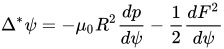
where is the poloidal flux function, is the plasma pressure profile, is the toroidal field function, and is the Grad-Shafranov operator.

Atomic Dissociation & Reconstruction

The core MSAART process involves using the high energy density of plasmoids to perform low-energy atomic transmutations (LEAT) — also referred to as "cold fusion" or LENR (Low Energy Nuclear Reactions):

  • CO₂ exhaust molecules are dissociated:
  • CO molecules are dissociated:
  • NOₓ molecules are broken:
  • Liberated oxygen is returned to the exhaust stream (explaining the observed increase in O₂ levels)
  • Liberated carbon may undergo further reconstruction into other elements per Bendall's "Alpha and Omega Ladder" — a stepwise atomic reconstruction sequence

This is described in Bendall's Part 08 of 20: "Plasmoid enabled by ZP assimilation Low Energy Atomic Transmutations (LEAT) and old fusion elemental transformation."

Certified Test Results

The Thunderstorm Generator has been tested by Element (global TIC service provider, London, UK) and independently by Clearwater, USA:

Element Labs (Dartford, UK) — Honda 5500 CL Generator

Before/After Emissions — Honda 5500 CL with Thunderstorm Generator
Gas Before (Baseline) After (TSG Active) % Reduction
CO₂ Standard levels Near zero >95%
CO Standard levels Safe levels >90%
NOₓ Standard levels Near zero >90%
O₂ Depleted (as expected in exhaust) Near atmospheric (~20.9%) Oxygen restored

Plasmoid Power Self-Certified Test (Test #13)

Test conducted on a 5,500 W portable gasoline generator with 2,200 W load:

  • Thunderstorm Generator activated after exhaust reached 260 °C operating temperature
  • Results stabilized after 3–4 minutes (time for plasmoid population to build)
  • CO₂, CO, and NOₓ emissions were "almost eliminated"
  • O₂ levels increased to near atmospheric levels
  • Hydrocarbon readings showed some inconsistency, possibly due to generator running at only 40% capacity
  • Very low standard deviation across 4 stable runs — highly consistent performance

Open-Source Documentation

Malcolm Bendall's complete 20-part technical notes (Draft #518,400 B KMV) are freely available via the Strike Foundation:

Part Title
01 Applications for a Plasmoid's Form and Functions
02 MSAART EVO System for Engines (Schematic & Photos)
03 Plasmoid System Description, Schematic & Photos
04 Virtual Plasmoid Implosive Turbine, Plasmoid Gun & Quadrature Assembly
05 Solomon's Molten Sea Lens (Terra Tek Leachate Results)
06 MSAART System Applied to a New Car
07 MSAART Atomic Octave Resonant Chamber Shockwave Generator
08 Plasmoid-enabled ZP Assimilation LEAT & Elemental Transformation
09 MSAART System for Waste Energy Recovery from ICE
10 Plasmoid ZP Enabled Elemental Dissociation, Assimilation, Transformation & Transmutation
11 Charge Separation and Amplification
12 Radiator Plasmoid System for 2005 Ford Fairlane Futura
13 Solomon's Molten Sea Lens Plasmoid Generator & Arc Charger
14 Vesica Piscis
15 Alien Maths and Chemistry
16 Octave Model of the Elements & Elemental Plasmoid Calculations
17–20 Solomon's Molten Sea Ark Atomic Reconstruction Technology (Torus Vajra MSAART)

Supporting research cited by the Strike Foundation includes: Bostick (1958) on plasmoid experimental study, Ken Shoulders (1987–2009) on EVOs, Fleischmann & Pons (1989) on electrochemically induced fusion, Gharib et al. (2017) on hydrodynamic plasmoid generation, and Jaitner (2020) on condensed plasmoid physics and LENR.

Atmospheric Electricity Generators

The second definition of "Thunderstorm Generator" refers to devices that harvest energy from the atmospheric potential gradient — the natural voltage difference between the Earth's surface and the upper atmosphere.

The Global Electric Circuit

The Earth maintains a global electric field of approximately:

This corresponds to a potential difference of approximately 300,000–400,000 volts between the Earth's surface and the ionosphere (~60 km altitude). The total current flowing in the global circuit is approximately:

This represents a continuous power source of approximately:

Thunderstorms act as the "batteries" of this circuit, maintaining the charge separation through convective charge transport.

Tesla's Radiant Energy Apparatus (US 685,957, 1901)

Nikola Tesla's patent describes a device for collecting "radiant energy" — which Tesla understood to include cosmic rays, ultraviolet radiation, and cathode-ray-like particle streams from the sun and space:

Construction

  • Elevated conducting plate: Insulated, polished metal plate exposed to the sky — acts as a collector of atmospheric charge
  • Ground connection: The opposite terminal is connected to Earth, which Tesla described as "a vast reservoir of negative electricity"
  • Condenser: A high-quality mica dielectric capacitor (per Tesla patent 577,671) stores the accumulated charge
  • Circuit controller: When the condenser reaches a threshold voltage, a switching device discharges it through a load (motor, lamp, or other device)

Tesla wrote: "The source of energy is the sun's rays... the sun, as well as other sources of radiant energy, throw off minute particles of matter which are strongly electrified, and which, impinging upon the plate, communicate an electrical charge."

Physics

The current collected by an elevated plate antenna:

where is the atmospheric conductivity (~10⁻¹⁴ S/m at ground level, increasing with altitude), is the local electric field, and is the effective collecting area.

For a plate at height above ground:

Thus a collector at 300 m altitude would see approximately 30,000 V potential difference with ground.

Plauson's Atmospheric Converter (US 1,540,998, 1925)

Hermann Plauson's comprehensive patent describes an engineered system for large-scale atmospheric electricity harvesting:

Key Innovations

  • Metallic balloon collectors — lightweight aluminum-magnesium alloy (magnalium, specific gravity 1.8), 0.1–0.2 mm thick, filled with hydrogen or helium
  • Radioactive ionization enhancement — small quantities of polonium, ionium, or mesothorium applied to balloon surfaces to increase local ionization and charge collection
  • Spark gap oscillation circuit — converts high-voltage DC from atmospheric charge into high-frequency electromagnetic oscillations for practical use
  • Safety electromagnet (choke) — protects equipment from lightning strikes and voltage surges
  • Condenser batteries — store harvested energy; cooled in liquefied gases for large installations
  • Unipolar connection — connecting condenser batteries by only one pole to the collector network, increasing working voltage from ~400 V to >500 V

Circuit Operation

Static atmospheric charge → spark gap discharge → RLC oscillation circuit → high-frequency AC:

where is the inductance of the primary coil and is the total capacitance of the condenser batteries. The high-frequency output could drive specialized resonance motors or be converted to standard AC/DC.

Plauson scaled his designs from single-balloon collectors (300 m altitude, ~40,000 V) to networks of interconnected collector rings spanning entire regions, with condenser equalization systems to handle voltage variations between stations.

The Gray Motor (US 4,595,975, 1986)

Edwin V. Gray Sr.'s "Efficient Power Supply" demonstrates a principle relevant to both Thunderstorm Generator variants — back-EMF energy recovery:

  • A conversion switching element tube with high-voltage anode, low-voltage anode, and electrostatic grids captures energy from collapsing inductive fields
  • The back-EMF (counter-electromotive force) from inductive loads is stored in a secondary capacitor and returned to the battery system
  • This energy recycling principle is fundamental to the efficiency claims of both MSAART systems (which recycle exhaust energy) and atmospheric harvesters (which must efficiently store intermittent charge)

Integration with FusionGirl Systems

In the FusionGirl universe, Thunderstorm Generator technology is central to the Plasmoid Tech ecosystem:

See Also

External References

  • Bendall, Malcolm. "Draft #518,400 B KMV — MSAART Notes Parts 1–20." Strike Foundation (2022). Available: https://www.strikefoundation.earth/open-source-research
  • Plasmoid Power Co. Ltd. "Certified Test Results." Available: https://plasmoid-power.com/test-results
  • Tesla, Nikola. "Apparatus for the utilization of radiant energy." US Patent 685,957 (1901).
  • Plauson, Hermann. "Conversion of atmospheric electric energy." US Patent 1,540,998 (1925).
  • Gray, Edwin V. Sr. "Efficient power supply suitable for inductive loads." US Patent 4,595,975 (1986).
  • Bostick, Winston H. "Experimental Study of Plasmoids." UC Berkeley Radiation Laboratory (1958).
  • Shoulders, Ken. "EV — A Tale of Discovery." Jupiter Technologies (1987).
  • Gharib, M. et al. "Toroidal plasmoid generation via extreme hydrodynamic shear." PNAS (2017).
  • Jaitner, Lutz. "The Physics of Condensed Plasmoids and Low-Energy Nuclear Reactions." condensed-plasmoids.com (2020).