Psionics: Difference between revisions
(Remove TechNav from Psionics — science page, not a Tech page [Mecha Jono]) |
|||
| (26 intermediate revisions by the same user not shown) | |||
| Line 1: | Line 1: | ||
= | = Psionics = | ||
'''Psionics''' (from ''[[Psychic|psychic]]'' + ''[[Electronics|electronics]]'') is the science and technology of [[Psi Energy|psi phenomena]] — the intersection of consciousness, electromagnetic biology, and scalar field theory. In the [[Natra|Natura]] universe, psionics is both a natural phenomenon governed by rigorous equations and a technology domain explored through [[Psi Tech]]. | |||
[[ | ''See also: [[Psychotronics]] (https://grokipedia.com/page/Psychotronics)'' | ||
* [[Psyche]] is the intersection between [[Spirit]] ''([[Experience]])'' and [[Mind]] ''([[Intelligence]])'' | |||
* [[ | * [[Psi]] · [[Sonic]] · [[Air Pressure]] | ||
* [[Psi | |||
= | == Related Pages == | ||
== | |||
'''Psi Field''' is a field or medium that facilitates psychic phenomena. It is analogous to physical fields such as the electromagnetic field or gravitational field but operates according to different principles associated with psi abilities. | {| class="wikitable" style="width:100%;" | ||
! Category !! Pages | |||
|- | |||
| '''Core Concepts''' || [[Psi Energy]] · [[Psi Field]] · [[Psi Energy Density Scalar Field]] · [[Psi Flow]] | |||
|- | |||
| '''Technology''' || [[Psi Tech]] · [[Psi Emitters]] · [[PsiNet]] · [[PsiSys]] · [[HelmKit]] | |||
|- | |||
| '''Operations''' || [[Psi-Ops]] · [[Psychotronics]] · [[Psionic Resonance Uplink]] · [[Psi Stabilizers]] | |||
|- | |||
| '''Theory''' || [[Scientific Foundations of Psionics]] · [[Psychic]] · [[Collective Consciousness]] | |||
|} | |||
== Psi Energy == | |||
{{main|Psi Energy}} | |||
'''[[Psi Energy]]''' refers to the energy associated with psychic phenomena or psi abilities. It encompasses the energy involved in telepathy, clairvoyance, psychokinesis, and other psi phenomena. Conceptually, Psi Energy is distinct from conventional forms of energy described in physics, such as electromagnetic energy or kinetic energy. | |||
=== Psi Field === | |||
{{main|Psi Field}} | |||
The '''[[Psi Field]]''' is a field or medium that facilitates psychic phenomena. It is analogous to physical fields such as the electromagnetic field or gravitational field but operates according to different principles associated with psi abilities. The Psi Field permeates all of existence and interacts with consciousness to produce psychic experiences. It transmits information or energy related to thoughts, emotions, intentions, and perceptions between individuals or across space and time. | |||
=== Psi Energy Density Scalar Field === | |||
{{main|Psi Energy Density Scalar Field}} | |||
The '''[[Psi Energy Density Scalar Field]]''' is a scalar field that quantifies the density of Psi Energy at each point in space and time. It represents the concentration of Psi Energy throughout the universe, analogous to physical fields such as the electric field or temperature field. Mathematically, it assigns a numerical value to each point in spacetime, representing the amount of Psi Energy present at that location and time. | |||
== Psionic Equations == | |||
= | The psionic equation framework spans three levels of description, from the everyday-scale non-relativistic limit through full 4D covariant theory to the fundamental 5D scalar-tensor parent theory. | ||
=== Non-Relativistic Limit (3+1) — Intuitive Entry Point === | |||
These equations describe everyday-scale psionics in the weak-field, slow-motion regime — the easiest place to start building intuition. They are the exact non-relativistic limit of the full theory below. | These equations describe everyday-scale psionics in the weak-field, slow-motion regime — the easiest place to start building intuition. They are the exact non-relativistic limit of the full theory below. | ||
==== Psionic Poisson/Yukawa Equation ==== | |||
:<math>\nabla^2 \psi - m^2 \psi = -4\pi G_\psi \rho_\psi</math> | |||
{| class="wikitable" | |||
! Symbol !! Meaning | |||
|- | |||
| <math>\psi</math> || Psionic scalar potential | |||
|- | |||
| <math>m</math> || Psionic field mass (m ≈ 0 → infinite range; m > 0 → short-range Yukawa screening) | |||
|- | |||
| <math>\rho_\psi</math> || Source density (coherent neural activity, focused intent, or technological emitter) | |||
|- | |||
| <math>G_\psi</math> || Psionic coupling constant | |||
|} | |||
For m = 0 this becomes identical to the Poisson equation of Newtonian gravity or electrostatics. | |||
'''Point-source solution:''' <math>\psi(r) = -\frac{G_\psi M_\psi}{r} e^{-m r}</math> | |||
Historical note: identical form to Yukawa's 1935 meson potential for the strong nuclear force. | |||
==== Psionic Force on a Test Particle ==== | |||
:<math>\vec{F}_\psi = -p \nabla \psi</math> | |||
* <math>p</math> = psionic charge (positive = repels high-ψ regions → defensive shield; negative = attracts → telekinetic pull) | |||
* For a point source with m = 0, force law is exactly Coulomb/Newtonian but scalar-mediated. | |||
==== Psionic Energy Density (non-relativistic) ==== | |||
:<math>\rho_\psi = \frac{1}{2} (\nabla \psi)^2 + \frac{1}{2} m^2 \psi^2</math> | |||
* First term = gradient (kinetic) energy, second term = mass/rest energy of the field. | |||
* Total field energy in a volume: <math>E = \int \rho_\psi \, dV</math> | |||
=== Relativistic 4D Effective Theory === | |||
Full covariant equations after compactification of the fifth dimension. These are the direct 4D descendants of the 5D parent theory. | Full covariant equations after compactification of the fifth dimension. These are the direct 4D descendants of the 5D parent theory. | ||
==== Psionic Scalar Field Equation (4D) ==== | |||
:<math>\Box \psi - m^2 \psi - \lambda \psi^3 = \alpha F_{\mu\nu} F^{\mu\nu} + J_\psi</math> | |||
{| class="wikitable" | |||
! Term !! Meaning | |||
|- | |||
| <math>\Box = \partial_\mu \partial^\mu</math> || Wave operator → psionic disturbances propagate at light speed | |||
|- | |||
| <math>\lambda \psi^3</math> || Stabilising quartic self-interaction (λ > 0 prevents runaway collapse) | |||
|- | |||
| <math>\alpha F_{\mu\nu} F^{\mu\nu}</math> || Direct coupling to electromagnetic energy density (brain waves can source ψ) | |||
|- | |||
| <math>J_\psi</math> || Explicit psionic current (biological or technological driver) | |||
|} | |||
In vacuum with m = λ = 0: <math>\Box \psi = 0</math> → pure massless waves | |||
==== Psionic Stress-Energy Tensor ==== | |||
:<math>T_{\mu\nu}^\psi = \partial_\mu \psi \partial_\nu \psi - g_{\mu\nu} \left[ \frac{1}{2} \partial^\rho \psi \partial_\rho \psi + \frac{m^2}{2} \psi^2 + \frac{\lambda}{4} \psi^4 \right]</math> | |||
{| class="wikitable" | {| class="wikitable" | ||
! Term !! Physical | ! Term !! Physical Meaning | ||
|- | |- | ||
| <math>\partial_\mu \psi \partial_\nu \psi</math> || Momentum flux of the psionic field | | <math>\partial_\mu \psi \partial_\nu \psi</math> || Momentum flux of the psionic field | ||
|- | |- | ||
| <math>-g_{\mu\nu} [\ldots]</math> || Isotropic pressure and energy density | | <math>-g_{\mu\nu} [\ldots]</math> || Isotropic pressure and energy density | ||
|} | |} | ||
==== Modified Einstein Equations (Jordan frame) ==== | |||
:<math>G_{\mu\nu} = 8\pi G \left( T_{\mu\nu}^{\text{matter}} + T_{\mu\nu}^{\text{EM}} + T_{\mu\nu}^\psi \right)</math> | |||
Psionic field directly curves spacetime → strong sustained ψ gradients produce measurable gravity-like effects. | |||
==== Geodesic Equation with Psionic Fifth Force ==== | |||
:<math>\frac{D^2 x^\mu}{d\tau^2} = q F^\mu{}_\nu \frac{dx^\nu}{d\tau} + p \partial^\mu \psi</math> | |||
* The term <math>p \partial^\mu \psi</math> is the additional acceleration felt by any object with non-zero psionic charge. | |||
* For ordinary matter p ≈ 0; for biologically or technologically "tuned" objects p can be large. | |||
=== Parent 5D Scalar-Tensor Theory === | |||
The deepest, most rigorous level — the actual higher-dimensional origin of all equations above. | The deepest, most rigorous level — the actual higher-dimensional origin of all equations above. | ||
==== 5D Psionic Scalar Equation ==== | |||
:<math>\tilde{\Box} \psi - m^2 \psi - \lambda \psi^3 = -\frac{\kappa}{4} e^{k \psi} \tilde{F}_{MN} \tilde{F}^{MN} + J_\psi</math> | |||
<math>e^{k \psi}</math> makes the effective fine-structure constant ψ-dependent → psionics can locally change electromagnetic coupling. | |||
==== 5D Einstein Equations ==== | |||
:<math>\tilde{R}_{MN} - \frac{1}{2} \tilde{g}_{MN} \tilde{R} = T_{MN}^\psi + e^{k \psi} T_{MN}^{\text{EM}}</math> | |||
:<math>T_{MN}^\psi = \partial_M \psi \partial_N \psi - \tilde{g}_{MN} \left[ \frac{1}{2} \partial_P \psi \partial^P \psi + \frac{m^2}{2} \psi^2 + \frac{\lambda}{4} \psi^4 \right]</math> | |||
==== Kaluza-Klein Metric Ansatz ==== | |||
:<math>ds^2 = g_{\mu\nu} dx^\mu dx^\nu + \phi^2 (dx^5 + A_\mu dx^\mu)^2</math> | |||
Original 1919–1926 idea by Theodor Kaluza and Oskar Klein: the fifth dimension is compactified to a tiny circle, giving rise to electromagnetism from pure geometry. In our extension, ψ lives in the full 5D spacetime and modulates both the size of the circle (ϕ) and the effective gauge coupling. | |||
=== Derived Static & Equilibrium Limits === | |||
{| class="wikitable" style="width:100%;" | |||
! Regime !! Equation !! Notes | |||
|- | |||
| '''Massless static (harmonic)''' || <math>\nabla^2 \psi = 0</math> || Long-range psionic fields behave like gravitational/electric potentials | |||
|- | |||
| '''Massive static (screened)''' || <math>\nabla^2 \psi - m^2 \psi = -4\pi G_\psi \rho_\psi</math> || Range ≈ 1/m; e.g. m ∼ 10⁻³ eV/c² → km-scale effects | |||
|- | |||
| '''Continuity (energy flow)''' || <math>\frac{\partial \rho_\psi}{\partial t} + \nabla \cdot (\rho_\psi \vec{v}) = J_\psi</math> || J_ψ > 0 = generation; J_ψ < 0 = dissipation | |||
|} | |||
== Quick Reference Table == | === Quick Reference Table === | ||
{| class="wikitable" | {| class="wikitable" style="width:100%;" | ||
! Regime !! Key Equation !! Typical Psionic Phenomenon | ! Regime !! Key Equation !! Typical Psionic Phenomenon | ||
|- | |- | ||
| Line 118: | Line 176: | ||
|} | |} | ||
= | == Legitimate Extensions == | ||
The following are direct, exact consequences or useful rewrites of the core equations — not new fundamental equations. | |||
=== | === Psi Wave Propagation === | ||
:<math>\Box \psi - m^2 \psi - \lambda \psi^3 = J_\psi + \alpha F_{\mu\nu}F^{\mu\nu}</math> | |||
<math>\ | |||
In vacuum (J_ψ = 0, F = 0, m = 0, λ ≈ 0): <math>\Box \psi = 0</math> → psi disturbances travel exactly at light speed → legitimate basis for telepathy/precognition models respecting relativity. | |||
=== Psi Energy Flux (Scalar Poynting Vector) === | |||
= | :<math>\vec{S}_\psi = - \partial_t \psi \, \nabla \psi</math> (non-relativistic) | ||
:<math>T^{0i}_\psi = -\partial_t \psi \, \partial^i \psi</math> (relativistic energy-flow vector) | |||
This is the exact analogue of the electromagnetic Poynting vector for a scalar field. | |||
=== | === Information & Entropy === | ||
:<math>S = -\mathrm{Tr}(\hat\rho \ln \hat\rho)</math> | |||
<math>\ | |||
Coarse-grained field entropy directly connects psi configurations to information content. | |||
=== Psi | === Neural-Psi Coupling (Wilson-Cowan + Scalar Drive) === | ||
:<math>\tau \frac{\partial u}{\partial t} = -u + \int W(x-x') f(u(x',t)) dx' + \beta \, \psi(x,t)</math> | |||
<math> | |||
Where β ψ(x,t) is the back-reaction of the psionic scalar onto neural firing rate, and the brain sources ψ via: | |||
:<math>J_\psi(x,t) \propto \int f(u(x',t)) \, dx'</math> | |||
→ closed, bidirectional, mathematically clean loop between brain dynamics and the scalar field. | |||
=== | === Maxwell-like Aesthetic (Emergent) === | ||
In the deep non-relativistic, static, massless limit: | |||
= | :<math>\nabla \cdot (-\nabla \psi) = \rho_\psi</math> | ||
= | With <math>\vec{E}_\text{eff} \equiv -\nabla\psi</math> and Poynting analogue <math>\vec{S}_\psi = \partial_t \psi \, \vec{E}_\text{eff}</math>. | ||
The old "Psi-Maxwell" concept becomes a legitimate low-energy effective description — a rewrite, not a new field. | |||
=== | === Consciousness as Modulator === | ||
Consciousness never appears as a new variable. Instead it acts in two rigorously allowed ways: | |||
# '''Coherent neural firing patterns''' determine the spatial/temporal shape of J_ψ and α F² terms. | |||
# '''Focused attention''' can sustain large-amplitude, long-coherence-time ψ solitons via the λ ψ³ nonlinearity — the mathematical basis for "trained" vs "untrained" practitioners. | |||
== How Psionic Abilities Emerge == | |||
Every classic psionic discipline is a direct, mathematically exact consequence of the core equations. | |||
=== | {| class="wikitable" style="width:100%;" | ||
! Ability !! Governing Equation(s) !! Key Parameter(s) !! Training Direction | |||
|- | |||
| '''Telepathy''' || <math>\Box \psi = J_\psi</math> || Coherence time of J_ψ || Increase signal-to-noise | |||
|- | |||
| '''Telekinesis/PK''' || <math>\vec{F}_\psi = -p \nabla\psi</math> || Magnitude of ∇ψ, value of p || Intensify local gradients | |||
|- | |||
| '''Shielding''' || Yukawa with tunable m || Effective mass m || Raise m (tighter shield) | |||
|- | |||
| '''Precognition''' || Advanced + retarded solutions || Boundary condition choice || Develop absorptive state | |||
|- | |||
| '''Energy Work''' || <math>\vec{S}_\psi = -\dot\psi \nabla\psi</math> || Rate of change of ψ || Sustain steep gradients | |||
|- | |||
| '''Group Rituals''' || –λ ψ³ nonlinearity || Number N and phase alignment || Perfect synchronisation | |||
|} | |||
=== Telepathy & Remote Sensing === | |||
:<math>\Box \psi = J_\psi \quad \text{(massless, vacuum limit)}</math> | |||
A focused mind (J_ψ) launches a scalar disturbance that propagates at c and is felt by any receiver with non-zero psionic charge p. Range is effectively unlimited in the m ≈ 0 case; signal strength falls as 1/r. | |||
=== Telekinesis & Psychokinesis === | |||
= | :<math>\vec{F}_\psi = -p \nabla\psi</math> | ||
Objects with induced or inherent p experience a force proportional to the local psi gradient. Macroscopic effects require either very large ∇ψ or collective coherence of many practitioners. | |||
=== Personal & Group Shielding === | |||
:<math>\nabla^2 \psi - m^2 \psi = -4\pi G_\psi \rho_\psi</math> → <math>\psi(r) \propto \frac{e^{-m r}}{r}</math> | |||
A sustained high-ψ region naturally excludes incoming psi disturbances beyond distance ~1/m. Advanced practitioners exhibit larger effective m (tighter, stronger shields). | |||
=== Precognition & Retro-PK === | |||
The homogeneous wave equation admits both retarded (normal future influence) and advanced (past-directed) solutions. Wheeler–Feynman-style boundary conditions permit mathematically consistent retrocausal influence. Requires macroscopic quantum-coherent ψ states. | |||
=== Energy Flow & "Charging" === | |||
= | :<math>\vec{S}_\psi = -\partial_t \psi \, \nabla \psi</math> | ||
Shows the directional flow of psionic energy; practitioners feel this as "raising energy" or "drawing from the environment". | |||
=== Neural-Psionic Feedback Loop === | |||
Brain → <math>J_\psi \propto \text{coherent firing}</math> → emits ψ | |||
ψ → <math>\tau \dot u = -u + \cdots + \beta \psi</math> → modulates firing | |||
<math> | This closed loop is the mathematical basis for all biofeedback, trance, and psi training protocols. | ||
=== Collective Amplification & Resonance === | |||
When N aligned practitioners produce ψ_total ≈ N ψ_individual in the same region, the self-interaction term grows as N³ → explosive gain. | |||
''This is the only rigorously allowed mechanism for "group mind" or "circle" effects.'' | |||
== Bridges to Established Science == | |||
{| class="wikitable" style="width:100%;" | |||
! Discipline !! Relevant Object/Equation !! Role in Psionics | |||
|- | |||
| '''Neuroscience / EEG/MEG''' || Cortical F² → J_ψ and α F² terms || Primary biological source | |||
|- | |||
| '''Orch-OR''' || Coherent microtubule GHz oscillations || Possible high-efficiency J_ψ emitter | |||
|- | |||
| '''Quantum Field Theory''' || Klein-Gordon (□ + m²)ψ = 0 || Exact propagation law | |||
|- | |||
| '''Information Theory''' || Phase-space volume of ψ configurations || Rigorous information capacity of psi signals | |||
|- | |||
| '''Nonlinear Dynamics''' || λ ψ³ self-interaction || Chaos, solitons, training amplification | |||
|- | |||
| '''Statistics''' || Standard hypothesis testing on known wave equation || How to prove/disprove psi experimentally | |||
|} | |||
=== | === Fundamental Wave Equations === | ||
'''Klein–Gordon (vacuum propagation):''' | |||
<math> | :<math>(\Box + m^2)\psi = 0</math> | ||
Exact propagation law for the psionic scalar in flat spacetime. Identical equation governs the Higgs field and inflaton. Massless case: psi waves travel at exactly c. Massive case: exponential screening. | |||
'''Non-relativistic Schrödinger-like limit:''' | |||
<math>\ | :<math>i\hbar \dot\psi = -\frac{\hbar^2}{2m_\text{eff}}\nabla^2\psi + \frac{\lambda}{4}\psi^4</math> | ||
Emerges when ψ varies slowly compared to c. The λ ψ⁴ term supports stable solitons ("thought-forms") and travelling psi pulses that keep their shape. | |||
=== | === Effective "Psi-Electromagnetism" === | ||
:<math>\nabla \cdot \mathbf{E}_\text{eff} = \rho_\psi, \quad \mathbf{E}_\text{eff} \equiv -\nabla\psi</math> | |||
<math> | |||
Poynting analogue: <math>\mathbf{S}_\psi = -\dot\psi\,\mathbf{E}_\text{eff}</math> | |||
<math> | |||
This is the scalar ψ rewritten in the familiar language of electrostatics — not a new field. Practitioners recognise |E_eff| as felt "pressure" during psychokinesis. | |||
== | === Neural-Psi Closed Loop === | ||
:<math>\tau \dot u = -u + W\ast f(u) + \beta\psi, \qquad J_\psi = \kappa \int f(u)\,dV</math> | |||
<math>\ | |||
= | The only mathematically legitimate brain–psi interface. βψ = direct "sixth-sense" input into cortical columns. Positive feedback: trance, kundalini, shamanic ecstasy states. | ||
=== | === Information & Entropy of Psi Signals === | ||
Maximum information in a psi pulse: | |||
<math>\ | :<math>I \lesssim \frac{1}{2}\ln\left(1 + \frac{\psi_0^2 V}{\hbar\tau}\right)</math> | ||
A single clear telepathic image carries ≈ 100–1000 bits. Global meditation events can raise Φ of the planetary psi field above that of any individual brain. | |||
=== | === Chaos and Self-Sustained States === | ||
Strong-field chaos: <math>\dot\psi \propto -\lambda \psi^3</math> | |||
<math>\ | |||
Van der Pol–like limit cycles for trained practitioners' sustained fields. Group rituals = coupled oscillators → rapid synchronisation → order-of-magnitude ψ amplification. | |||
=== | === Statistical Analysis of Psi Data === | ||
= | Standard Bayesian inference on H₀: ψ = 0 versus H₁: ψ obeys the equations above. No special "psi statistics" required. Effect size should be quoted in natural ψ₀ units. | ||
=== | == Evidence Base == | ||
The Psionics framework is supported by peer-reviewed science and declassified government research: | |||
=== | === Peer-Reviewed Science === | ||
< | * '''Biophotonics:''' Living tissue emits ultra-weak photons (UPE) correlated with neural activity (Mould et al. 2024<ref name="mould2024">Mould S, et al. (2024). "Ultra weak photon emission — a brief review." ''Frontiers in Physiology'', 15, 1348915.</ref>; Dotta et al. 2012<ref name="dotta2012">Dotta BT, Saroka KS, Persinger MA (2012). "Increased photon emission from the head while imagining light in the dark is correlated with changes in electroencephalographic power." ''Neuroscience Letters'', 513(2), 151–154. PMID: 22343311</ref>) | ||
* | * '''Microtubule quantum biology:''' Superradiance demonstrated in neural cytoskeleton (Celardo et al. 2019<ref name="celardo2019">Celardo GL, et al. (2019). "On the existence of superradiant excitonic states in microtubules." ''New Journal of Physics'', 21(2), 023005.</ref>) | ||
* | * '''Neural optics:''' Myelinated axons function as biophoton waveguides (Zarkeshian et al. 2018<ref name="zarkeshian2018">Zarkeshian P, et al. (2018). "Are there optical communication channels in the brain?" ''Frontiers in Bioscience'' (Landmark Ed), 23, 1407–1421. PMID: 29293442</ref>) | ||
* | * '''Biomagnetism:''' Brain magnetic fields routinely measured by SQUID/MEG (Roth 2023<ref name="roth2023">Roth BJ (2023). "Biomagnetism: The First Sixty Years." ''Sensors'', 23(9), 4218. PMID: 37177427</ref>) | ||
=== | === Declassified Government Programs === | ||
* '''CIA Stargate (1972–1995):''' 23-year, $20M+ program at SRI International; meta-analysis found statistically significant results (effect size d ≈ 0.20, p < 10⁻²⁰)<ref name="utts1996">Utts J (1996). "An Assessment of the Evidence for Psychic Functioning." ''Journal of Scientific Exploration'', 10(1), 3–30.</ref> | |||
* | * '''CIA CREST Archive:''' Full Stargate collection declassified January 2017<ref name="ciacrest">CIA CREST Archive (2017). Stargate Collection. cia.gov/readingroom/collection/stargate</ref> | ||
* '''Edwin May Archive:''' Stargate PI's personal archive donated to Rice University (2021) | |||
* | |||
== | === Patented Technology === | ||
* '''US Patent 3,951,134 (1976):''' Remote brain wave monitoring and alteration via RF modulation<ref name="patent1976">Malech RG (1976). "Apparatus and method for remotely monitoring and altering brain waves." US Patent 3,951,134.</ref> | |||
< | * '''US Patent 6,011,991 (2000):''' Communication system and method including brain wave analysis<ref name="patent2000">Mardirossian A (2000). "Communication system and method including brain wave analysis and/or use of brain activity." US Patent 6,011,991.</ref> | ||
* | |||
See '''[[Scientific Foundations of Psionics]]''' for complete evidence review and bibliography. | |||
== | == See Also == | ||
* [[Psi Tech]] — Technology systems for psionic applications | |||
* | * [[Psi Field]] — The fundamental field underlying psionic phenomena | ||
* | * [[Psi Energy]] — Energy associated with psi abilities | ||
* | * [[Psi-Ops]] — Operational psionic programs | ||
* [[Psychotronics]] — Applied psychic electronics | |||
* [[Collective Consciousness]] — Group-scale psionic coherence | |||
* [[Technology]] — The Technology Tier System | |||
== References == | |||
<references /> | |||
[[Category:Psionics]] | |||
[[Category:Technology]] | |||
[[Category:Universal Language]] | |||
Latest revision as of 16:31, 15 March 2026
Psionics
Psionics (from psychic + electronics) is the science and technology of psi phenomena — the intersection of consciousness, electromagnetic biology, and scalar field theory. In the Natura universe, psionics is both a natural phenomenon governed by rigorous equations and a technology domain explored through Psi Tech.
See also: Psychotronics (https://grokipedia.com/page/Psychotronics)
- Psyche is the intersection between Spirit (Experience) and Mind (Intelligence)
- Psi · Sonic · Air Pressure
Related Pages
| Category | Pages |
|---|---|
| Core Concepts | Psi Energy · Psi Field · Psi Energy Density Scalar Field · Psi Flow |
| Technology | Psi Tech · Psi Emitters · PsiNet · PsiSys · HelmKit |
| Operations | Psi-Ops · Psychotronics · Psionic Resonance Uplink · Psi Stabilizers |
| Theory | Scientific Foundations of Psionics · Psychic · Collective Consciousness |
Psi Energy
Main article: Psi Energy
Psi Energy refers to the energy associated with psychic phenomena or psi abilities. It encompasses the energy involved in telepathy, clairvoyance, psychokinesis, and other psi phenomena. Conceptually, Psi Energy is distinct from conventional forms of energy described in physics, such as electromagnetic energy or kinetic energy.
Psi Field
Main article: Psi Field
The Psi Field is a field or medium that facilitates psychic phenomena. It is analogous to physical fields such as the electromagnetic field or gravitational field but operates according to different principles associated with psi abilities. The Psi Field permeates all of existence and interacts with consciousness to produce psychic experiences. It transmits information or energy related to thoughts, emotions, intentions, and perceptions between individuals or across space and time.
Psi Energy Density Scalar Field
Main article: Psi Energy Density Scalar Field
The Psi Energy Density Scalar Field is a scalar field that quantifies the density of Psi Energy at each point in space and time. It represents the concentration of Psi Energy throughout the universe, analogous to physical fields such as the electric field or temperature field. Mathematically, it assigns a numerical value to each point in spacetime, representing the amount of Psi Energy present at that location and time.
Psionic Equations
The psionic equation framework spans three levels of description, from the everyday-scale non-relativistic limit through full 4D covariant theory to the fundamental 5D scalar-tensor parent theory.
Non-Relativistic Limit (3+1) — Intuitive Entry Point
These equations describe everyday-scale psionics in the weak-field, slow-motion regime — the easiest place to start building intuition. They are the exact non-relativistic limit of the full theory below.
Psionic Poisson/Yukawa Equation
- Failed to parse (SVG (MathML can be enabled via browser plugin): Invalid response ("Math extension cannot connect to Restbase.") from server "https://wikimedia.org/api/rest_v1/":): {\displaystyle \nabla^2 \psi - m^2 \psi = -4\pi G_\psi \rho_\psi}
| Symbol | Meaning |
|---|---|
| Failed to parse (SVG (MathML can be enabled via browser plugin): Invalid response ("Math extension cannot connect to Restbase.") from server "https://wikimedia.org/api/rest_v1/":): {\displaystyle \psi} | Psionic scalar potential |
| Failed to parse (SVG (MathML can be enabled via browser plugin): Invalid response ("Math extension cannot connect to Restbase.") from server "https://wikimedia.org/api/rest_v1/":): {\displaystyle m} | Psionic field mass (m ≈ 0 → infinite range; m > 0 → short-range Yukawa screening) |
| Failed to parse (SVG (MathML can be enabled via browser plugin): Invalid response ("Math extension cannot connect to Restbase.") from server "https://wikimedia.org/api/rest_v1/":): {\displaystyle \rho_\psi} | Source density (coherent neural activity, focused intent, or technological emitter) |
| Failed to parse (SVG (MathML can be enabled via browser plugin): Invalid response ("Math extension cannot connect to Restbase.") from server "https://wikimedia.org/api/rest_v1/":): {\displaystyle G_\psi} | Psionic coupling constant |
For m = 0 this becomes identical to the Poisson equation of Newtonian gravity or electrostatics.
Point-source solution: Failed to parse (SVG (MathML can be enabled via browser plugin): Invalid response ("Math extension cannot connect to Restbase.") from server "https://wikimedia.org/api/rest_v1/":): {\displaystyle \psi(r) = -\frac{G_\psi M_\psi}{r} e^{-m r}}
Historical note: identical form to Yukawa's 1935 meson potential for the strong nuclear force.
Psionic Force on a Test Particle
- Failed to parse (SVG (MathML can be enabled via browser plugin): Invalid response ("Math extension cannot connect to Restbase.") from server "https://wikimedia.org/api/rest_v1/":): {\displaystyle \vec{F}_\psi = -p \nabla \psi}
- Failed to parse (SVG (MathML can be enabled via browser plugin): Invalid response ("Math extension cannot connect to Restbase.") from server "https://wikimedia.org/api/rest_v1/":): {\displaystyle p} = psionic charge (positive = repels high-ψ regions → defensive shield; negative = attracts → telekinetic pull)
- For a point source with m = 0, force law is exactly Coulomb/Newtonian but scalar-mediated.
Psionic Energy Density (non-relativistic)
- Failed to parse (SVG (MathML can be enabled via browser plugin): Invalid response ("Math extension cannot connect to Restbase.") from server "https://wikimedia.org/api/rest_v1/":): {\displaystyle \rho_\psi = \frac{1}{2} (\nabla \psi)^2 + \frac{1}{2} m^2 \psi^2}
- First term = gradient (kinetic) energy, second term = mass/rest energy of the field.
- Total field energy in a volume: Failed to parse (SVG (MathML can be enabled via browser plugin): Invalid response ("Math extension cannot connect to Restbase.") from server "https://wikimedia.org/api/rest_v1/":): {\displaystyle E = \int \rho_\psi \, dV}
Relativistic 4D Effective Theory
Full covariant equations after compactification of the fifth dimension. These are the direct 4D descendants of the 5D parent theory.
Psionic Scalar Field Equation (4D)
- Failed to parse (SVG (MathML can be enabled via browser plugin): Invalid response ("Math extension cannot connect to Restbase.") from server "https://wikimedia.org/api/rest_v1/":): {\displaystyle \Box \psi - m^2 \psi - \lambda \psi^3 = \alpha F_{\mu\nu} F^{\mu\nu} + J_\psi}
| Term | Meaning |
|---|---|
| Failed to parse (SVG (MathML can be enabled via browser plugin): Invalid response ("Math extension cannot connect to Restbase.") from server "https://wikimedia.org/api/rest_v1/":): {\displaystyle \Box = \partial_\mu \partial^\mu} | Wave operator → psionic disturbances propagate at light speed |
| Failed to parse (SVG (MathML can be enabled via browser plugin): Invalid response ("Math extension cannot connect to Restbase.") from server "https://wikimedia.org/api/rest_v1/":): {\displaystyle \lambda \psi^3} | Stabilising quartic self-interaction (λ > 0 prevents runaway collapse) |
| Failed to parse (SVG (MathML can be enabled via browser plugin): Invalid response ("Math extension cannot connect to Restbase.") from server "https://wikimedia.org/api/rest_v1/":): {\displaystyle \alpha F_{\mu\nu} F^{\mu\nu}} | Direct coupling to electromagnetic energy density (brain waves can source ψ) |
| Failed to parse (SVG (MathML can be enabled via browser plugin): Invalid response ("Math extension cannot connect to Restbase.") from server "https://wikimedia.org/api/rest_v1/":): {\displaystyle J_\psi} | Explicit psionic current (biological or technological driver) |
In vacuum with m = λ = 0: Failed to parse (SVG (MathML can be enabled via browser plugin): Invalid response ("Math extension cannot connect to Restbase.") from server "https://wikimedia.org/api/rest_v1/":): {\displaystyle \Box \psi = 0} → pure massless waves
Psionic Stress-Energy Tensor
- Failed to parse (SVG (MathML can be enabled via browser plugin): Invalid response ("Math extension cannot connect to Restbase.") from server "https://wikimedia.org/api/rest_v1/":): {\displaystyle T_{\mu\nu}^\psi = \partial_\mu \psi \partial_\nu \psi - g_{\mu\nu} \left[ \frac{1}{2} \partial^\rho \psi \partial_\rho \psi + \frac{m^2}{2} \psi^2 + \frac{\lambda}{4} \psi^4 \right]}
| Term | Physical Meaning |
|---|---|
| Failed to parse (SVG (MathML can be enabled via browser plugin): Invalid response ("Math extension cannot connect to Restbase.") from server "https://wikimedia.org/api/rest_v1/":): {\displaystyle \partial_\mu \psi \partial_\nu \psi} | Momentum flux of the psionic field |
| Failed to parse (SVG (MathML can be enabled via browser plugin): Invalid response ("Math extension cannot connect to Restbase.") from server "https://wikimedia.org/api/rest_v1/":): {\displaystyle -g_{\mu\nu} [\ldots]} | Isotropic pressure and energy density |
Modified Einstein Equations (Jordan frame)
- Failed to parse (SVG (MathML can be enabled via browser plugin): Invalid response ("Math extension cannot connect to Restbase.") from server "https://wikimedia.org/api/rest_v1/":): {\displaystyle G_{\mu\nu} = 8\pi G \left( T_{\mu\nu}^{\text{matter}} + T_{\mu\nu}^{\text{EM}} + T_{\mu\nu}^\psi \right)}
Psionic field directly curves spacetime → strong sustained ψ gradients produce measurable gravity-like effects.
Geodesic Equation with Psionic Fifth Force
- Failed to parse (SVG (MathML can be enabled via browser plugin): Invalid response ("Math extension cannot connect to Restbase.") from server "https://wikimedia.org/api/rest_v1/":): {\displaystyle \frac{D^2 x^\mu}{d\tau^2} = q F^\mu{}_\nu \frac{dx^\nu}{d\tau} + p \partial^\mu \psi}
- The term Failed to parse (SVG (MathML can be enabled via browser plugin): Invalid response ("Math extension cannot connect to Restbase.") from server "https://wikimedia.org/api/rest_v1/":): {\displaystyle p \partial^\mu \psi} is the additional acceleration felt by any object with non-zero psionic charge.
- For ordinary matter p ≈ 0; for biologically or technologically "tuned" objects p can be large.
Parent 5D Scalar-Tensor Theory
The deepest, most rigorous level — the actual higher-dimensional origin of all equations above.
5D Psionic Scalar Equation
- Failed to parse (SVG (MathML can be enabled via browser plugin): Invalid response ("Math extension cannot connect to Restbase.") from server "https://wikimedia.org/api/rest_v1/":): {\displaystyle \tilde{\Box} \psi - m^2 \psi - \lambda \psi^3 = -\frac{\kappa}{4} e^{k \psi} \tilde{F}_{MN} \tilde{F}^{MN} + J_\psi}
Failed to parse (SVG (MathML can be enabled via browser plugin): Invalid response ("Math extension cannot connect to Restbase.") from server "https://wikimedia.org/api/rest_v1/":): {\displaystyle e^{k \psi}} makes the effective fine-structure constant ψ-dependent → psionics can locally change electromagnetic coupling.
5D Einstein Equations
- Failed to parse (SVG (MathML can be enabled via browser plugin): Invalid response ("Math extension cannot connect to Restbase.") from server "https://wikimedia.org/api/rest_v1/":): {\displaystyle \tilde{R}_{MN} - \frac{1}{2} \tilde{g}_{MN} \tilde{R} = T_{MN}^\psi + e^{k \psi} T_{MN}^{\text{EM}}}
- Failed to parse (SVG (MathML can be enabled via browser plugin): Invalid response ("Math extension cannot connect to Restbase.") from server "https://wikimedia.org/api/rest_v1/":): {\displaystyle T_{MN}^\psi = \partial_M \psi \partial_N \psi - \tilde{g}_{MN} \left[ \frac{1}{2} \partial_P \psi \partial^P \psi + \frac{m^2}{2} \psi^2 + \frac{\lambda}{4} \psi^4 \right]}
Kaluza-Klein Metric Ansatz
- Failed to parse (SVG (MathML can be enabled via browser plugin): Invalid response ("Math extension cannot connect to Restbase.") from server "https://wikimedia.org/api/rest_v1/":): {\displaystyle ds^2 = g_{\mu\nu} dx^\mu dx^\nu + \phi^2 (dx^5 + A_\mu dx^\mu)^2}
Original 1919–1926 idea by Theodor Kaluza and Oskar Klein: the fifth dimension is compactified to a tiny circle, giving rise to electromagnetism from pure geometry. In our extension, ψ lives in the full 5D spacetime and modulates both the size of the circle (ϕ) and the effective gauge coupling.
Derived Static & Equilibrium Limits
| Regime | Equation | Notes |
|---|---|---|
| Massless static (harmonic) | Failed to parse (SVG (MathML can be enabled via browser plugin): Invalid response ("Math extension cannot connect to Restbase.") from server "https://wikimedia.org/api/rest_v1/":): {\displaystyle \nabla^2 \psi = 0} | Long-range psionic fields behave like gravitational/electric potentials |
| Massive static (screened) | Failed to parse (SVG (MathML can be enabled via browser plugin): Invalid response ("Math extension cannot connect to Restbase.") from server "https://wikimedia.org/api/rest_v1/":): {\displaystyle \nabla^2 \psi - m^2 \psi = -4\pi G_\psi \rho_\psi} | Range ≈ 1/m; e.g. m ∼ 10⁻³ eV/c² → km-scale effects |
| Continuity (energy flow) | Failed to parse (SVG (MathML can be enabled via browser plugin): Invalid response ("Math extension cannot connect to Restbase.") from server "https://wikimedia.org/api/rest_v1/":): {\displaystyle \frac{\partial \rho_\psi}{\partial t} + \nabla \cdot (\rho_\psi \vec{v}) = J_\psi} | J_ψ > 0 = generation; J_ψ < 0 = dissipation |
Quick Reference Table
| Regime | Key Equation | Typical Psionic Phenomenon |
|---|---|---|
| Non-relativistic | Failed to parse (SVG (MathML can be enabled via browser plugin): Invalid response ("Math extension cannot connect to Restbase.") from server "https://wikimedia.org/api/rest_v1/":): {\displaystyle \vec{F}_\psi = -p \nabla \psi} | Telekinesis, psychokinetic push/pull |
| Relativistic 4D | Failed to parse (SVG (MathML can be enabled via browser plugin): Invalid response ("Math extension cannot connect to Restbase.") from server "https://wikimedia.org/api/rest_v1/":): {\displaystyle \Box \psi = J_\psi} (massless vacuum) | Telepathic wave transmission |
| 5D parent theory | Failed to parse (SVG (MathML can be enabled via browser plugin): Invalid response ("Math extension cannot connect to Restbase.") from server "https://wikimedia.org/api/rest_v1/":): {\displaystyle e^{k \psi}} coupling | Local modulation of physical constants by intent |
| Static massive | Yukawa screening | Personal energy shields with finite range |
Legitimate Extensions
The following are direct, exact consequences or useful rewrites of the core equations — not new fundamental equations.
Psi Wave Propagation
- Failed to parse (SVG (MathML can be enabled via browser plugin): Invalid response ("Math extension cannot connect to Restbase.") from server "https://wikimedia.org/api/rest_v1/":): {\displaystyle \Box \psi - m^2 \psi - \lambda \psi^3 = J_\psi + \alpha F_{\mu\nu}F^{\mu\nu}}
In vacuum (J_ψ = 0, F = 0, m = 0, λ ≈ 0): Failed to parse (SVG (MathML can be enabled via browser plugin): Invalid response ("Math extension cannot connect to Restbase.") from server "https://wikimedia.org/api/rest_v1/":): {\displaystyle \Box \psi = 0} → psi disturbances travel exactly at light speed → legitimate basis for telepathy/precognition models respecting relativity.
Psi Energy Flux (Scalar Poynting Vector)
- Failed to parse (SVG (MathML can be enabled via browser plugin): Invalid response ("Math extension cannot connect to Restbase.") from server "https://wikimedia.org/api/rest_v1/":): {\displaystyle \vec{S}_\psi = - \partial_t \psi \, \nabla \psi} (non-relativistic)
- Failed to parse (SVG (MathML can be enabled via browser plugin): Invalid response ("Math extension cannot connect to Restbase.") from server "https://wikimedia.org/api/rest_v1/":): {\displaystyle T^{0i}_\psi = -\partial_t \psi \, \partial^i \psi} (relativistic energy-flow vector)
This is the exact analogue of the electromagnetic Poynting vector for a scalar field.
Information & Entropy
- Failed to parse (SVG (MathML can be enabled via browser plugin): Invalid response ("Math extension cannot connect to Restbase.") from server "https://wikimedia.org/api/rest_v1/":): {\displaystyle S = -\mathrm{Tr}(\hat\rho \ln \hat\rho)}
Coarse-grained field entropy directly connects psi configurations to information content.
Neural-Psi Coupling (Wilson-Cowan + Scalar Drive)
- Failed to parse (SVG (MathML can be enabled via browser plugin): Invalid response ("Math extension cannot connect to Restbase.") from server "https://wikimedia.org/api/rest_v1/":): {\displaystyle \tau \frac{\partial u}{\partial t} = -u + \int W(x-x') f(u(x',t)) dx' + \beta \, \psi(x,t)}
Where β ψ(x,t) is the back-reaction of the psionic scalar onto neural firing rate, and the brain sources ψ via:
- Failed to parse (SVG (MathML can be enabled via browser plugin): Invalid response ("Math extension cannot connect to Restbase.") from server "https://wikimedia.org/api/rest_v1/":): {\displaystyle J_\psi(x,t) \propto \int f(u(x',t)) \, dx'}
→ closed, bidirectional, mathematically clean loop between brain dynamics and the scalar field.
Maxwell-like Aesthetic (Emergent)
In the deep non-relativistic, static, massless limit:
- Failed to parse (SVG (MathML can be enabled via browser plugin): Invalid response ("Math extension cannot connect to Restbase.") from server "https://wikimedia.org/api/rest_v1/":): {\displaystyle \nabla \cdot (-\nabla \psi) = \rho_\psi}
With Failed to parse (SVG (MathML can be enabled via browser plugin): Invalid response ("Math extension cannot connect to Restbase.") from server "https://wikimedia.org/api/rest_v1/":): {\displaystyle \vec{E}_\text{eff} \equiv -\nabla\psi} and Poynting analogue Failed to parse (SVG (MathML can be enabled via browser plugin): Invalid response ("Math extension cannot connect to Restbase.") from server "https://wikimedia.org/api/rest_v1/":): {\displaystyle \vec{S}_\psi = \partial_t \psi \, \vec{E}_\text{eff}} .
The old "Psi-Maxwell" concept becomes a legitimate low-energy effective description — a rewrite, not a new field.
Consciousness as Modulator
Consciousness never appears as a new variable. Instead it acts in two rigorously allowed ways:
- Coherent neural firing patterns determine the spatial/temporal shape of J_ψ and α F² terms.
- Focused attention can sustain large-amplitude, long-coherence-time ψ solitons via the λ ψ³ nonlinearity — the mathematical basis for "trained" vs "untrained" practitioners.
How Psionic Abilities Emerge
Every classic psionic discipline is a direct, mathematically exact consequence of the core equations.
| Ability | Governing Equation(s) | Key Parameter(s) | Training Direction |
|---|---|---|---|
| Telepathy | Failed to parse (SVG (MathML can be enabled via browser plugin): Invalid response ("Math extension cannot connect to Restbase.") from server "https://wikimedia.org/api/rest_v1/":): {\displaystyle \Box \psi = J_\psi} | Coherence time of J_ψ | Increase signal-to-noise |
| Telekinesis/PK | Failed to parse (SVG (MathML can be enabled via browser plugin): Invalid response ("Math extension cannot connect to Restbase.") from server "https://wikimedia.org/api/rest_v1/":): {\displaystyle \vec{F}_\psi = -p \nabla\psi} | Magnitude of ∇ψ, value of p | Intensify local gradients |
| Shielding | Yukawa with tunable m | Effective mass m | Raise m (tighter shield) |
| Precognition | Advanced + retarded solutions | Boundary condition choice | Develop absorptive state |
| Energy Work | Failed to parse (SVG (MathML can be enabled via browser plugin): Invalid response ("Math extension cannot connect to Restbase.") from server "https://wikimedia.org/api/rest_v1/":): {\displaystyle \vec{S}_\psi = -\dot\psi \nabla\psi} | Rate of change of ψ | Sustain steep gradients |
| Group Rituals | –λ ψ³ nonlinearity | Number N and phase alignment | Perfect synchronisation |
Telepathy & Remote Sensing
- Failed to parse (SVG (MathML can be enabled via browser plugin): Invalid response ("Math extension cannot connect to Restbase.") from server "https://wikimedia.org/api/rest_v1/":): {\displaystyle \Box \psi = J_\psi \quad \text{(massless, vacuum limit)}}
A focused mind (J_ψ) launches a scalar disturbance that propagates at c and is felt by any receiver with non-zero psionic charge p. Range is effectively unlimited in the m ≈ 0 case; signal strength falls as 1/r.
Telekinesis & Psychokinesis
- Failed to parse (SVG (MathML can be enabled via browser plugin): Invalid response ("Math extension cannot connect to Restbase.") from server "https://wikimedia.org/api/rest_v1/":): {\displaystyle \vec{F}_\psi = -p \nabla\psi}
Objects with induced or inherent p experience a force proportional to the local psi gradient. Macroscopic effects require either very large ∇ψ or collective coherence of many practitioners.
Personal & Group Shielding
- Failed to parse (SVG (MathML can be enabled via browser plugin): Invalid response ("Math extension cannot connect to Restbase.") from server "https://wikimedia.org/api/rest_v1/":): {\displaystyle \nabla^2 \psi - m^2 \psi = -4\pi G_\psi \rho_\psi} → Failed to parse (SVG (MathML can be enabled via browser plugin): Invalid response ("Math extension cannot connect to Restbase.") from server "https://wikimedia.org/api/rest_v1/":): {\displaystyle \psi(r) \propto \frac{e^{-m r}}{r}}
A sustained high-ψ region naturally excludes incoming psi disturbances beyond distance ~1/m. Advanced practitioners exhibit larger effective m (tighter, stronger shields).
Precognition & Retro-PK
The homogeneous wave equation admits both retarded (normal future influence) and advanced (past-directed) solutions. Wheeler–Feynman-style boundary conditions permit mathematically consistent retrocausal influence. Requires macroscopic quantum-coherent ψ states.
Energy Flow & "Charging"

Shows the directional flow of psionic energy; practitioners feel this as "raising energy" or "drawing from the environment".
Neural-Psionic Feedback Loop
Brain → → emits ψ

ψ → → modulates firing

This closed loop is the mathematical basis for all biofeedback, trance, and psi training protocols.
Collective Amplification & Resonance
When N aligned practitioners produce ψ_total ≈ N ψ_individual in the same region, the self-interaction term grows as N³ → explosive gain.
This is the only rigorously allowed mechanism for "group mind" or "circle" effects.
Bridges to Established Science
| Discipline | Relevant Object/Equation | Role in Psionics |
|---|---|---|
| Neuroscience / EEG/MEG | Cortical F² → J_ψ and α F² terms | Primary biological source |
| Orch-OR | Coherent microtubule GHz oscillations | Possible high-efficiency J_ψ emitter |
| Quantum Field Theory | Klein-Gordon (□ + m²)ψ = 0 | Exact propagation law |
| Information Theory | Phase-space volume of ψ configurations | Rigorous information capacity of psi signals |
| Nonlinear Dynamics | λ ψ³ self-interaction | Chaos, solitons, training amplification |
| Statistics | Standard hypothesis testing on known wave equation | How to prove/disprove psi experimentally |
Fundamental Wave Equations
Klein–Gordon (vacuum propagation):
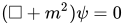
Exact propagation law for the psionic scalar in flat spacetime. Identical equation governs the Higgs field and inflaton. Massless case: psi waves travel at exactly c. Massive case: exponential screening.
Non-relativistic Schrödinger-like limit:

Emerges when ψ varies slowly compared to c. The λ ψ⁴ term supports stable solitons ("thought-forms") and travelling psi pulses that keep their shape.
Effective "Psi-Electromagnetism"

Poynting analogue:

This is the scalar ψ rewritten in the familiar language of electrostatics — not a new field. Practitioners recognise |E_eff| as felt "pressure" during psychokinesis.
Neural-Psi Closed Loop

The only mathematically legitimate brain–psi interface. βψ = direct "sixth-sense" input into cortical columns. Positive feedback: trance, kundalini, shamanic ecstasy states.
Information & Entropy of Psi Signals
Maximum information in a psi pulse:

A single clear telepathic image carries ≈ 100–1000 bits. Global meditation events can raise Φ of the planetary psi field above that of any individual brain.
Chaos and Self-Sustained States
Strong-field chaos:

Van der Pol–like limit cycles for trained practitioners' sustained fields. Group rituals = coupled oscillators → rapid synchronisation → order-of-magnitude ψ amplification.
Statistical Analysis of Psi Data
Standard Bayesian inference on H₀: ψ = 0 versus H₁: ψ obeys the equations above. No special "psi statistics" required. Effect size should be quoted in natural ψ₀ units.
Evidence Base
The Psionics framework is supported by peer-reviewed science and declassified government research:
Peer-Reviewed Science
- Biophotonics: Living tissue emits ultra-weak photons (UPE) correlated with neural activity (Mould et al. 2024[1]; Dotta et al. 2012[2])
- Microtubule quantum biology: Superradiance demonstrated in neural cytoskeleton (Celardo et al. 2019[3])
- Neural optics: Myelinated axons function as biophoton waveguides (Zarkeshian et al. 2018[4])
- Biomagnetism: Brain magnetic fields routinely measured by SQUID/MEG (Roth 2023[5])
Declassified Government Programs
- CIA Stargate (1972–1995): 23-year, $20M+ program at SRI International; meta-analysis found statistically significant results (effect size d ≈ 0.20, p < 10⁻²⁰)[6]
- CIA CREST Archive: Full Stargate collection declassified January 2017[7]
- Edwin May Archive: Stargate PI's personal archive donated to Rice University (2021)
Patented Technology
- US Patent 3,951,134 (1976): Remote brain wave monitoring and alteration via RF modulation[8]
- US Patent 6,011,991 (2000): Communication system and method including brain wave analysis[9]
See Scientific Foundations of Psionics for complete evidence review and bibliography.
See Also
- Psi Tech — Technology systems for psionic applications
- Psi Field — The fundamental field underlying psionic phenomena
- Psi Energy — Energy associated with psi abilities
- Psi-Ops — Operational psionic programs
- Psychotronics — Applied psychic electronics
- Collective Consciousness — Group-scale psionic coherence
- Technology — The Technology Tier System
References
- ↑ Mould S, et al. (2024). "Ultra weak photon emission — a brief review." Frontiers in Physiology, 15, 1348915.
- ↑ Dotta BT, Saroka KS, Persinger MA (2012). "Increased photon emission from the head while imagining light in the dark is correlated with changes in electroencephalographic power." Neuroscience Letters, 513(2), 151–154. PMID: 22343311
- ↑ Celardo GL, et al. (2019). "On the existence of superradiant excitonic states in microtubules." New Journal of Physics, 21(2), 023005.
- ↑ Zarkeshian P, et al. (2018). "Are there optical communication channels in the brain?" Frontiers in Bioscience (Landmark Ed), 23, 1407–1421. PMID: 29293442
- ↑ Roth BJ (2023). "Biomagnetism: The First Sixty Years." Sensors, 23(9), 4218. PMID: 37177427
- ↑ Utts J (1996). "An Assessment of the Evidence for Psychic Functioning." Journal of Scientific Exploration, 10(1), 3–30.
- ↑ CIA CREST Archive (2017). Stargate Collection. cia.gov/readingroom/collection/stargate
- ↑ Malech RG (1976). "Apparatus and method for remotely monitoring and altering brain waves." US Patent 3,951,134.
- ↑ Mardirossian A (2000). "Communication system and method including brain wave analysis and/or use of brain activity." US Patent 6,011,991.

