Engineering Technology that combines Magnetohydrodynamic (MHD) fluids, Quantum Mechanics, and Spin Waves: Difference between revisions
(Created page with "== Engineering Technology: Formulas and Applications == === MHD Fluids in Technology === ==== MHD Dynamo Equation ==== The MHD dynamo equation governs the generation of magnetic fields in electrically conducting fluids. It plays a crucial role in designing magnetohydrodynamic generators for power generation. <math display="block"> \nabla \times (\mathbf{u} \times \mathbf{B}) = \eta \nabla^2 \mathbf{B} + \mu_0 \mathbf{J} </math> Where: - \(\mathbf{u}\) is the fluid ve...") |
No edit summary |
||
| (11 intermediate revisions by the same user not shown) | |||
| Line 1: | Line 1: | ||
= Engineering Technology: Formulas and Applications = | |||
== MHD Fluids in Technology == | |||
{| class="wikitable" | |||
|- | |||
! Formula | |||
! Name | |||
! Application | |||
|- | |||
| <math display="block">\nabla \times (\mathbf{u} \times \mathbf{B}) = \eta \nabla^2 \mathbf{B} + \mu_0 \mathbf{J}</math> | |||
| MHD Dynamo Equation | |||
| Generation of magnetic fields in MHD systems, essential for designing magnetohydrodynamic generators for power generation. | |||
|- | |||
| <math display="block">P = -\int_V \mathbf{E} \cdot \mathbf{J} \, dV</math> | |||
| MHD Energy Conversion Formula | |||
| Representation of power generated in MHD systems, providing insights into energy efficiency. | |||
|} | |||
=== MHD Fluid Applications in Technology === | |||
# [[Power Generation|'''Power Generation''']] | |||
## [[Magnetohydrodynamic Generators]]: | |||
##* ''Implementation of MHD fluids for direct conversion of kinetic energy into electrical power.'' | |||
## [[MHD Dynamo Systems]]: | |||
##* ''Systems utilizing MHD principles to generate and amplify magnetic fields for power generation.'' | |||
# [[Propulsion Systems|'''Propulsion Systems''']] | |||
## [[MHD Propulsion for Aerospace]]: | |||
##* ''Integration of MHD fluids in aerospace propulsion systems for enhanced thrust and efficiency.'' | |||
## [[MHD Marine Propulsion]]: | |||
##* ''Application of MHD principles in marine propulsion systems for increased fuel efficiency and maneuverability.'' | |||
# [[Energy Conversion and Storage|'''Energy Conversion and Storage''']] | |||
## [[MHD Energy Conversion Systems]]: | |||
##* ''Development of systems converting thermal or kinetic energy from MHD fluids into electrical power.'' | |||
## [[MHD Energy Storage]]: | |||
##* ''Exploration of MHD fluids in energy storage technologies, such as magnetic energy storage systems.'' | |||
# [[Magnetohydrodynamic Control Systems|'''Magnetohydrodynamic Control Systems''']] | |||
## [[MHD Fluid Dynamics Control]]: | |||
##* ''Utilization of MHD principles to control and manipulate fluid dynamics in various industrial processes.'' | |||
## [[MHD Flow Control in Confinement]]: | |||
##* ''Application of MHD techniques for precise control of fluid flows in confined spaces.'' | |||
# [[Space Exploration|'''Space Exploration''']] | |||
## [[MHD Thrusters for Satellites]]: | |||
##* ''Integration of MHD propulsion in satellite thrusters for precise orbit adjustments.'' | |||
## [[MHD Fluids in Space Propulsion]]: | |||
##* ''Research and development of MHD systems for advanced space propulsion technologies.'' | |||
# [[Industrial Processes|'''Industrial Processes''']] | |||
## [[MHD Fluids in Metallurgy]]: | |||
##* ''Application of MHD principles in metallurgical processes for improved metal extraction and refining.'' | |||
## [[MHD Fluids in Chemical Processing]]: | |||
##* ''Exploration of MHD fluids for enhanced mixing and reaction control in chemical processes.'' | |||
# [[Environmental Applications|'''Environmental Applications''']] | |||
## [[MHD Fluids in Environmental Cleanup]]: | |||
##* Use of MHD techniques for efficient removal of pollutants from water and air. | |||
## [[MHD Fluids in Environmental Monitoring]]: | |||
##* Integration of MHD sensors for monitoring and analyzing environmental parameters. | |||
== Quantum Mechanics in Technology == | |||
- \(\mathbf{ | {| class="wikitable" | ||
- \ | |- | ||
! Formula | |||
! Name | |||
! Application | |||
|- | |||
| <math display="block">\hat{H} = -\frac{\hbar^2}{2m} \nabla^2 + V(\mathbf{r},t)</math> | |||
| Quantum Mechanical Hamiltonian | |||
| Foundation for understanding energy states and dynamics of quantum systems, critical for designing quantum technologies. | |||
|- | |||
| <math display="block">\hat{S}_x = \frac{\hbar}{2} \sigma_x, \quad \hat{S}_y = \frac{\hbar}{2} \sigma_y, \quad \hat{S}_z = \frac{\hbar}{2} \sigma_z</math> | |||
| Quantum Mechanical Spin Operators | |||
| Crucial for manipulating spin states, forming the basis for technologies such as quantum computing and spintronics. | |||
|} | |||
==== | == Spin Waves in Technology == | ||
{| class="wikitable" | |||
|- | |||
! Formula | |||
! Name | |||
! Application | |||
|- | |||
| <math display="block">\omega = \gamma \sqrt{B + \mu_0 M \left( M + H \right)}</math> | |||
| Spin Wave Dispersion Relation | |||
| Characterizes the relationship between spin wave frequency and wave vector, crucial for designing spin wave-based devices. | |||
|- | |||
| <math display="block">\delta S = -i\alpha \left( \omega_0 + \omega_M \right) S + \beta \nabla^2 S + \eta H_{\text{rf}}(t)</math> | |||
| Spin Wave Excitation Formula | |||
| Describes the excitation of spin waves using microwave fields, a fundamental process in spin wave-based technology. | |||
|} | |||
= Applications in Technology = | |||
* Quantum-Enhanced MHD Propulsion Systems | |||
* Spin Wave-Based Quantum Information Processing | |||
- | |||
- | |||
== Quantum-Enhanced MHD Propulsion Systems == | |||
==== | ==== Background: ==== | ||
Traditional MHD propulsion systems leverage the interaction between electrically conductive fluids and magnetic fields for propulsion. Integrating Quantum Mechanics and Spin Waves into this system can bring about quantum-enhanced features. | |||
==== Application: ==== | |||
# '''Quantum-Enhanced Thrust:''' | |||
- \(\ | #* Quantum-coherent states of MHD fluids, influenced by quantum mechanics, can lead to enhanced thrust generation. Quantum states, such as superposition, may allow for precise control over fluid dynamics, resulting in more efficient and powerful propulsion. | ||
- | {| class="wikitable" | ||
- | |- | ||
- \ | ! Formula | ||
! Name | |||
! Description | |||
|- | |||
| <math display="block">\mathbf{F} = \int (\rho \nabla |\Psi|^2) \times \mathbf{B} \, dV</math> | |||
| Quantum-Enhanced Thrust | |||
| The quantum-enhanced thrust formula incorporating the quantum-coherent state <math>|\Psi\rangle</math> of MHD fluids, where <math>\rho</math> is the fluid density and <math>\mathbf{B}</math> is the magnetic field. | |||
|} | |||
# '''Quantum Sensors for Feedback:''' | |||
#* Incorporating quantum sensors based on Spin Waves enables highly sensitive measurements of fluid properties. This quantum-enhanced feedback system allows for real-time adjustments to optimize propulsion efficiency. | |||
{| class="wikitable" | |||
|- | |||
! Formula | |||
! Name | |||
! Description | |||
|- | |||
| <math display="block">\Delta \mathbf{P} = \frac{\hbar}{2}\nabla(\rho \nabla|\Psi|^2)</math> | |||
| Quantum Sensor Feedback | |||
| Quantum-enhanced feedback using the gradient of the quantum-coherent state <math>|\Psi\rangle</math> for precise measurements of fluid properties. | |||
|} | |||
<math display="block"> | # '''Quantum Coherent MHD Turbines:''' | ||
\ | #* Quantum coherence in MHD turbines, influenced by Quantum Mechanics, can potentially enhance energy conversion efficiency. Spin Wave control mechanisms may allow for more efficient extraction of energy from the fluid-magnetic field interaction. | ||
</math> | {| class="wikitable" | ||
|- | |||
! Formula | |||
! Name | |||
! Description | |||
|- | |||
| <math display="block">\mathcal{H} = -\frac{\hbar^2}{2m}\nabla^2 + V + V_{\text{ext}}\cdot \mathbf{S}</math> | |||
| Quantum Coherent MHD Turbines | |||
| The Hamiltonian for Quantum Coherent MHD Turbines, considering the influence of the external potential <math>V_{\text{ext}}</math> on the Spin Operator <math>\mathbf{S}</math>. | |||
|} | |||
==== Potential Benefits: ==== | |||
* '''Increased Efficiency:''' | |||
** ''Quantum coherence may lead to more controlled and efficient energy conversion in MHD propulsion, reducing energy losses.'' | |||
* '''Enhanced Precision:''' | |||
** ''Quantum sensors can provide unprecedented precision in monitoring and controlling fluid properties, optimizing propulsion performance.'' | |||
== Spin Wave-Based Quantum Information Processing == | |||
==== Background: ==== | |||
Spin Waves, collective excitations of spins in a material, offer a unique platform for information processing. Integrating Quantum Mechanics into Spin Waves enables the development of advanced quantum information processing technologies. | |||
==== | === Application: === | ||
<math display="block"> | ==== '''Spin Wave Quantum Gates:''' ==== | ||
\ | * Utilize the coherent nature of Spin Waves to implement quantum gates for information processing. Spin Wave-based quantum gates can form the building blocks of quantum circuits for computation. | ||
</math> | {| class="wikitable" | ||
|- | |||
! Formula | |||
! Name | |||
! Description | |||
|- | |||
| <math display="block">\hat{U}(\theta, \phi) = e^{-i\frac{\theta}{2}\mathbf{n}\cdot\mathbf{S}}, \quad \mathbf{n} = (\sin\phi\cos\theta, \sin\phi\sin\theta, \cos\phi)</math> | |||
| Spin Wave Quantum Gate | |||
| The representation of a quantum gate acting on a Spin Wave system, where <math>\theta</math> and <math>\phi</math> define the rotation angles and <math>\mathbf{S}</math> is the Spin Operator. | |||
|} | |||
==== '''Quantum Memory Storage:''' ==== | |||
* Leverage the long coherence times of Spin Waves to store and retrieve quantum information. Quantum Mechanics allows for the encoding, manipulation, and retrieval of quantum states in Spin Wave-based memory systems. | |||
- | {| class="wikitable" | ||
- \ | |- | ||
! Formula | |||
! Name | |||
! Description | |||
|- | |||
| <math display="block">\hat{H}_{\text{SW}} = -\gamma\mu_B\mathbf{H}_{\text{ext}}\cdot\mathbf{S}</math> | |||
| Spin Wave Quantum Memory Storage | |||
| The Hamiltonian describing the interaction of Spin Waves <math>\mathbf{S}</math> with an external magnetic field <math>\mathbf{H}_{\text{ext}}</math> in a quantum memory storage system. | |||
|} | |||
== | ==== '''Quantum Communication Channels:''' ==== | ||
* Exploit Spin Waves as quantum communication channels. The ability of Spin Waves to propagate over long distances with minimal energy loss makes them suitable for transmitting quantum information. | |||
{| class="wikitable" | |||
|- | |||
! Formula | |||
! Name | |||
! Description | |||
|- | |||
| <math display="block">\omega_{\text{SW}} = \gamma\mu_B\sqrt{H(H + H_{\text{ext}})}</math> | |||
| Spin Wave Frequency | |||
| The spin wave frequency <math>\omega_{\text{SW}}</math> characterizing the interaction between Spin Waves and an external magnetic field <math>\mathbf{H}_{\text{ext}}</math>. | |||
|} | |||
==== Potential Benefits: ==== | |||
* '''Long Coherence Times:''' | |||
** ''Spin Waves offer extended coherence times, enhancing the stability and reliability of quantum information processing.'' | |||
* '''Low Energy Consumption:''' | |||
** ''The inherent properties of Spin Waves allow for low-energy quantum information transfer and processing.'' | |||
=== Conclusion: === | |||
The integration of MHD fluids, Quantum Mechanics, and Spin Waves presents exciting possibilities for technological advancements. Quantum-enhanced MHD propulsion systems and Spin Wave-based quantum information processing represent just a glimpse of the potential applications in fields ranging from aerospace engineering to quantum computing. Continued research and development in these areas hold promise for creating transformative technologies that harness the unique characteristics of MHD fluids, quantum coherence, and Spin Waves. | |||
=== | |||
{{PhysicsPortal}} | {{PhysicsPortal}} | ||
Latest revision as of 22:04, 11 February 2024
Engineering Technology: Formulas and Applications
MHD Fluids in Technology
| Formula | Name | Application |
|---|---|---|
| MHD Dynamo Equation | Generation of magnetic fields in MHD systems, essential for designing magnetohydrodynamic generators for power generation. | |
| MHD Energy Conversion Formula | Representation of power generated in MHD systems, providing insights into energy efficiency. |


MHD Fluid Applications in Technology
- Power Generation
- Magnetohydrodynamic Generators:
- Implementation of MHD fluids for direct conversion of kinetic energy into electrical power.
- MHD Dynamo Systems:
- Systems utilizing MHD principles to generate and amplify magnetic fields for power generation.
- Magnetohydrodynamic Generators:
- Propulsion Systems
- MHD Propulsion for Aerospace:
- Integration of MHD fluids in aerospace propulsion systems for enhanced thrust and efficiency.
- MHD Marine Propulsion:
- Application of MHD principles in marine propulsion systems for increased fuel efficiency and maneuverability.
- MHD Propulsion for Aerospace:
- Energy Conversion and Storage
- MHD Energy Conversion Systems:
- Development of systems converting thermal or kinetic energy from MHD fluids into electrical power.
- MHD Energy Storage:
- Exploration of MHD fluids in energy storage technologies, such as magnetic energy storage systems.
- MHD Energy Conversion Systems:
- Magnetohydrodynamic Control Systems
- MHD Fluid Dynamics Control:
- Utilization of MHD principles to control and manipulate fluid dynamics in various industrial processes.
- MHD Flow Control in Confinement:
- Application of MHD techniques for precise control of fluid flows in confined spaces.
- MHD Fluid Dynamics Control:
- Space Exploration
- MHD Thrusters for Satellites:
- Integration of MHD propulsion in satellite thrusters for precise orbit adjustments.
- MHD Fluids in Space Propulsion:
- Research and development of MHD systems for advanced space propulsion technologies.
- MHD Thrusters for Satellites:
- Industrial Processes
- MHD Fluids in Metallurgy:
- Application of MHD principles in metallurgical processes for improved metal extraction and refining.
- MHD Fluids in Chemical Processing:
- Exploration of MHD fluids for enhanced mixing and reaction control in chemical processes.
- MHD Fluids in Metallurgy:
- Environmental Applications
- MHD Fluids in Environmental Cleanup:
- Use of MHD techniques for efficient removal of pollutants from water and air.
- MHD Fluids in Environmental Monitoring:
- Integration of MHD sensors for monitoring and analyzing environmental parameters.
- MHD Fluids in Environmental Cleanup:
Quantum Mechanics in Technology
| Formula | Name | Application |
|---|---|---|
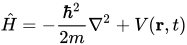
| Quantum Mechanical Hamiltonian | Foundation for understanding energy states and dynamics of quantum systems, critical for designing quantum technologies. | |
| Quantum Mechanical Spin Operators | Crucial for manipulating spin states, forming the basis for technologies such as quantum computing and spintronics. |

Spin Waves in Technology
| Formula | Name | Application |
|---|---|---|
| Spin Wave Dispersion Relation | Characterizes the relationship between spin wave frequency and wave vector, crucial for designing spin wave-based devices. | |
| Spin Wave Excitation Formula | Describes the excitation of spin waves using microwave fields, a fundamental process in spin wave-based technology. |


Applications in Technology
- Quantum-Enhanced MHD Propulsion Systems
- Spin Wave-Based Quantum Information Processing
Quantum-Enhanced MHD Propulsion Systems
Background:
Traditional MHD propulsion systems leverage the interaction between electrically conductive fluids and magnetic fields for propulsion. Integrating Quantum Mechanics and Spin Waves into this system can bring about quantum-enhanced features.
Application:
- Quantum-Enhanced Thrust:
- Quantum-coherent states of MHD fluids, influenced by quantum mechanics, can lead to enhanced thrust generation. Quantum states, such as superposition, may allow for precise control over fluid dynamics, resulting in more efficient and powerful propulsion.
| Formula | Name | Description |
|---|---|---|
| Quantum-Enhanced Thrust | The quantum-enhanced thrust formula incorporating the quantum-coherent state of MHD fluids, where is the fluid density and is the magnetic field. |


- Quantum Sensors for Feedback:
- Incorporating quantum sensors based on Spin Waves enables highly sensitive measurements of fluid properties. This quantum-enhanced feedback system allows for real-time adjustments to optimize propulsion efficiency.
| Formula | Name | Description |
|---|---|---|
| Quantum Sensor Feedback | Quantum-enhanced feedback using the gradient of the quantum-coherent state for precise measurements of fluid properties. |

- Quantum Coherent MHD Turbines:
- Quantum coherence in MHD turbines, influenced by Quantum Mechanics, can potentially enhance energy conversion efficiency. Spin Wave control mechanisms may allow for more efficient extraction of energy from the fluid-magnetic field interaction.
| Formula | Name | Description |
|---|---|---|
| Quantum Coherent MHD Turbines | The Hamiltonian for Quantum Coherent MHD Turbines, considering the influence of the external potential on the Spin Operator . |


Potential Benefits:
- Increased Efficiency:
- Quantum coherence may lead to more controlled and efficient energy conversion in MHD propulsion, reducing energy losses.
- Enhanced Precision:
- Quantum sensors can provide unprecedented precision in monitoring and controlling fluid properties, optimizing propulsion performance.
Spin Wave-Based Quantum Information Processing
Background:
Spin Waves, collective excitations of spins in a material, offer a unique platform for information processing. Integrating Quantum Mechanics into Spin Waves enables the development of advanced quantum information processing technologies.
Application:
Spin Wave Quantum Gates:
- Utilize the coherent nature of Spin Waves to implement quantum gates for information processing. Spin Wave-based quantum gates can form the building blocks of quantum circuits for computation.
| Formula | Name | Description |
|---|---|---|
| Spin Wave Quantum Gate | The representation of a quantum gate acting on a Spin Wave system, where and define the rotation angles and is the Spin Operator. |


Quantum Memory Storage:
- Leverage the long coherence times of Spin Waves to store and retrieve quantum information. Quantum Mechanics allows for the encoding, manipulation, and retrieval of quantum states in Spin Wave-based memory systems.
| Formula | Name | Description |
|---|---|---|
| Spin Wave Quantum Memory Storage | The Hamiltonian describing the interaction of Spin Waves with an external magnetic field in a quantum memory storage system. |


Quantum Communication Channels:
- Exploit Spin Waves as quantum communication channels. The ability of Spin Waves to propagate over long distances with minimal energy loss makes them suitable for transmitting quantum information.
| Formula | Name | Description |
|---|---|---|
| Spin Wave Frequency | The spin wave frequency characterizing the interaction between Spin Waves and an external magnetic field . |


Potential Benefits:
- Long Coherence Times:
- Spin Waves offer extended coherence times, enhancing the stability and reliability of quantum information processing.
- Low Energy Consumption:
- The inherent properties of Spin Waves allow for low-energy quantum information transfer and processing.
Conclusion:
The integration of MHD fluids, Quantum Mechanics, and Spin Waves presents exciting possibilities for technological advancements. Quantum-enhanced MHD propulsion systems and Spin Wave-based quantum information processing represent just a glimpse of the potential applications in fields ranging from aerospace engineering to quantum computing. Continued research and development in these areas hold promise for creating transformative technologies that harness the unique characteristics of MHD fluids, quantum coherence, and Spin Waves.

