|
|
| Line 3: |
Line 3: |
| === MHD Fluids in Technology === | | === MHD Fluids in Technology === |
|
| |
|
| ==== MHD Dynamo Equation ==== | | {| class="wikitable" |
| The MHD dynamo equation governs the generation of magnetic fields in electrically conducting fluids. It plays a crucial role in designing magnetohydrodynamic generators for power generation.
| | |- |
| | | ! Formula |
| <math display="block"> | | ! Name |
| \nabla \times (\mathbf{u} \times \mathbf{B}) = \eta \nabla^2 \mathbf{B} + \mu_0 \mathbf{J} | | ! Application |
| </math> | | |- |
| | | | <math display="block">\nabla \times (\mathbf{u} \times \mathbf{B}) = \eta \nabla^2 \mathbf{B} + \mu_0 \mathbf{J}</math> |
| Where:
| | | MHD Dynamo Equation |
| - \(\mathbf{u}\) is the fluid velocity,
| | | Generation of magnetic fields in MHD systems, essential for designing magnetohydrodynamic generators for power generation. |
| - \(\mathbf{B}\) is the magnetic field,
| | |- |
| - \(\eta\) is the magnetic diffusivity,
| | | <math display="block">P = -\int_V \mathbf{E} \cdot \mathbf{J} \, dV</math> |
| - \(\mu_0\) is the permeability of free space,
| | | MHD Energy Conversion Formula |
| - \(\mathbf{J}\) is the current density.
| | | Representation of power generated in MHD systems, providing insights into energy efficiency. |
| | | |} |
| ==== MHD Energy Conversion Formula ====
| |
| The MHD energy conversion formula represents the power generated in MHD systems, providing insights into energy efficiency.
| |
| | |
| <math display="block"> | |
| P = -\int_V \mathbf{E} \cdot \mathbf{J} \, dV | |
| </math> | |
| | |
| Where:
| |
| - \(P\) is the power generated,
| |
| - \(\mathbf{E}\) is the electric field,
| |
| - \(\mathbf{J}\) is the current density.
| |
|
| |
|
| === Quantum Mechanics in Technology === | | === Quantum Mechanics in Technology === |
|
| |
|
| ==== Quantum Mechanical Hamiltonian ==== | | {| class="wikitable" |
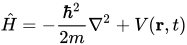
| The quantum mechanical Hamiltonian forms the foundation for understanding the energy states and dynamics of quantum systems, critical for designing quantum technologies.
| | |- |
| | | ! Formula |
| <math display="block"> | | ! Name |
| \hat{H} = -\frac{\hbar^2}{2m} \nabla^2 + V(\mathbf{r},t) | | ! Application |
| </math> | | |- |
| | | | <math display="block">\hat{H} = -\frac{\hbar^2}{2m} \nabla^2 + V(\mathbf{r},t)</math> |
| Where:
| | | Quantum Mechanical Hamiltonian |
| - \(\hat{H}\) is the Hamiltonian operator,
| | | Foundation for understanding energy states and dynamics of quantum systems, critical for designing quantum technologies. |
| - \(\hbar\) is the reduced Planck constant,
| | |- |
| - \(m\) is the particle mass,
| | | <math display="block">\hat{S}_x = \frac{\hbar}{2} \sigma_x, \quad \hat{S}_y = \frac{\hbar}{2} \sigma_y, \quad \hat{S}_z = \frac{\hbar}{2} \sigma_z</math> |
| - \(\nabla^2\) is the Laplacian operator,
| | | Quantum Mechanical Spin Operators |
| - \(V(\mathbf{r},t)\) is the potential energy.
| | | Crucial for manipulating spin states, forming the basis for technologies such as quantum computing and spintronics. |
| | | |} |
| ==== Quantum Mechanical Spin Operators ====
| |
| The quantum mechanical spin operators are crucial for manipulating spin states, forming the basis for technologies such as quantum computing and spintronics.
| |
| | |
| <math display="block"> | |
| \hat{S}_x = \frac{\hbar}{2} \sigma_x, \quad \hat{S}_y = \frac{\hbar}{2} \sigma_y, \quad \hat{S}_z = \frac{\hbar}{2} \sigma_z | |
| </math> | |
| | |
| Where:
| |
| - \(\hat{S}_x, \hat{S}_y, \hat{S}_z\) are the spin operators along the x, y, and z axes,
| |
| - \(\hbar\) is the reduced Planck constant,
| |
| - \(\sigma_x, \sigma_y, \sigma_z\) are Pauli matrices.
| |
|
| |
|
| === Spin Waves in Technology === | | === Spin Waves in Technology === |
|
| |
|
| ==== Spin Wave Dispersion Relation ==== | | {| class="wikitable" |
| The spin wave dispersion relation characterizes the relationship between spin wave frequency and wave vector, crucial for designing spin wave-based devices.
| | |- |
| | | ! Formula |
| <math display="block"> | | ! Name |
| \omega = \gamma \sqrt{B + \mu_0 M \left( M + H \right)} | | ! Application |
| </math> | | |- |
| | | | <math display="block">\omega = \gamma \sqrt{B + \mu_0 M \left( M + H \right)}</math> |
| Where:
| | | Spin Wave Dispersion Relation |
| - \(\omega\) is the spin wave frequency,
| | | Characterizes the relationship between spin wave frequency and wave vector, crucial for designing spin wave-based devices. |
| - \(\gamma\) is the gyromagnetic ratio,
| | |- |
| - \(B\) is the exchange stiffness,
| | | <math display="block">\delta S = -i\alpha \left( \omega_0 + \omega_M \right) S + \beta \nabla^2 S + \eta H_{\text{rf}}(t)</math> |
| - \(\mu_0\) is the permeability of free space,
| | | Spin Wave Excitation Formula |
| - \(M\) is the magnetization,
| | | Describes the excitation of spin waves using microwave fields, a fundamental process in spin wave-based technology. |
| - \(H\) is the external magnetic field.
| | |} |
| | |
| ==== Spin Wave Excitation Formula ====
| |
| The spin wave excitation formula describes the excitation of spin waves using microwave fields, a fundamental process in spin wave-based technology.
| |
| | |
| <math display="block"> | |
| \delta S = -i\alpha \left( \omega_0 + \omega_M \right) S + \beta \nabla^2 S + \eta H_{\text{rf}}(t) | |
| </math> | |
| | |
| Where:
| |
| - \(\delta S\) is the spin wave amplitude,
| |
| - \(\alpha\) is the Gilbert damping parameter,
| |
| - \(\omega_0, \omega_M\) are the precession and magnetization frequencies,
| |
| - \(\beta\) is the exchange stiffness,
| |
| - \(\nabla^2 S\) represents spatial variation in spin amplitude,
| |
| - \(\eta\) is the gyromagnetic ratio, | |
| - \(H_{\text{rf}}(t)\) is the time-dependent microwave field.
| |
|
| |
|
| == Applications in Technology == | | == Applications in Technology == |
|
| |
|
| === Exploring Innovative Technologies Through the Integration of MHD Fluids, Quantum Mechanics, and Spin Waves === | | === MHD, Quantum Mechanics, and Spin Waves in Synergy === |
| '''Introduction''':
| |
| | |
| * The confluence of Magnetohydrodynamics (MHD) fluids, Quantum Mechanics, and Spin Waves has opened up new frontiers in technological innovation. This article explores how the integration of these fields has given rise to groundbreaking technologies with diverse applications.
| |
| | |
| | |
| '''Technological Synergy Overview:'''
| |
| | |
| * The integration of MHD fluids, Quantum Mechanics, and Spin Waves offers a unique synergy, capitalizing on the strengths of each field. This section briefly outlines the shared principles and potential advantages in combining these disciplines.
| |
| | |
| | |
| Quantum Magnetohydrodynamics (QMHD):
| |
| | |
| == Emerging Field of Quantum Magnetohydrodynamics (QMHD) ==
| |
| | |
| === Incorporation of Quantum Principles ===
| |
| | |
| The integration of quantum principles into classical Magnetohydrodynamics (MHD) equations involves several key aspects:
| |
| | |
| 1. **Quantization of Fluid Properties:**
| |
| - In classical MHD, fluid properties are treated as continuous variables. In Quantum Magnetohydrodynamics (QMHD), these properties become quantized, reflecting the discrete nature of quantum mechanics.
| |
| | |
| 2. **Inclusion of Quantum Operators:**
| |
| - Quantum operators, such as position and momentum operators, are introduced to describe the behavior of quantum particles within the fluid. For example, the velocity of the fluid may be represented by a quantum operator.
| |
| | |
| 3. **Spin-Orbit Coupling:**
| |
| - QMHD introduces spin-orbit coupling, considering the intrinsic spin of particles in addition to their orbital motion.
| |
| | |
| === Theoretical Frameworks and Computational Models ===
| |
| | |
| 1. **Schrodinger Equation for Fluid Elements:**
| |
| - QMHD utilizes a modified Schrödinger equation to describe the quantum behavior of fluid elements. This equation incorporates terms related to the magnetic field, fluid velocity, and quantum potential.
| |
| | |
| \[ i\hbar\frac{\partial}{\partial t}\Psi = -\frac{\hbar^2}{2m}\nabla^2\Psi + V(\mathbf{r},t)\Psi \]
| |
| | |
| Where:
| |
| - \(\Psi\) is the quantum wave function of the fluid element,
| |
| - \(\hbar\) is the reduced Planck constant,
| |
| - \(m\) is the mass of the fluid element,
| |
| - \(V(\mathbf{r},t)\) is the potential energy.
| |
| | |
| 2. **Quantum Extension of MHD Equations:**
| |
| - Quantum extensions of classical MHD equations are formulated to account for quantum effects. This involves modifying the MHD momentum equation, induction equation, and energy equation to incorporate terms related to quantum potential, spin-orbit coupling, and quantized fluid properties.
| |
| | |
| \[ \nabla \times (\mathbf{u}\times\mathbf{B}) = \eta\nabla^2\mathbf{B} + \mu_0\mathbf{J} + \nabla Q \]
| |
| | |
| Where:
| |
| - \(Q\) represents the quantum potential.
| |
| | |
| 3. **Monte Carlo Simulations:**
| |
| - Computational models in QMHD often involve Monte Carlo simulations to capture the statistical behavior of quantum particles within the fluid. These simulations consider the quantum nature of particles and their interactions with magnetic fields.
| |
| | |
| === Challenges and Future Directions ===
| |
| | |
| While QMHD holds promise for unraveling new physics in complex systems, several challenges exist, including the need for advanced numerical techniques and a deeper understanding of the interplay between quantum and classical behaviors. Future directions involve refining theoretical models, conducting laboratory experiments, and leveraging advancements in quantum computing to simulate quantum fluid dynamics more accurately.
| |
| | |
| In conclusion, Quantum Magnetohydrodynamics represents a frontier where classical fluid dynamics, electromagnetism, and quantum mechanics converge. By incorporating quantum principles into MHD equations, researchers aim to deepen our understanding of quantum fluid behavior and pave the way for technological applications in fields such as astrophysics, plasma physics, and quantum-enhanced engineering.
| |
| | |
| | |
| | |
| | |
| === MHD with Quantum Mechanics and Spin Waves ===
| |
| | |
| Magnetohydrodynamics (MHD) finds a fascinating intersection with Quantum Mechanics and Spin Waves, leading to innovative research and potential technological applications.
| |
| | |
| ==== Quantum Magnetohydrodynamics (QMHD) ====
| |
| Quantum Magnetohydrodynamics (QMHD) emerges at the crossroads of MHD and Quantum Mechanics. This interdisciplinary field investigates the quantum behavior of electrically conductive fluids under the influence of magnetic fields. Key aspects include the quantization of fluid properties and the incorporation of quantum effects into classical MHD equations.
| |
| | |
| <math display="block">
| |
| \hat{H}_{\text{QMHD}} = -\frac{\hbar^2}{2m} \nabla^2 + V(\mathbf{r},t) - \mu \mathbf{B} \cdot \mathbf{S}
| |
| </math>
| |
| | |
| Where:
| |
| - \(\hat{H}_{\text{QMHD}}\) is the quantum magnetohydrodynamic Hamiltonian,
| |
| - \(\hbar\) is the reduced Planck constant,
| |
| - \(m\) is the particle mass,
| |
| - \(\nabla^2\) is the Laplacian operator,
| |
| - \(V(\mathbf{r},t)\) is the potential energy,
| |
| - \(\mu\) is the magnetic moment,
| |
| - \(\mathbf{B}\) is the magnetic field,
| |
| - \(\mathbf{S}\) is the spin operator.
| |
| | |
| ==== Spin Waves in Magnetohydrodynamics ====
| |
| Spin Waves, collective excitations of electron spins, introduce quantum phenomena into the realm of MHD. Understanding the quantum aspects of spin waves is crucial for harnessing their potential in MHD systems and exploring quantum-enhanced magnetohydrodynamic technologies.
| |
| | |
| <math display="block">
| |
| \omega_{\text{SW}} = \gamma \sqrt{B + \mu_0 M \left( M + H \right)}
| |
| </math>
| |
| | |
| Where:
| |
| - \(\omega_{\text{SW}}\) is the spin wave frequency,
| |
| - \(\gamma\) is the gyromagnetic ratio,
| |
| - \(B\) is the exchange stiffness,
| |
| - \(\mu_0\) is the permeability of free space,
| |
| - \(M\) is the magnetization,
| |
| - \(H\) is the external magnetic field.
| |
| | |
| === Technological Synergy ===
| |
|
| |
|
| The confluence of MHD with Quantum Mechanics and Spin Waves opens up avenues for technological innovation. Explore the super section on [[Engineering Technology that combines Magnetohydrodynamic (MHD) fluids, Quantum Mechanics, and Spin Waves#Engineering Technology: Formulas and Applications|Engineering Technology: Formulas and Applications]] to delve into specific formulas and their applications in developing cutting-edge technologies that integrate these disciplines.
| | Explore how the integration of MHD fluids, Quantum Mechanics, and Spin Waves can lead to innovative technologies, such as quantum-enhanced MHD propulsion systems or spin wave-based quantum information processing. |
|
| |
|
| {{PhysicsPortal}} | | {{PhysicsPortal}} |