Heim Theory
| Heim Theory | |
|---|---|
| Overview | |
| Creator | Burkhard Heim (1925–2001) |
| Extended By | Walter Dröscher & Jochem Hauser (2004–2009) |
| Dimensions | 6D (Heim) → 8D (Dröscher-Hauser) |
| Key Achievement | Mass formula: particle masses predicted to ~1% |
| Key Prediction | Gravitophoton force — EM-generated gravitational thrust |
| Experimental Status | No experimental validation; mass formula never independently derived |
| Status | Speculative · Not mainstream · AIAA presentations |
| The most ambitious theoretical framework connecting EM fields to gravitational propulsion | |
| ⚡️ | Electrogravitics - Electrogravitic Tech | Electrokinetics - Electrokinetic Tech |
| 🧲 | Magnetogravitics - Magnetogravitic Tech | Magnetokinetics - Magnetokinetic Tech |
Heim theory is a geometric theory of fundamental physics developed by German theoretical physicist Burkhard Heim (1925–2001) that extends general relativity from 4 spacetime dimensions to 6 (later 8) dimensions. Its most notable achievement is a mass formula that reportedly reproduces the masses of known elementary particles to within ~1% accuracy using only integer quantum numbers and fundamental constants. Its most dramatic prediction — via the Dröscher-Hauser extension — is that rotating electromagnetic fields can generate gravitophoton forces, enabling propellantless propulsion.
Heim theory remains speculative and outside the mainstream, but was considered significant enough for invited presentations at the American Institute of Aeronautics and Astronautics (AIAA) Joint Propulsion Conferences.
Burkhard Heim
| Aspect | Detail |
|---|---|
| Born | February 9, 1925, Potsdam, Germany |
| Died | January 14, 2001, Northeim, Germany |
| Education | University of Göttingen (physics) |
| Disability | Lost both hands and most of his eyesight in a WWII explosives accident (1944); worked with assistants for all calculations |
| Career | Institute for Field Physics (MHI), Northeim, Germany; largely independent researcher |
| Language | Published primarily in German; limited international dissemination |
| Key paper | "Vorschlag eines Weges einer einheitlichen Beschreibung der Elementarteilchen." Zeitschrift für Naturforschung 32a, 233–243 (1977) |
Heim's severe injuries forced him to work in near-total isolation, dictating equations to assistants. This isolation contributed both to the originality of his approach and to its limited peer review.
The 6D (and 8D) Framework
Heim's 6 Dimensions
Heim extended spacetime by adding two "transdimensions":
| Dimension | Symbol | Character |
|---|---|---|
| Spatial | Standard 3D space | |
| Temporal | Standard time | |
| (organizational) | Governs structural organization of matter | |
| (informational) | Governs informational content of matter |


Dröscher-Hauser 8D Extension
Walter Dröscher and Jochem Hauser extended Heim's framework to 8 dimensions: [1]
| Dimension | Symbol | Character |
|---|---|---|
| (entelechial) | Related to self-organization / teleological ordering | |
| (aeonic) | Related to time-like ordering beyond |


The 8D metric tensor (A, B = 1...8) decomposes into subspaces whose off-diagonal couplings generate new force terms beyond the four known fundamental forces.

The Heim Mass Formula
Heim's most striking result: a formula that predicts particle masses from pure geometry. [2]
Structure
In Heim's framework, elementary particles are excitations of a quantized 6D geometry. The fundamental quantum of area is the metron:

Each particle is characterized by a set of integer quantum numbers describing its internal geometric structure. The mass formula (simplified notation):

![{\displaystyle m(n,k,p,q)={\frac {h}{c}}\cdot {\frac {1}{4\ell _{p}^{2}}}\cdot A(n,k)\cdot \left[C_{1}+C_{2}\cdot Q(p,q)+C_{3}\cdot W(n,k,p,q)\right]}](https://wikimedia.org/api/rest_v1/media/math/render/svg/5ed265d91ac39fa630a6702b5b91e9cf9302d26a)
where:
- m (Planck length)
- = geometric area quantization function (depends on metron geometry)
- = charge-like quantum numbers
- = mixing terms between geometric and charge sectors
- = calculable constants involving only


Results
| Particle | Measured Mass (MeV/c²) | Heim Prediction | Error |
|---|---|---|---|
| Electron | 0.511 | Input | — |
| Proton | 938.3 | Input | — |
| Muon | 105.7 | ~106 | ~0.3% |
| Pion (π⁺) | 139.6 | ~140 | ~0.3% |
| Kaon (K⁺) | 493.7 | ~495 | ~0.3% |
| Neutron | 939.6 | ~940 | <1% |
The formula uses the electron and proton masses as inputs and predicts all other particle masses. The ~1% accuracy across the particle spectrum is remarkable if correct — no other theoretical framework achieves this without adjustable parameters.
Caveats
- Heim's derivation was published only in German and has never been independently reproduced from first principles
- The calculations were performed by hand (with assistant dictation) and no independent numerical verification exists
- Some physicists (Reed, JBIS 2008) have attempted to reconstruct the calculation with partial success [3]
- The quantum number assignments for each particle may not be unique
Three New Fundamental Forces
The 8D extension predicts new force terms from off-diagonal metric couplings: [4]
| Interaction | Coupling Dimensions | Character | Analog |
|---|---|---|---|
| Gravitophoton (attractive) | Short-range gravity-like | Enhanced gravitomagnetic | |
| Gravitophoton (repulsive) | Short-range anti-gravity-like | Repulsive gravitomagnetic | |
| Quintessence | Long-range dark-energy-like | Cosmological |


The gravitophoton interactions are produced in pairs (one attractive, one repulsive), analogous to virtual particle-antiparticle pairs. The net effect depends on the configuration of the generating field.
The Heim-Lorentz Force
The propulsion-relevant prediction is the Heim-Lorentz force — the force on a body due to a gravitophoton field:

where:
- = gravitophoton coupling constant (calculable from the 8D metric)
- = velocity of the body through the gravitomagnetic field


This is structurally identical to the electromagnetic Lorentz force , but with gravitational "charge" replacing electric charge. Compare with the GEM Lorentz force:
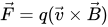

The Heim-Lorentz force differs from the GEM version in that can be enormously larger than the GEM coupling (which is suppressed by ).

Generating Gravitophoton Fields
Dröscher and Hauser proposed that a rotating magnetic field generates gravitophoton pairs:

where:
- = number of turns in the generating coil
- = rotation frequency of the magnetic field
- = magnetic field strength
- = characteristic radius of the device


Required parameters for practical thrust:
- T (achievable with current superconducting magnets)
- rad/s (rotation of the field, not mechanical rotation)
- Predicted thrust: on the order of acceleration
- Predicted specific impulse: infinite (no propellant consumed)


Connection to Other Frameworks
| Theory | Connection | Agreement |
|---|---|---|
| Kaluza-Klein Unification | Both add extra dimensions; KK uses 5D, Heim uses 6–8D | Partial — KK is mathematically rigorous; Heim extends the concept |
| Gravitoelectromagnetism | Heim-Lorentz force has same structure as GEM Lorentz force | Structural agreement in weak-field limit |
| Li-Torr | Both predict amplified gravitomagnetic effects from EM configurations | Different mechanism — Li-Torr uses condensed matter, Heim uses geometry |
| Tajmar | Tajmar coined "graviphoton" independently; similar concept | Qualitative agreement; quantitative comparison unclear |
| Pais Effect | Both invoke EM field configurations generating gravitational effects | Different frameworks; Pais uses vacuum polarization, Heim uses metric coupling |
| String Theory | Both use extra compactified dimensions | Heim has fewer dimensions (8 vs 10/11); different mathematical foundations |
Credibility Assessment
| Aspect | Status |
|---|---|
| Mathematical consistency | Partially verified; never fully reconstructed by outsiders |
| Mass formula accuracy | If correct, highly significant (~1% for dozens of particles) |
| Independent reproduction | Not achieved — the detailed calculation has not been independently derived |
| Experimental validation | None — no gravitophoton or quintessence has been detected |
| Peer review | Limited — German publications, AIAA conference proceedings |
| Mainstream acceptance | Not accepted by mainstream physics community |
| AIAA evaluation | Considered noteworthy enough for invited presentations (2004, 2006) |
Bottom line: The mass formula is tantalizing but unverified. The propulsion predictions are extraordinary claims without experimental support. Heim theory occupies a unique position — partly respectable (AIAA presentations, German-language peer review) and partly fringe (no mainstream adoption, no replication, no experimental evidence).
Significance for Magneto Speeder
Heim theory provides a theoretical framework where magnetogravitic propulsion could work through a completely different mechanism than Li-Torr:
- Li-Torr: Rotating superconductor → amplified gravitomagnetic London moment → thrust
- Heim: Rotating magnetic field → gravitophoton pair production → net thrust
For the Magneto Speeder, Heim theory offers:
- A second theoretical pathway to the same engineering goal
- The concept of gravitophoton pair production as an energy source/sink
- Specific engineering parameters (B ~ 15–30 T, ω ~ 10³ rad/s) that could guide rotor array design
- An explanation for why Tajmar's anomalous signal (~10⁻⁸ coupling) might be real — it could be gravitophoton-mediated rather than purely gravitomagnetic
See Also
- Gravitoelectromagnetism
- Kaluza-Klein Unification
- Ning Li
- Martin Tajmar
- Gravitomagnetic London Moment
- Pais Effect
- Woodward Effect
- Magnetogravitics
- Magneto Speeder
References
- ↑ Dröscher, W. & Hauser, J. (2004). "Guidelines for a Space Propulsion Device Based on Heim's Quantum Theory." AIAA-2004-3700, 40th AIAA/ASME/SAE/ASEE Joint Propulsion Conference.
- ↑ Heim, B. (1977). "Vorschlag eines Weges einer einheitlichen Beschreibung der Elementarteilchen." Zeitschrift für Naturforschung 32a, 233–243.
- ↑ Reed, J. (2008). "The Heim Theory." Journal of the British Interplanetary Society 61, 268–278.
- ↑ Dröscher, W. & Hauser, J. (2006). "Advanced Propulsion Systems from Artificial Gravitational Fields." AIAA-2006-4608.

