Magnetogravitics: Difference between revisions
(Fix GEM Lorentz force (add factor-of-4), add Theoretical Chain section (KK→GEM→Li-Torr→Tajmar→Speeder), expand See Also) |
|||
| (2 intermediate revisions by the same user not shown) | |||
| Line 1: | Line 1: | ||
{{Infobox | |||
| title = Magnetogravitics | |||
| image = | |||
| caption = Gravitoelectromagnetic (GEM) field theory & applications | |||
| header1 = Overview | |||
| label2 = Also Known As | |||
| data2 = Gravitomagnetism · Gravitoelectromagnetism (GEM) | |||
| label3 = Domain | |||
| data3 = Weak-field general relativity · field propulsion | |||
| label4 = Key Effect | |||
| data4 = Frame-dragging (Lense-Thirring precession) | |||
| label5 = Experimental Confirmation | |||
| data5 = Gravity Probe B (2011) — 19% accuracy | |||
| label6 = Application | |||
| data6 = [[Magneto Speeder]] · [[Star Speeder]] propulsion | |||
| header7 = Key Equations | |||
| label8 = GEM Gauss's Law | |||
| data8 = ∇·E_g = −4πGρ | |||
| label9 = Lense-Thirring | |||
| data9 = Ω_LT = 2GL/(c²r³) | |||
| label10 = GEM Lorentz Force | |||
| data10 = F = m(E_g + v × B_g) | |||
| below = ''Theoretical basis for [[Magnetogravitic Tech]]'' | |||
}} | |||
{| class="wikitable" | {| class="wikitable" | ||
|+ | |+ | ||
| ⚡️ | | ⚡️ || [[Electrogravitics]] - [[Electrogravitic Tech]] || [[Electrokinetics]] - [[Electrokinetic Tech]] | ||
| [[Electrogravitics]] | |||
| [[Electrokinetics]] | |||
|- | |- | ||
| 🧲 | | 🧲 || '''Magnetogravitics''' - [[Magnetogravitic Tech]] || [[Magnetokinetics]] - [[Magnetokinetic Tech]] | ||
| [[ | |||
| [[Magnetokinetics]] | |||
|} | |} | ||
'''Magnetogravitics''' (also '''gravitomagnetism''' or '''gravitoelectromagnetism''', GEM) is the study of gravitational analogs to magnetic fields arising from mass currents in the weak-field, low-velocity limit of general relativity. Just as moving electric charges produce magnetic fields, moving masses produce gravitomagnetic fields that influence nearby objects via frame-dragging. | |||
Magnetogravitics provides the theoretical foundation for the [[Magneto Speeder]] and [[Star Speeder]]'s field-based propulsion systems. | |||
== Theoretical Framework == | |||
=== GEM Field Equations === | |||
In the weak-field approximation (<math>g_{\mu\nu} \approx \eta_{\mu\nu} + h_{\mu\nu}</math>, <math>|h_{\mu\nu}| \ll 1</math>), Einstein's field equations decompose into Maxwell-like equations for gravity: <ref>Mashhoon, B. (2003). "Gravitoelectromagnetism: A Brief Review." In: Iorio, L. (ed.), ''The Measurement of Gravitomagnetism''. Nova Science. arXiv:gr-qc/0311030</ref> | |||
'''Gauss's law for gravity:''' | |||
<math>\nabla \cdot \mathbf{E}_g = -4\pi G\rho</math> | |||
'''No gravitomagnetic monopoles:''' | |||
<math>\nabla \cdot \mathbf{B}_g = 0</math> | |||
'''Faraday's law analog:''' | |||
<math>\nabla \times \mathbf{E}_g = -\frac{\partial \mathbf{B}_g}{\partial t}</math> | |||
'''Ampère-Maxwell law analog:''' | |||
<math>\nabla \times \mathbf{B}_g = -\frac{4\pi G}{c^2}\mathbf{J}_m + \frac{1}{c^2}\frac{\partial \mathbf{E}_g}{\partial t}</math> | |||
where <math>\mathbf{E}_g</math> is the gravitoelectric field (Newtonian gravity), <math>\mathbf{B}_g</math> is the gravitomagnetic field, <math>\rho</math> is mass density, and <math>\mathbf{J}_m = \rho\mathbf{v}</math> is mass current density. | |||
'''Key distinction from electromagnetism:''' The factor of 4 in the Ampère analog (vs. 1 in EM) arises because gravity is mediated by a spin-2 tensor field rather than spin-1. | |||
=== Gravitomagnetic Field of a Rotating Mass === | |||
For a rotating body with angular momentum <math>\mathbf{L}</math>: | |||
<math>\mathbf{B}_g = -\frac{2G}{c^2}\frac{\mathbf{L} \times \hat{r}}{r^3}</math> | |||
For Earth (<math>L \approx 5.86 \times 10^{33}\,\text{kg·m}^2\text{/s}</math>): | |||
<math>B_g^{\text{Earth}} \approx \frac{2 \times 6.674 \times 10^{-11} \times 5.86 \times 10^{33}}{(3 \times 10^8)^2 \times (6.371 \times 10^6)^3} \approx 3.0 \times 10^{-14}\,\text{rad/s}</math> | |||
This is extraordinarily small — measuring it required the exquisite precision of Gravity Probe B. | |||
=== The Lorentz Force Analog === | |||
A test mass <math>m</math> moving with velocity <math>\mathbf{v}</math> in a GEM field experiences the full '''GEM Lorentz force''': <ref>Ruggiero, M.L. & Tartaglia, A. (2002). "Gravitomagnetic effects." ''Nuovo Cimento B'' 117, 743–768. arXiv:gr-qc/0207065</ref> | |||
<math>\mathbf{F} = m\left(\mathbf{E}_g + 4\frac{\mathbf{v}}{c} \times \mathbf{B}_g\right)</math> | |||
The '''factor of 4''' distinguishes gravitomagnetism from electromagnetism — gravity is mediated by a spin-2 tensor field (graviton) rather than a spin-1 vector field (photon). This factor appears throughout the GEM formalism (see [[Gravitoelectromagnetism]] for full derivation). The velocity-dependent <math>\mathbf{v} \times \mathbf{B}_g</math> term is the frame-dragging force that the [[Magneto Speeder]] exploits for propulsion. | |||
=== Lense-Thirring Precession === | |||
A gyroscope in orbit around a rotating mass precesses at: <ref>Lense, J. & Thirring, H. (1918). "Über den Einfluß der Eigenrotation der Zentralkörper auf die Bewegung der Planeten und Monde nach der Einsteinschen Gravitationstheorie." ''Physikalische Zeitschrift'' 19, 156–163.</ref> | |||
<math>\boldsymbol{\Omega}_{LT} = \frac{2G\mathbf{L}}{c^2 r^3}</math> | |||
For a satellite at 642 km altitude (Gravity Probe B orbit): | |||
<math>\Omega_{LT} \approx 39\,\text{mas/yr} \quad (0.039\,\text{arcsec/year})</math> | |||
Gravity Probe B measured: <math>37.2 \pm 7.2\,\text{mas/yr}</math> — confirming GR prediction to 19%. <ref>Everitt, C.W.F. et al. (2011). "Gravity Probe B: Final Results." ''Phys. Rev. Lett.'' 106, 221101. doi:10.1103/PhysRevLett.106.221101</ref> | |||
=== Geodetic (de Sitter) Precession === | |||
In addition to frame-dragging, a gyroscope in curved spacetime experiences geodetic precession: | |||
<math>\boldsymbol{\Omega}_{\text{geo}} = \frac{3GM}{2c^2 r^3}(\mathbf{r} \times \mathbf{v})</math> | |||
Gravity Probe B measured: <math>6{,}601.8 \pm 18.3\,\text{mas/yr}</math> vs. predicted <math>6{,}606.1\,\text{mas/yr}</math> — confirming to 0.28%. | |||
== Experimental History == | |||
{| class="wikitable" | |||
|+ Magnetogravitic Experimental Milestones | |||
|- | |||
! Year !! Milestone !! Precision !! Reference | |||
|- | |||
| 1918 || Lense-Thirring theory published || Theoretical prediction || Lense & Thirring | |||
|- | |||
| 1959 || Schiff proposes gyroscope experiment || Mission concept || Schiff, L.I. (1960). ''Phys. Rev. Lett.'' 4, 215 | |||
|- | |||
| 1996 || LAGEOS satellite frame-dragging || ~20% || Ciufolini & Pavlis (1998) | |||
|- | |||
| 2004 || Gravity Probe B launched || — || NASA/Stanford | |||
|- | |||
| 2006 || Tajmar anomalous frame-dragging in lab || 10¹⁸× GR prediction || Tajmar et al. (2006) <ref>Tajmar, M. et al. (2006). "Measurement of Gravitomagnetic and Acceleration Fields Around Rotating Superconductors." ''AIP Conf. Proc.'' 880, 1071–1082.</ref> | |||
|- | |||
| 2011 || Gravity Probe B final results || 19% (LT), 0.28% (geo) || Everitt et al. (2011) | |||
|- | |||
| 2012 || LARES satellite launched || ~5% target || Ciufolini et al. (2016) | |||
|- | |||
| 2019 || LARES-2 approved || ~1% target || ASI/ESA | |||
|} | |||
The Tajmar experiments remain ''contested'' — the anomalous signals may be artifacts of frame vibration or thermal gradient coupling. However, if confirmed, they would imply a superconductor-gravity coupling mechanism of immense engineering significance for the [[Magneto Speeder]] program. | |||
== Amplification Pathways == | |||
The central engineering challenge for magnetogravitic propulsion: natural gravitomagnetic fields are vanishingly small. Earth's frame-dragging is ~10⁻¹⁴ rad/s. Useful propulsion requires amplification by many orders of magnitude. | |||
=== Superconducting Mass-Current Rotors === | |||
The gravitomagnetic field scales with mass current <math>\mathbf{J}_m = \rho\mathbf{v}</math>. High-density material rotating at high speed maximizes <math>|\mathbf{J}_m|</math>: | |||
<math>B_g \propto \frac{G \rho v R^2}{c^2 r^2}</math> | |||
For a YBCO ring (<math>\rho \approx 6{,}300\,\text{kg/m}^3</math>) of radius 0.3 m spinning at 10,000 rad/s: | |||
<math>J_m = \rho \cdot v = 6{,}300 \times 3{,}000 = 1.89 \times 10^7\,\text{kg/(m}^2\text{·s)}</math> | |||
The resulting gravitomagnetic field, per standard GR, is still tiny (~10⁻²⁰ rad/s). But the Tajmar anomaly, if real, suggests a Cooper-pair-mediated enhancement factor: | |||
<math>B_g^{\text{enhanced}} = \xi_{\text{SC}} \cdot B_g^{\text{GR}} \quad \text{where } \xi_{\text{SC}} \sim 10^{18}\text{ (claimed)}</math> | |||
=== Stacked Counter-Rotating Arrays === | |||
The [[Magneto Speeder]] uses multiple counter-rotating YBCO rings in a Helmholtz-like configuration. Counter-rotation creates a gravitomagnetic ''gradient'' rather than uniform field — analogous to a magnetic quadrupole: | |||
<math>\nabla B_g \propto N \cdot J_m \cdot \frac{d}{r^3}</math> | |||
where <math>N</math> is the number of rotor pairs and <math>d</math> is the pair spacing. This gradient produces a net force on the vehicle by: | |||
= | <math>F_{\text{drive}} = m_{\text{vehicle}} \cdot v_{\text{vehicle}} \times \nabla B_g</math> | ||
== Applications in Tho'ra Vehicles == | |||
{| class="wikitable" | {| class="wikitable" | ||
|+ Magnetogravitic Systems by Vehicle | |||
|- | |- | ||
! Vehicle !! System !! Role !! Maturity | |||
|- | |- | ||
| | | [[Magneto Speeder]] || Counter-rotating YBCO ring array || Primary atmospheric lift + low-orbital insertion || Prototype (2038–2042) | ||
|- | |- | ||
| | | [[Star Speeder]] || Full GEM field drive || Propellantless interplanetary thrust || Operational (2044+) | ||
|- | |- | ||
| | | [[Tho'ra HQ]] || Fixed rotor test rig || Research & development platform || Active (2036+) | ||
|} | |||
== Cross-Disciplinary Integration == | |||
{| class="wikitable" | |||
|+ Magnetogravitics Across Physics Disciplines | |||
|- | |- | ||
! Discipline !! Key Equation !! Role | |||
|- | |- | ||
| | | General Relativity || <math>\mathbf{B}_g = -\frac{4G}{c^2}\int \frac{\rho\mathbf{v} \times \hat{r}}{r^2}\,dV</math> || Frame-dragging from rotating masses | ||
|- | |- | ||
| | | Electromagnetism || Biot-Savart analog: <math>\mathbf{B}_g = -\frac{2G}{c^2}\frac{\mathbf{L} \times \hat{r}}{r^3}</math> || Unified field formulations | ||
|- | |- | ||
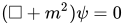
| | | QFT || Klein-Gordon with GEM coupling: <math>(\Box + m^2)\psi = 0</math> || Quantum gravitomagnetic effects | ||
|- | |- | ||
| | | Astrophysics || Lense-Thirring: <math>\Omega_{LT} = 2GL/(c^2 r^3)</math> || Orbital dynamics, pulsar timing | ||
|- | |- | ||
| Engineering || | | Nonlinear Dynamics || Self-interaction: <math>\lambda\psi^3</math> terms || Amplification near ergospheres | ||
|- | |||
| Engineering || Torque on gyroscope: <math>\boldsymbol{\tau} = \mathbf{I} \times \mathbf{B}_g</math> || Precision measurement / detection | |||
|} | |} | ||
== Theoretical Chain: From GR to Propulsion == | |||
The complete theoretical pathway from established physics to the [[Magneto Speeder]]: | |||
{| class="wikitable" | |||
|- | |||
! Step !! Physics !! Status !! Page | |||
|- | |||
| 1 || [[Kaluza-Klein Unification|Kaluza-Klein]]: EM and gravity are geometric projections of 5D spacetime || Established theory || [[Kaluza-Klein Unification]] | |||
|- | |||
| 2 || [[Gravitoelectromagnetism|GEM]]: Weak-field GR → Maxwell-like equations for gravity || Confirmed ([[Gravity Probe B]]) || [[Gravitoelectromagnetism]] | |||
|- | |||
| 3 || London moment: spinning superconductor → magnetic field (universal, precision-verified) || Established || (standard SC physics) | |||
|- | |||
| 4 || [[Tate Experiment]]: Cooper pair mass has 84 ppm anomaly above 2m<sub>e</sub> || Experimental fact || [[Tate Experiment]] | |||
|- | |||
| 5 || [[Ning Li|Li-Torr]]: anomaly = gravitomagnetic coupling; superconductors amplify B<sub>g</sub> by ~10¹¹× || Peer-reviewed theory || [[Ning Li]] | |||
|- | |||
| 6 || [[Gravitomagnetic London Moment]]: spinning SC → amplified gravitomagnetic field || Theoretical prediction || [[Gravitomagnetic London Moment]] | |||
|- | |||
| 7 || [[Martin Tajmar|Tajmar]]: possible direct detection of B<sub>g</sub> near spinning SC (~10⁻⁸ coupling) || Experimental (disputed) || [[Martin Tajmar]] | |||
|- | |||
| 8 || [[Magneto Speeder]]: rotor array engineering of B<sub>g</sub> fields for thrust || Speculative engineering || [[Magneto Speeder]] | |||
|} | |||
This chain builds from '''confirmed physics''' (steps 1–3) through '''disputed experimental evidence''' (steps 4, 7) to '''speculative engineering''' (step 8). The fiction of the [[Magneto Speeder]] assumes steps 4–7 are all confirmed in-universe. | |||
== Alternative Theoretical Frameworks == | |||
Several alternative theories also predict magnetogravitic effects through different mechanisms: | |||
* '''[[Heim Theory]]''' — 8D metric predicts gravitophoton forces from rotating magnetic fields | |||
* '''[[Pais Effect]]''' — Navy patent for HEEMFG vacuum polarization | |||
* '''[[Woodward Effect]]''' — Mach principle mass fluctuation via piezoelectric drives | |||
== See Also == | |||
* [[Gravitoelectromagnetism]] | |||
* [[Kaluza-Klein Unification]] | |||
* [[Gravity Probe B]] | |||
* [[Ning Li]] | |||
* [[Tate Experiment]] | |||
* [[Gravitomagnetic London Moment]] | |||
* [[Martin Tajmar]] | |||
* [[Heim Theory]] | |||
* [[Pais Effect]] | |||
* [[Woodward Effect]] | |||
* [[Electrogravitics]] | |||
* [[Magnetohydrodynamic]] | |||
* [[MHD Core]] | |||
* [[Magneto Speeder]] | |||
* [[Star Speeder]] | |||
* [[Magnetogravitic Tech]] | |||
* [[MHD Tech]] | |||
== References == | |||
<references /> | |||
[[Category:Technology]] | |||
[[Category:Magnetogravitic Tech]] | |||
[[Category:MHD Tech]] | |||
[[Category:Physics]] | |||
[[Category:Clan Tho'ra]] | |||
Latest revision as of 23:24, 13 March 2026
| Magnetogravitics | |
|---|---|
| Overview | |
| Also Known As | Gravitomagnetism · Gravitoelectromagnetism (GEM) |
| Domain | Weak-field general relativity · field propulsion |
| Key Effect | Frame-dragging (Lense-Thirring precession) |
| Experimental Confirmation | Gravity Probe B (2011) — 19% accuracy |
| Application | Magneto Speeder · Star Speeder propulsion |
| Key Equations | |
| GEM Gauss's Law | ∇·E_g = −4πGρ |
| Lense-Thirring | Ω_LT = 2GL/(c²r³) |
| GEM Lorentz Force | F = m(E_g + v × B_g) |
| Theoretical basis for Magnetogravitic Tech | |
| ⚡️ | Electrogravitics - Electrogravitic Tech | Electrokinetics - Electrokinetic Tech |
| 🧲 | Magnetogravitics - Magnetogravitic Tech | Magnetokinetics - Magnetokinetic Tech |
Magnetogravitics (also gravitomagnetism or gravitoelectromagnetism, GEM) is the study of gravitational analogs to magnetic fields arising from mass currents in the weak-field, low-velocity limit of general relativity. Just as moving electric charges produce magnetic fields, moving masses produce gravitomagnetic fields that influence nearby objects via frame-dragging.
Magnetogravitics provides the theoretical foundation for the Magneto Speeder and Star Speeder's field-based propulsion systems.
Theoretical Framework
GEM Field Equations
In the weak-field approximation (, ), Einstein's field equations decompose into Maxwell-like equations for gravity: [1]


Gauss's law for gravity:

No gravitomagnetic monopoles:

Faraday's law analog:

Ampère-Maxwell law analog:

where is the gravitoelectric field (Newtonian gravity), is the gravitomagnetic field, is mass density, and is mass current density.


Key distinction from electromagnetism: The factor of 4 in the Ampère analog (vs. 1 in EM) arises because gravity is mediated by a spin-2 tensor field rather than spin-1.
Gravitomagnetic Field of a Rotating Mass
For a rotating body with angular momentum :


For Earth ():


This is extraordinarily small — measuring it required the exquisite precision of Gravity Probe B.
The Lorentz Force Analog
A test mass moving with velocity in a GEM field experiences the full GEM Lorentz force: [2]


The factor of 4 distinguishes gravitomagnetism from electromagnetism — gravity is mediated by a spin-2 tensor field (graviton) rather than a spin-1 vector field (photon). This factor appears throughout the GEM formalism (see Gravitoelectromagnetism for full derivation). The velocity-dependent term is the frame-dragging force that the Magneto Speeder exploits for propulsion.

Lense-Thirring Precession
A gyroscope in orbit around a rotating mass precesses at: [3]

For a satellite at 642 km altitude (Gravity Probe B orbit):

Gravity Probe B measured: — confirming GR prediction to 19%. [4]

Geodetic (de Sitter) Precession
In addition to frame-dragging, a gyroscope in curved spacetime experiences geodetic precession:

Gravity Probe B measured: vs. predicted — confirming to 0.28%.


Experimental History
| Year | Milestone | Precision | Reference |
|---|---|---|---|
| 1918 | Lense-Thirring theory published | Theoretical prediction | Lense & Thirring |
| 1959 | Schiff proposes gyroscope experiment | Mission concept | Schiff, L.I. (1960). Phys. Rev. Lett. 4, 215 |
| 1996 | LAGEOS satellite frame-dragging | ~20% | Ciufolini & Pavlis (1998) |
| 2004 | Gravity Probe B launched | — | NASA/Stanford |
| 2006 | Tajmar anomalous frame-dragging in lab | 10¹⁸× GR prediction | Tajmar et al. (2006) [5] |
| 2011 | Gravity Probe B final results | 19% (LT), 0.28% (geo) | Everitt et al. (2011) |
| 2012 | LARES satellite launched | ~5% target | Ciufolini et al. (2016) |
| 2019 | LARES-2 approved | ~1% target | ASI/ESA |
The Tajmar experiments remain contested — the anomalous signals may be artifacts of frame vibration or thermal gradient coupling. However, if confirmed, they would imply a superconductor-gravity coupling mechanism of immense engineering significance for the Magneto Speeder program.
Amplification Pathways
The central engineering challenge for magnetogravitic propulsion: natural gravitomagnetic fields are vanishingly small. Earth's frame-dragging is ~10⁻¹⁴ rad/s. Useful propulsion requires amplification by many orders of magnitude.
Superconducting Mass-Current Rotors
The gravitomagnetic field scales with mass current . High-density material rotating at high speed maximizes :


For a YBCO ring () of radius 0.3 m spinning at 10,000 rad/s:


The resulting gravitomagnetic field, per standard GR, is still tiny (~10⁻²⁰ rad/s). But the Tajmar anomaly, if real, suggests a Cooper-pair-mediated enhancement factor:

Stacked Counter-Rotating Arrays
The Magneto Speeder uses multiple counter-rotating YBCO rings in a Helmholtz-like configuration. Counter-rotation creates a gravitomagnetic gradient rather than uniform field — analogous to a magnetic quadrupole:

where is the number of rotor pairs and is the pair spacing. This gradient produces a net force on the vehicle by:


Applications in Tho'ra Vehicles
| Vehicle | System | Role | Maturity |
|---|---|---|---|
| Magneto Speeder | Counter-rotating YBCO ring array | Primary atmospheric lift + low-orbital insertion | Prototype (2038–2042) |
| Star Speeder | Full GEM field drive | Propellantless interplanetary thrust | Operational (2044+) |
| Tho'ra HQ | Fixed rotor test rig | Research & development platform | Active (2036+) |
Cross-Disciplinary Integration
| Discipline | Key Equation | Role |
|---|---|---|
| General Relativity | Frame-dragging from rotating masses | |
| Electromagnetism | Biot-Savart analog: | Unified field formulations |
| QFT | Klein-Gordon with GEM coupling: | Quantum gravitomagnetic effects |
| Astrophysics | Lense-Thirring: | Orbital dynamics, pulsar timing |
| Nonlinear Dynamics | Self-interaction: terms | Amplification near ergospheres |
| Engineering | Torque on gyroscope: | Precision measurement / detection |



Theoretical Chain: From GR to Propulsion
The complete theoretical pathway from established physics to the Magneto Speeder:
| Step | Physics | Status | Page |
|---|---|---|---|
| 1 | Kaluza-Klein: EM and gravity are geometric projections of 5D spacetime | Established theory | Kaluza-Klein Unification |
| 2 | GEM: Weak-field GR → Maxwell-like equations for gravity | Confirmed (Gravity Probe B) | Gravitoelectromagnetism |
| 3 | London moment: spinning superconductor → magnetic field (universal, precision-verified) | Established | (standard SC physics) |
| 4 | Tate Experiment: Cooper pair mass has 84 ppm anomaly above 2me | Experimental fact | Tate Experiment |
| 5 | Li-Torr: anomaly = gravitomagnetic coupling; superconductors amplify Bg by ~10¹¹× | Peer-reviewed theory | Ning Li |
| 6 | Gravitomagnetic London Moment: spinning SC → amplified gravitomagnetic field | Theoretical prediction | Gravitomagnetic London Moment |
| 7 | Tajmar: possible direct detection of Bg near spinning SC (~10⁻⁸ coupling) | Experimental (disputed) | Martin Tajmar |
| 8 | Magneto Speeder: rotor array engineering of Bg fields for thrust | Speculative engineering | Magneto Speeder |
This chain builds from confirmed physics (steps 1–3) through disputed experimental evidence (steps 4, 7) to speculative engineering (step 8). The fiction of the Magneto Speeder assumes steps 4–7 are all confirmed in-universe.
Alternative Theoretical Frameworks
Several alternative theories also predict magnetogravitic effects through different mechanisms:
- Heim Theory — 8D metric predicts gravitophoton forces from rotating magnetic fields
- Pais Effect — Navy patent for HEEMFG vacuum polarization
- Woodward Effect — Mach principle mass fluctuation via piezoelectric drives
See Also
- Gravitoelectromagnetism
- Kaluza-Klein Unification
- Gravity Probe B
- Ning Li
- Tate Experiment
- Gravitomagnetic London Moment
- Martin Tajmar
- Heim Theory
- Pais Effect
- Woodward Effect
- Electrogravitics
- Magnetohydrodynamic
- MHD Core
- Magneto Speeder
- Star Speeder
- Magnetogravitic Tech
- MHD Tech
References
- ↑ Mashhoon, B. (2003). "Gravitoelectromagnetism: A Brief Review." In: Iorio, L. (ed.), The Measurement of Gravitomagnetism. Nova Science. arXiv:gr-qc/0311030
- ↑ Ruggiero, M.L. & Tartaglia, A. (2002). "Gravitomagnetic effects." Nuovo Cimento B 117, 743–768. arXiv:gr-qc/0207065
- ↑ Lense, J. & Thirring, H. (1918). "Über den Einfluß der Eigenrotation der Zentralkörper auf die Bewegung der Planeten und Monde nach der Einsteinschen Gravitationstheorie." Physikalische Zeitschrift 19, 156–163.
- ↑ Everitt, C.W.F. et al. (2011). "Gravity Probe B: Final Results." Phys. Rev. Lett. 106, 221101. doi:10.1103/PhysRevLett.106.221101
- ↑ Tajmar, M. et al. (2006). "Measurement of Gravitomagnetic and Acceleration Fields Around Rotating Superconductors." AIP Conf. Proc. 880, 1071–1082.

