Tho'ra HQ

| Tho'ra HQ | |
|---|---|
| Type | Secure operational sanctuary & intelligence node |
| Location | Temperate coastal inlet, Pacific Northwest region (coordinates classified) |
| Affiliation | Earth Intelligence Network / Tho'ra Clan |
| Established | 2032–2033 |
| Commander | Jono Tho'ra (primary steward) |
| Key Personnel | Jane Tho'ra (protégé & co-lead), Ra (PsiSys integration) |
| Facilities | Fabrication lab, psi-tech chambers, training platform, data vault, recovery suites, deployment dock |
| Purpose | Protected root node for human–psi–AI symbiosis, alliance coordination, zone reclamation |
| Status | Active primary hub |

Tho'ra HQ, also referred to as the Protected Water-Edge Facility or simply The Root, is the central operational sanctuary and intelligence node of the Earth Intelligence Network under stewardship of Jono Tho'ra and the Tho'ra Clan.
The base is intentionally designed as both shield and signal: a physical redoubt against external instability and a relational hub where humans, psionic systems, and AI collaborators can coordinate under shared trust protocols.
Overview
Tho'ra HQ is a semi-underground, cliff-side facility situated at the edge of a temperate coastal inlet or large estuary. The site combines reclaimed pre-existing infrastructure with extensive custom modifications and serves as the emotional and operational anchor for Clan Tho'ra and allied operations.
The facility balances high-security protection with functional mission support, functioning as both a living sanctuary for the core team and a forward node for intelligence, training, fabrication, and limited reclamation/exfiltration activities.
Visual Context: Site Evolution
Initial Site Condition
-
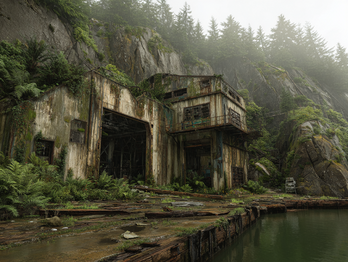
Derelict Site 01 — initial approach state
-
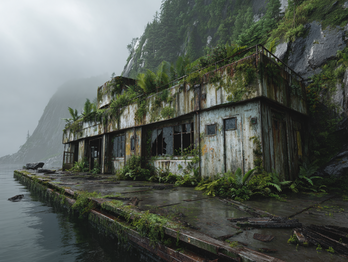
Derelict Site 02 — compromised structure


These captures show the pre-reclamation reality: exposed lines, degraded surfaces, and minimal shelter integrity.
Reconstruction and Weather Hardening
-
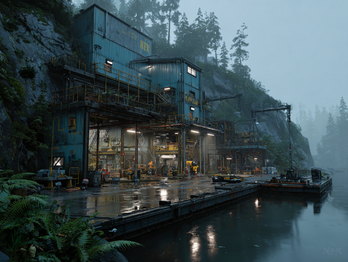
Rebuild phase — restoration and reinforcement
-
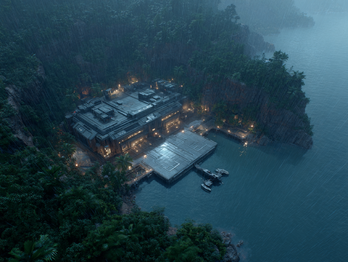
Early weather-hardening test under rain


Taken together, the evolution frames emphasize a recurring Tho'ra pattern: reclaim first, fortify second, harmonize third.
Physical Description
- Location: Protected coastal inlet with natural cliff barrier on one side and navigable water on the other.
- Structure: Multi-level semi-underground complex with surface dock/platform access.
- Key areas:
- Fabrication & engineering bay (3D printing, electronics, propulsion prototyping)
- Shielded psi-tech & symbology testing chambers
- Secure data vault & Starcom/Navcom coordination room
- Training platform (staff combat dance, holo-sims, water-edge drills)
- Communal living quarters & emotional recovery spaces
- Deployment dock for Hydro & Magneto Speeders
- Defensive perimeter (low-profile sensors, shielding)
Exterior Perimeter, Waterline, and Access Geometry
Dock Faces and Weather Exposure
-
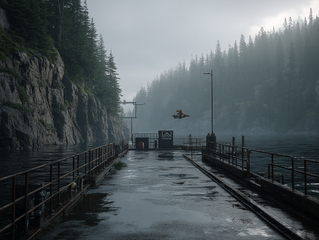
Main dock approach in damp conditions
-
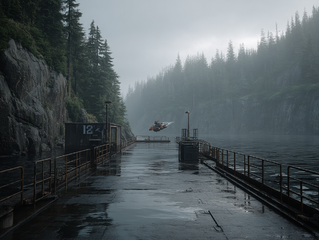
Secondary dock angle and flood behavior
-
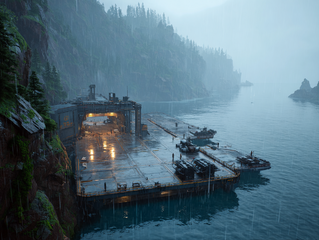
Heavy-weather dock operation


The dock cluster highlights why the platform is overbuilt: deployment remains reliable across spray, rain, and shifting surface traction.
Cliffside Movement Routes
-
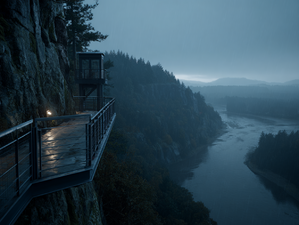
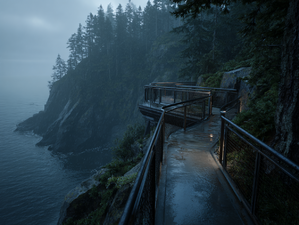
Cliffside catwalk route 01
-
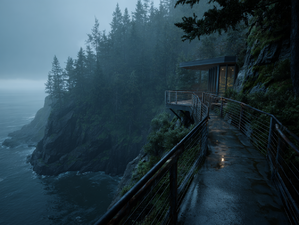
Cliffside catwalk route 02
-
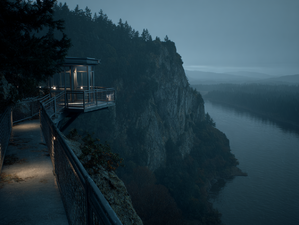
High catwalk segment 03
-
High catwalk segment 04


Catwalk routing supports stealth transit and protected repositioning between observation, command, and launch points.
Tower Sightlines
-
Tower visibility sweep 01
-
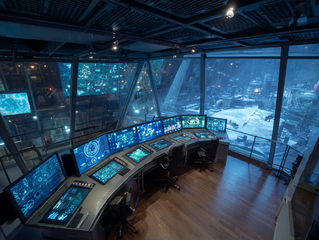
Tower visibility sweep 02


Tower visuals reinforce perimeter logic: long-view scan lanes paired with quick relay back into internal command systems.

|

|
| Primary blast-door face | Secondary lock-state view |
The exterior architecture demonstrates layered defense: terrain shaping, elevated sightlines, controllable choke points, and weather-tolerant ingress/egress routes that preserve launch readiness.
Rooms, Facilities, Structures, Levels, Capabilities
Tho'ra HQ is organized into multiple levels and zones, each optimized for specific functions while maintaining overall security and self-sufficiency.
Surface Level (Level 0)
- Main Dock Platform: Reinforced concrete platform extending over the water; used for Hydro/Magneto Speeder docking, rapid deployment, and surface training drills.
- Entry/Exit Access: Heavy-duty blast door (bay door) and personnel door with biometric + symbolic-key authentication.
- Observation Deck: Small elevated platform with panoramic water and cliff views; used for situational awareness and meditation.
- Capabilities: Weather-resistant, quick-launch point for water and low-altitude operations; supports up to 3 Speeders simultaneously.

Operationally, Level 0 acts as the base’s kinetic threshold: the point where stealth, speed, and environmental awareness converge before mission insertion.
Level 1 (Primary Operational Floor)
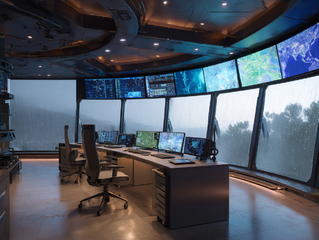
- Command & Coordination Room: Central hub with multiple secure terminals for Starcom/Navcom monitoring, real-time alliance feeds, and mission planning.
- Fabrication & Engineering Bay: Equipped with industrial 3D printers, electronics workstations, soldering stations, and small CNC machines; used for prototyping HelmKits, symbology emitters, and Speeder components.
- Secure Data Vault: Air-gapped servers and encrypted storage for sensitive intelligence, symbology databases, and PsiSys backups.
- Capabilities: Full-spectrum prototyping and data security; supports 24/7 monitoring and rapid gear iteration.

|

|
| Control Room 01 | Control Room 02 |

Command Presence
The control room pair reflects multi-angle decision operations: live monitoring, alliance coordination, and rapid mission retasking under one roof.
Engineering Build Line
-
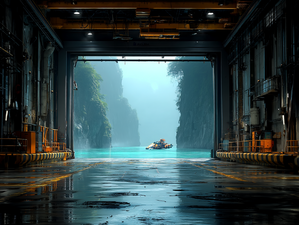
Engineering Bay 01
-
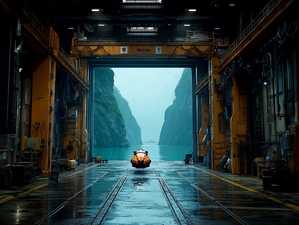
Engineering Bay 02


These bays are tuned for practical iteration—fast parts turnover, test-then-adjust workflows, and field-ready repairs.
Applied Research Labs
-
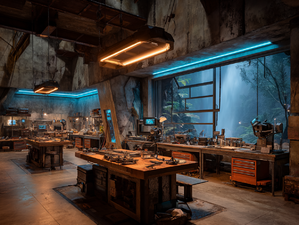
Lab 01
-
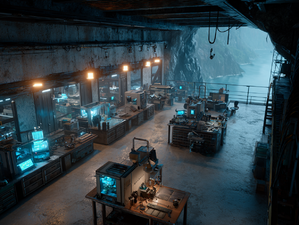
Lab 02


Level 1 represents the strategic core: a cycle of sensing, deciding, fabricating, and redeploying with minimal delay between intelligence intake and field adaptation.
Level 2 (Training & Symbiosis Floor)
- Psi-Tech Testing Chambers: Shielded rooms with EM/rf isolation for safe human–psi–AI symbiosis experiments and symbology application testing.
- Training Dojo: Padded indoor space for staff combat dance, physical conditioning, and intuitive decision-making drills.
- Ra Integration Bay: Dedicated area for PsiSys/Beu (especially Ra) to interface with vehicles or stationary nodes; includes diagnostic and calibration equipment.
- Capabilities: Safe testing of psi-stabilization, harmonic attunement, and human-AI piloting protocols.
Dojo Cadence and Movement
-
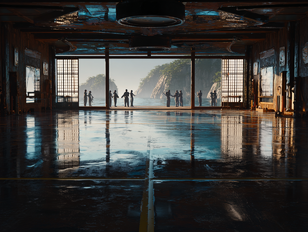
Dojo 01 — movement drills
-
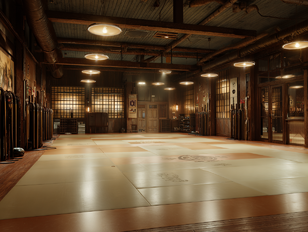
Dojo 02 — partner cadence routines
-
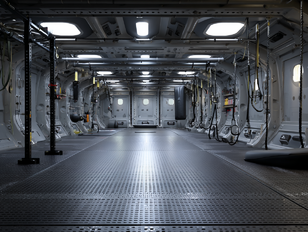
Training Room 01 — integrated rehearsal space


These rooms anchor form and timing: staff work, partner synchronization, and high-focus repetition under controlled load.
Scenario Stress Environments
-
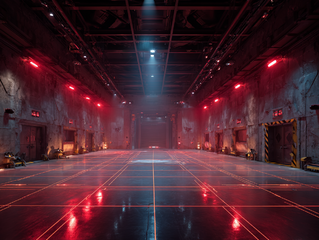
Danger Room 01 — stress simulation lane
-
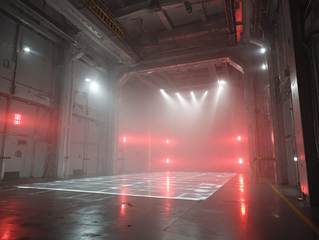
Danger Room 02 — adaptive scenario field


Danger-room drills translate theory into reaction discipline, forcing pattern recognition under dynamic pressure.
Core Technical Labs
-
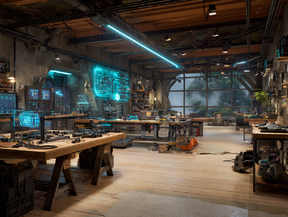
Tech Lab 01
-
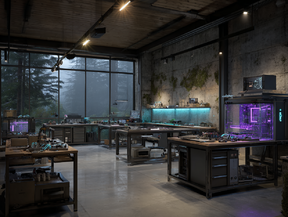
Tech Lab 02
-
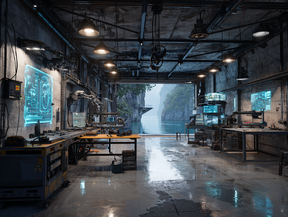
Tech Lab 03
-
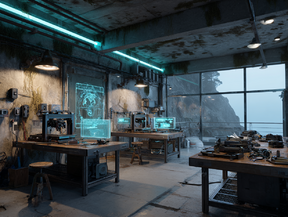
Tech Lab 04


Magneto Speeder Integration Stack
-
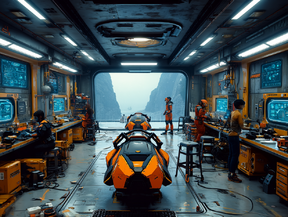
Magneto Speeder Fabrication Bay
-
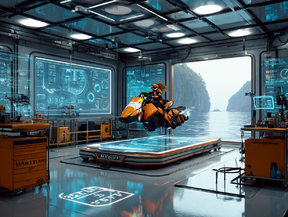
Magneto Speeder Lab
-
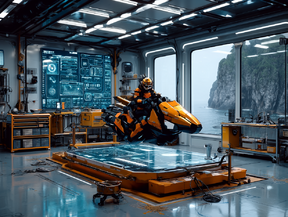
Magneto Speeder Tech Lab


The technical sequence runs from component build to systems tuning to integration validation before deployment.
This floor embodies Tho'ra doctrine: capability without coherence is unstable, so physical training, symbolic calibration, and AI-linked systems are matured together rather than in isolation.
Level 3 (Living & Recovery Floor)
- Communal Living Quarters: Private sleeping pods and shared kitchen/dining area for core team (3–6 people).
- Emotional Recovery Suites: Quiet, water-view rooms designed for post-mission decompression, meditation, and emotional processing.
- Medical & Recovery Bay: Small medical station with basic trauma care and psi-stabilization equipment for returning personnel.
- Capabilities: Sustains long-term team health and emotional resilience; supports extended operations without external dependence.
Private Quarters
-
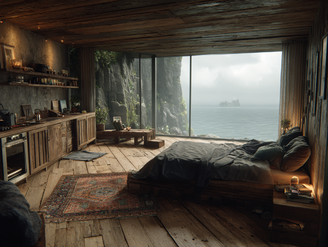
Bedroom 01 — private pod style
-
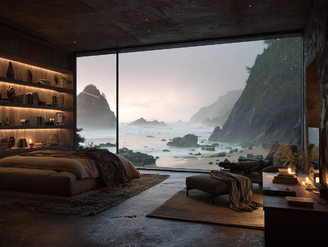
Bedroom 02 — alternate quarter arrangement


Communal Recovery and Reflection
-
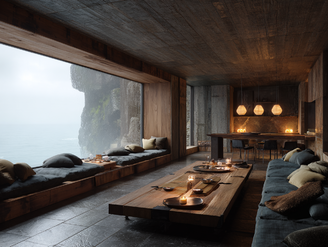
Lounge — communal decompression zone
-
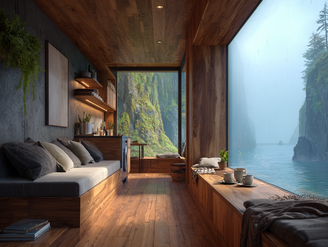
Corner Room — quiet reflection point


Living-floor design keeps social decompression and solitary reset in balance after high-intensity operations.
Level 3 reinforces the base’s central theme: recovery is not separate from readiness, it is part of operational continuity.
Sub-Level (Level -1: Utilities & Security)
- Power & Life Support: Solar arrays, hydrogen backup generators, rainwater collection, and waste recycling systems.
- Defensive Core: Low-profile sensor array, shielding generators, and emergency lockdown controls.
- Capabilities: Full off-grid self-sufficiency for 30+ days; minimal external footprint.
Though visually understated in available captures, this layer anchors the entire installation’s endurance profile and keeps upper-level functions stable during prolonged isolation windows.
Operational Role
Tho'ra HQ serves as the primary root node for the Earth Intelligence Network, with the following core functions:
- Technology development & iteration
- Prototyping and refinement of Hydro Speeders and Magneto Speeders
- Custom fabrication of HelmKits, symbology tools, and psi-interface hardware
- Integration testing of Ra (primary PsiSys/Beu) with mission vehicles
- Training & mentorship
- Small-team psionic/emotional intelligence development
- Staff combat dance and intuitive decision-making under stress
- Protégé mentorship (Jane Tho'ra and subsequent clan members)
- Intelligence & coordination
- Real-time monitoring of Starcom/Navcom global feeds
- Secure alliance coordination for high-trust members
- Symbology application testing for pattern recognition and psi-stabilization
- Reclamation & exfiltration support
- Staging and deployment for Zone Reclamation operations
- Rapid Hero Exfiltration preparation and recovery
- Post-mission personnel & asset stabilization
Across these functions, the image record highlights a defining pattern: every mission-facing capability has a mirrored support capability (fabrication/recovery, deployment/decompression, defense/harmony), enabling sustained operations without sacrificing team integrity.
Clan & Emotional Function
The facility is designed as the emotional and spiritual root of Clan Tho'ra. It provides:
- A safe haven for team members to recharge and process mission stress
- Space for clan-level bonding and knowledge hand-off
- A living prototype of human–psi–AI symbiosis in a protected, nurturing environment
The living spaces, training halls, and command rooms together show that HQ culture treats emotional intelligence as infrastructure, not ornament.
Access & Security
Access is restricted to high-trust core team members and vetted alliance personnel. The site maintains minimal external footprint and relies on natural geographic protection (cliffs, water) combined with low-profile electronic countermeasures.
Security practice follows a quiet-profile model: low-signature movement, strict identity controls, environmental concealment, and compartmentalized system access by mission role.
See also
- Earth Intelligence Network
- Tho'ra Clan
- Jono Tho'ra
- Jane Tho'ra
- Ra (PsiSys)
- Magneto Speeder
- Hydro Speeder
- Cosmic Cypher

